Negotiate activities before brightness settings
One person wants to read a paper book while another wants a subdued view of the television. A single central dimmer cannot necessarily satisfy both. Start by naming the simultaneous activities and their usual seats, then let each person describe the difficulty in concrete terms. “I lose the print when the ceiling light goes off” and “I see the bare bulb beside the screen” identify two solvable relationships.
Choose a short shared session when both people can use their normal materials. Bring the actual book, knitting or other task rather than a token sheet of paper. Set the television to the ordinary viewing arrangement if relevant, without changing its display settings to conceal a room-light problem. Record which seats and head directions each person normally uses.
The objective is a household agreement, not a universal brightness target. CCOHS’s lighting survey distinguishes task visibility, glare and contrast. Use those categories to keep one person’s need for more light on a page separate from the other person’s objection to a visible source. Neither preference has to be dismissed as an unreasonable taste.
Draw the room through two occupied views
On paper, mark the reading seat, viewing seat, television, windows, lamps and useful surfaces. Draw an arrow from each seat in its usual looking direction. Add the line between a reader’s eyes and the open page. This is a sight-line sketch, so approximate distances are enough at first. Include a reclined posture if it is normal; standing inspections often miss lamps exposed only from a low sofa.
Observe the room with the current lighting. Each person should point out visible bright sources and reflected patches without moving to the other person’s preferred viewpoint. Then swap seats briefly, with agreement, to understand the geometry. Do not use the swap to demand identical preferences. A bright lampshade might be acceptable to one person and distracting to the other even when both can see it.
Check routes between the zones as well as the seats. A darker viewing corner still needs a usable path to the door. Avoid arrangements that make someone step over lamp leads or walk around improvised screens. Draw lead routes and existing outlets before choosing a new lamp position, particularly when a side table moves away from the wall.
Aim light onto the task from a stable position
Use an existing adjustable task lamp if suitable. Place it on a stable surface within its intended reach and direct it onto the material. Keep the source out of the reader’s direct view while checking that a hand, shoulder or book cover does not cast an unhelpful shadow. For a person who changes posture often, test the two or three positions actually used rather than one carefully staged pose.
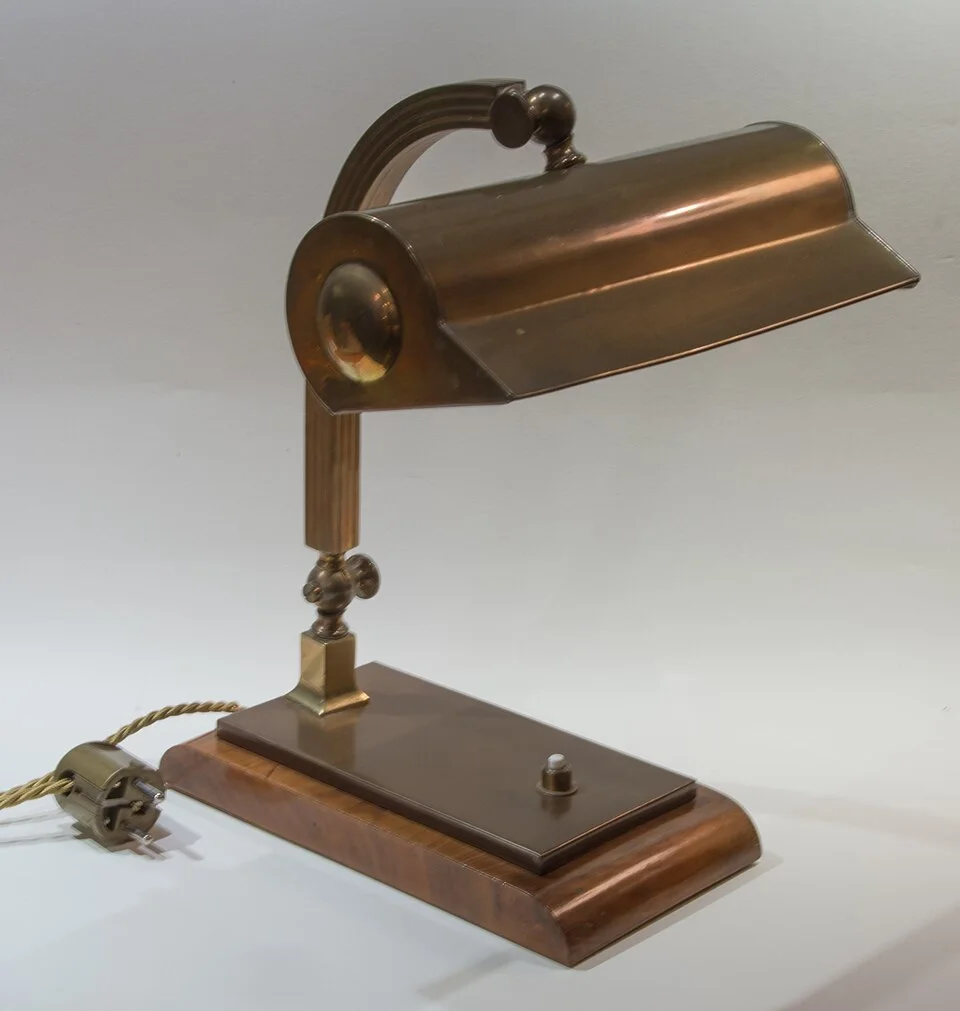
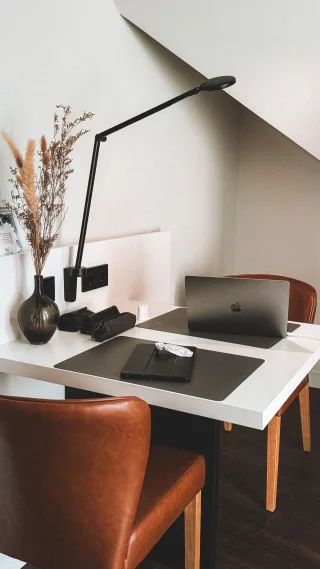
The jointed arm, shade and base show the parts to inspect before using an existing task lamp. Place your actual suitable lamp on a stable surface and use only its intended adjustment to reach the page, then check both occupants’ views. No book or second seat is shown here; this photograph does not demonstrate spill control or establish electrical condition.
Photo & usage
Hannes Grobe · CC BY-SA 4.0 · Source. Display copies resized and encoded as WebP; no instructional details were fabricated or removed.
Now check the second occupant’s view while the task lamp stays in place. Ask whether the bulb, bright interior of the shade or illuminated page is conspicuous beside the screen. Make a small intended adjustment to direction or height, then check the reader again. A change that helps the viewer by removing light from the page has merely transferred the difficulty.
OSHA’s workstation guidance discusses controlling lamps and reflections around displays. The household application is limited to observing those paths; it does not turn the living room into a compliant workstation. Follow the lamp’s clearances and adjustment instructions. Do not put cloth over a shade, tape paper around a bulb or use a book stack as an unstable lamp stand.
Agree the light between the two zones
Once local reading light is useful, adjust the existing general lighting to a mutually workable background. The lower-light occupant should describe what remains distracting from the occupied seat. The reader should check whether the page now feels like an isolated bright patch against an excessively dark surrounding area. Move gradually and allow a little time in each arrangement before judging.
Include window light if the activities overlap with daylight. Use ordinary curtains or blinds to alter a troublesome source, and record that covering state beside the lamp settings. YourHome discusses adjustable shading as a way to respond to changing solar conditions. Here the relevant action is a repeatable window setting for the occupied views, not an assumption that the same setting suits every hour.
Leave the access route and frequently used controls visible enough for ordinary use. Check what happens when someone gets up for a drink or returns carrying a tray. A two-zone arrangement should work while people move, not only in the instant both sit perfectly still. If the only agreeable condition creates an impractical route, return to the furniture and lamp sketch.
Compare layouts using separate acceptance checks
This illustrative table is invented to demonstrate negotiation, not a test of lamps. Each occupant judges their own activity after trying three intended arrangements. “Acceptable” is a personal decision for the session, not a measured level or a promise that the room will work for every book, screen or guest.
| Arrangement | Reader’s page | Viewer’s forward view | Route |
|---|---|---|---|
| A: ceiling light only | Acceptable | Unwanted screen reflection | Usable |
| B: task lamp beside screen | Acceptable | Bulb visible | Usable |
| C: task lamp behind reading shoulder | Acceptable | Acceptable | Usable |
If there are two occupant checks and one route check per arrangement, the three arrangements produce nine checks in total: 3 × 3 = 9. C satisfies all three in this invented example. Do not average A’s two acceptable checks into a score that overrides the viewer’s objection. A failed essential condition is a reason to adjust or reject that arrangement, even when other columns look good.
Write a setting another person can restore
Give the chosen arrangement an everyday name such as “reading plus television.” Record the lamp location, intended direction, background light control and window-covering position. A sketch of the shade angle is often clearer than “dim.” If a control has no numbers, describe its visible reference point without marking or modifying electrical equipment. Include who can change the setting and how to flag a problem.
Agree what happens when activities change. If the viewer begins detailed paperwork, the lower-light zone may need a different setup. If the reader leaves, the task lamp can be switched off through its ordinary control. Avoid giving either person permanent ownership of the whole room’s lighting because their activity began first. A shared mode should remain revisable.
Keep a fallback arrangement for visitors, cleaning and finding dropped objects. The negotiated evening setting need not serve every task. Place the instructions where household members can find them, and avoid buying equipment until the existing-room comparison has identified a specific unmet need. If new equipment is eventually considered, define that need in terms of task and spill rather than a vague demand for more brightness.
Check the agreement in a normal evening
Use the arrangement during an ordinary shared session and ask for two separate reports afterward. Can the reader keep a normal posture and follow the material? Can the viewer watch without the unwanted source or reflection? Note any changes in seat position, book finish or window light. These details explain why a successful trial may need a small adjustment later.
Check that the lamp remains stable when the side table is used, that leads stay clear and that controls can be reached without awkward stretching. If someone moves furniture back out of habit, update the practical arrangement rather than writing a stricter instruction. A successful mode should be easy enough to restore without a special performance every evening.
Finish with keep, adjust or abandon for this particular pairing of activities. Record unresolved objections explicitly. “Reader satisfied; viewer still sees shade when reclining” gives the next session a useful target. “Both should compromise more” does not. The work is complete when each person has an acceptable occupied view, the route works and the setting can be restored through ordinary controls.
THE REFERENCE FILE
Sources & scope
Documentation reviewed 1 Nov 2026. Examples are illustrative; this article does not claim hands-on product testing. Follow the instructions for your actual material, model and location.