A storage box may be easy to open with two free hands yet awkward when one hand holds a notebook, supports an ordinary task or is otherwise unavailable. The difficulty can come from the latch, the need to stabilize the box or the absence of a place for the lid. Examine the complete action before changing containers.
This guide helps compare household storage operations. It does not advise someone to abandon a prescribed aid or carry more than they can manage. Work with the intended user's preferences, and keep any child-resistant or security requirements intact when choosing a closure.
Break the operation into its component actions
Observe identifying the container, reaching the closure, stabilizing the base, releasing the latch, moving the lid and retrieving the object. Then observe closing and returning. A lid can be easy to release yet impossible to replace without the box sliding away.
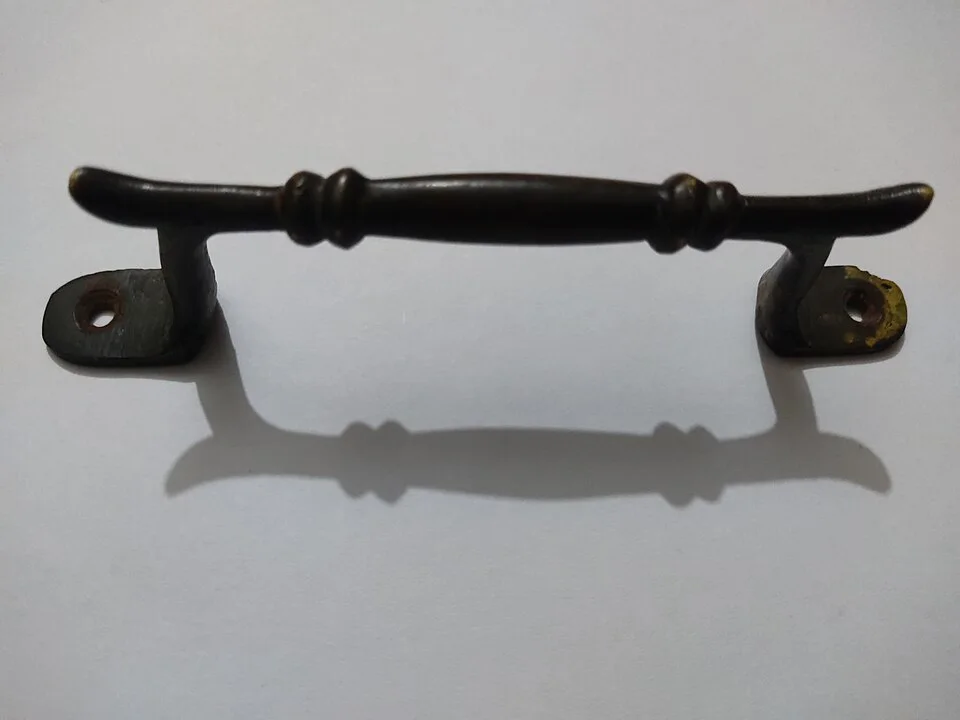
The detached pull shows the grip space and mounting ends, but no latch, lid or supporting container. Use that distinction when observing a closure: reaching and grasping are only part of the sequence. Test the actual installed item for stabilizing the base, releasing the closure, retrieving contents and closing it; this photograph establishes no one-handed performance.
Photo & usage
Blvrsngh80540 · CC BY-SA 4.0 · Source. Display copies resized and encoded as WebP; no instructional details were fabricated or removed.
Record exactly where a second hand becomes necessary. That detail suggests the right change: a more suitable handle, a different lid type, a stable intended base or an available landing surface. Avoid buying a container with a different color but the same underlying operation.
The U.S. Access Board — Operable Parts guide addresses one-handed operation for covered operable parts under its standards. Its concepts of avoiding difficult grasping or twisting can inform observation, but they do not certify a household container or guarantee suitability for a particular user. Let the actual operation and the user's judgment decide the comparison.
Check the loaded container in its real position
An empty box can be lifted and rotated easily, hiding the difficulty of a full category. Use a manageable representative load within the product's limits and place it on the intended shelf. Include the edge, lip or nearby objects that affect the grip.
The IKEA — SAMLA Box, Article 701.029.72 listing describes a specific base and compatible lid arrangement. For any product, verify the exact combination and how it is intended to open and stack. Do not assume a lid from the same-looking range operates in the same way or that an ordinary box is designed for one-handed use.
Watch for sliding or tipping during ordinary operation. Do not solve it with an improvised attachment that changes the container or furniture's intended use. Choose a suitable stable product or location instead. If stabilizing the base is the main problem, removing a latch alone will not necessarily make the action reliable.
Compare an illustrative action sequence
This example is illustrative, not a tested performance claim. Container A requires six recorded actions: pull it forward, stabilize it, release two clips counted separately, lift the lid and set the lid down. Container B requires three: pull forward, lift its intended hinged front and retrieve the item.
That comparison concerns opening only. If Container B requires two extra actions to align and close, its complete cycle has five actions compared with Container A's observed closing sequence, which must also be counted. Do not compare one product's opening with another's full use cycle.
Fewer actions are not automatically better. One difficult action can be less suitable than several easy ones, and required security may justify extra steps. Record the quality of the movement as well as the count. Use the illustrative sequence to structure observation, not to promise a universal percentage reduction in effort or time.
Give a removable lid a real resting place
If the chosen container has a lift-off lid, identify where it goes while the contents are used. A lid held under an arm or balanced against a chair can make the one-handed sequence impractical. A suitable clear surface nearby may be sufficient if it remains available in ordinary use.
Check whether that surface also serves another task. If a desk is normally covered with work, it cannot reliably become the lid destination without another clearing step. Include the dependency honestly. A hinged or open-front design might avoid it, provided the product and contents suit that form.
The AHRQ — Reducing Falls: A Safety Checklist for the Home home checklist emphasizes clear pathways. Do not use the floor beside the storage as the default lid destination, especially where people walk or stand to retrieve things. The opening routine should preserve the room's movement space, including after an interruption when the user may leave before completing the return.
Match the front to the retrieval frequency
For frequently used ordinary items, a shallow accessible tray or suitable open front may reduce unnecessary closure handling. Keep small loose objects contained and protected as appropriate. An open form still needs a stable location and a way to identify its contents.
For occasional items, a suitable lidded container may provide useful protection even if it takes more deliberate handling. The user can choose a planned setup on a clear surface rather than forcing one-handed access in place. Document that as the accepted method rather than calling the storage independently usable from the shelf.
Avoid universal recommendations based on age or a broad access label. Two users can prefer different handles, lid resistance and container sizes. Compare the actual products with the intended user where feasible, and retain a straightforward fallback if a new closure turns out to be inconvenient during ordinary household use.
Compare the loaded return rather than the empty opening
An empty demonstration can hide the main difficulty: returning the container to its shelf after an item has been removed. Ask the intended user to complete that movement with a manageable representative load, without balancing another object or giving up needed support. Observe whether the lid stays where its design intends.
If the closure works but the container catches the opening, change spacing or location before replacing the lid type. If the base slides during ordinary operation, choose a suitable stable arrangement instead of adding an improvised fixing. Record which part failed so the next product comparison addresses the actual cause rather than repeating the same operation in a different material.
Finish with the return and interruption checks
Retrieve the item, close the container and return it to its assigned position. Confirm the closure engages as intended without force, the label remains visible and the user's hand is not trapped against neighboring furniture. Check whether the next retrieval starts from the same stable arrangement.
Also consider an ordinary interruption. If the user pauses with the lid open, does it stay in its intended position without becoming a route obstruction or damaging contents? Follow the product's instructions; do not leave a lid propped by an unrelated object to create a temporary holding mechanism.
Completion means the agreed task works for the user through identification, opening, retrieval, closing and return. Keep separate arrangements where security or garment protection requires them. The useful outcome is an operation that matches the real task, rather than a broad claim that one closure is easiest for everyone.
THE REFERENCE FILE
Sources & scope
Documentation reviewed 1 Nov 2026. Examples are illustrative; this article does not claim hands-on product testing. Follow the instructions for your actual material, model and location.