Define the activity and its actual hours
A quiet-use period is an agreement about an activity, not a promise of silence. Start by identifying the household activity that is interrupted: a recorded lesson, quiet reading, a conversation or a concentration session. Write the desired start and finish times and the occupied location. Ask whether the full period needs the same conditions or whether a short part, such as making a recording, is especially sensitive to interruptions.
Choose a realistic week to observe, with household agreement. Do not demand that everyone freeze their routine while one person collects an ideal baseline. Record ordinary use and any known departures such as visitors or a different work schedule. The initial question is whether recurring appliance events overlap with the activity, rather than whether the home is generally noisy.
CCOHS’s noise-control guidance supports identifying sources and considering when exposure occurs. This is a modest domestic timing application, not an occupational assessment. It neither diagnoses appliance condition nor establishes that a sound is harmless. Keep any obvious equipment concern outside the scheduling experiment and deal with it through the appropriate instructions or responsible person.
Log known events without making accusations
Create columns for date, time, sound description, occupied position and known appliance state. Record “washing programme started by household at 18:10” when someone knows that fact. Record “low intermittent hum, source unconfirmed” when no one does. A sound through a shared wall does not establish which appliance operated, whose home it came from or whether anyone acted inconsiderately.
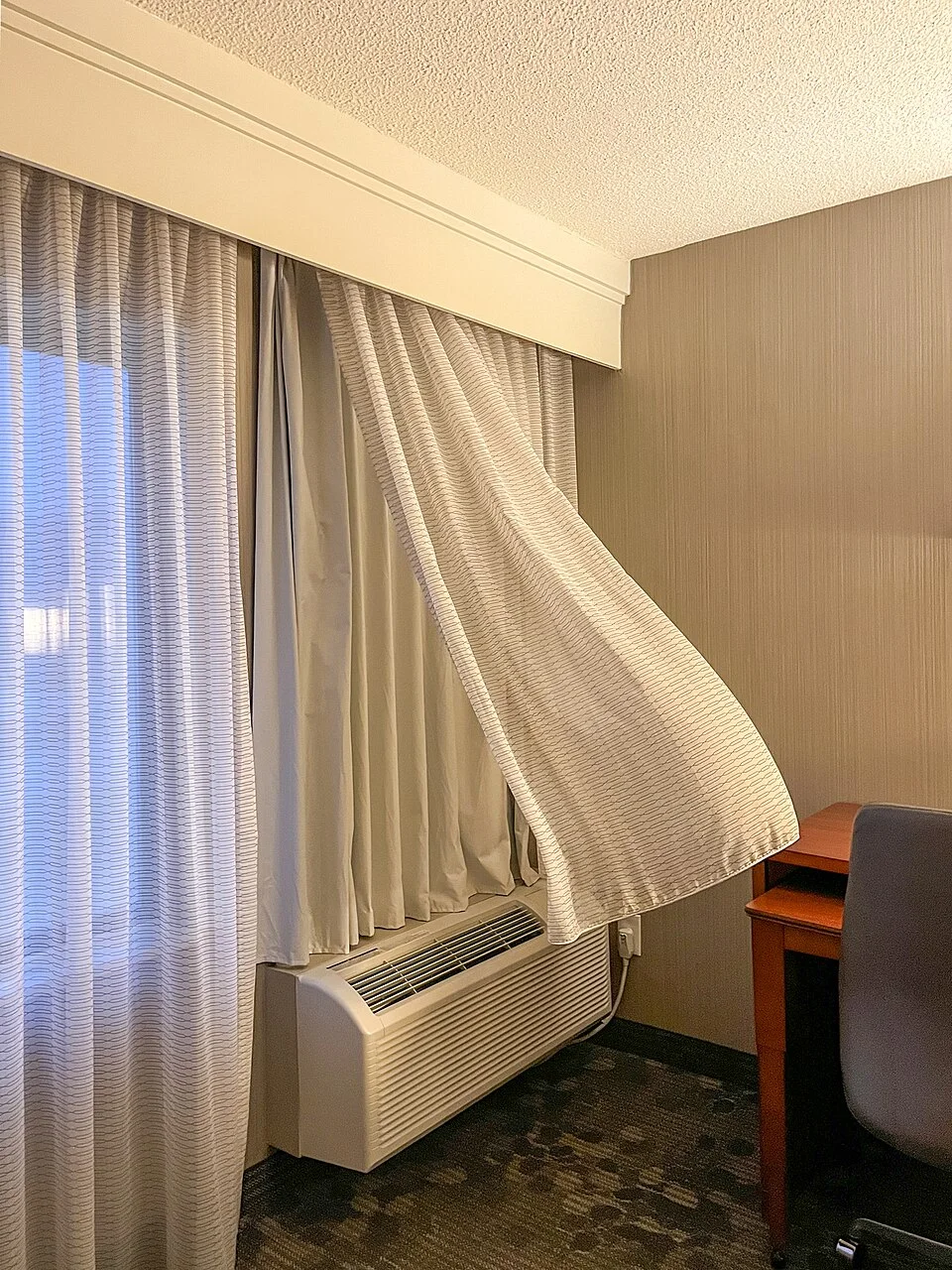
The air-conditioning unit and displaced curtain make an operating appliance identifiable in the room. In your event record, distinguish a fan setting, cooling start or stop, and the appliance’s ordinary cycle from background household activity. The photograph provides no sound recording or timing; it cannot show whether this event caused a particular audible interruption.
Photo & usage
Tim Kiser · CC BY-SA 4.0 · Source. Display copies resized and encoded as WebP; no instructional details were fabricated or removed.
For your own appliance, note an event that matters from the occupied room: a short burst, repeated sequence or continuous audible interval. Use normal operation and accessible controls only. You do not need to stand beside the machine or open it to identify internal stages. Avoid maintenance instructions, load experiments or deliberate fault reproduction; this notebook concerns the timing of ordinary audible events.
Keep the record about the room and task. Do not make recordings of private conversations or compile a surveillance diary of other households. If an uncertain event repeatedly interrupts the activity, you can still record its time and choose a different task window. You do not need to invent a source attribution before testing a practical timing change.
Draw event intervals beside activity intervals
Use one horizontal line for the desired activity and another for known appliance events. Mark clock times at consistent spacing. Shade only the observed audible interval rather than the entire appliance programme unless sound was actually noticed throughout. A programme display showing ninety minutes does not prove that ninety minutes of equally noticeable sound reaches the reading chair.
For an intermittent event, mark each burst or note a range with the interruption pattern. Include observation gaps: if you left the room for fifteen minutes, you cannot claim continuous quiet during that absence. Leave the gap blank and label it. This is especially important when the apparent overlap is only a few minutes and a missing interval could change the decision.
Add the appliance’s ordinary completion needs and the household member responsible for it. A schedule that looks elegant on paper may be unusable if unloading cannot happen or necessary operation is delayed. Do not schedule equipment unattended or overnight merely to move sound away from your activity; follow its instructions and the household’s suitable operating arrangements.
Calculate an illustrative overlap honestly
Consider invented observations for a desired quiet-use period from 19:00 to 20:00. A known household appliance produces a noticeable interval from 18:50 to 19:20 and a later brief interval from 19:45 to 19:50. These times illustrate interval arithmetic; no appliance or room was tested, and no actual programme behaviour is implied.
| Audible event | Event duration | Portion within 19:00–20:00 |
|---|---|---|
| 18:50–19:20 | 30 minutes | 20 minutes |
| 19:45–19:50 | 5 minutes | 5 minutes |
The non-overlapping audible intervals occupy 20 + 5 = 25 minutes of the activity. The activity contains 60 − 25 = 35 minutes outside those noted intervals, but those minutes are not certified silent. They may contain other sounds. If two appliances overlap with one another, count the shared minutes once when calculating affected activity time; adding every event duration would double-count them.
A hypothetical thirty-minute earlier start would move the first interval to 18:20–18:50 and the second to 19:15–19:20 only if the whole sequence shifted identically. That assumption requires checking during normal use. It predicts five minutes of overlap rather than twenty-five; it does not prove a twenty-minute improvement will occur.
Compare changes that people can actually make
List two or three reversible options: begin the activity later, use another existing room for its sensitive portion, or move a discretionary appliance start within its permitted routine. Ask the person responsible for the appliance what constraints apply before selecting an option. Necessary refrigeration, ventilation or other continuous services should not be switched off to create a quiet window.
Keep the selected change singular. If you move both the activity and the appliance start, you may obtain a useful evening but lose the ability to say which change mattered. Choose the option with the clearest practical advantage and the least disruption to other tasks. A small schedule adjustment that everyone can maintain is more useful than an ambitious timetable people immediately ignore.
OSHA’s workstation environment guidance includes the importance of the occupied setting. Apply that modestly when considering an alternative seat or room: confirm the task still works there, including light, access and ordinary comfort. Do not declare a room suitable solely because the appliance sounds less noticeable from its doorway. Sit where the activity will happen before choosing it.
Verify the prediction during ordinary operation
On the next suitable occasion, record the actual appliance start, the audible events and the activity window again. Keep programme and other ordinary conditions as comparable as practical, but do not manipulate a load just to make the timing match. If the programme varies naturally, that variability belongs in the record and may make a fixed quiet window less dependable.
Ask whether the sensitive part of the activity was interrupted, not simply whether the appliance finished earlier. A short event during a recording can matter more than a longer event during setup. Record the task outcome in plain terms, such as “paused reading twice” or “recorded passage without a restart.” Those are household observations rather than performance or health claims.
Optional sound readings need consistent placement and a documented app or instrument. NIOSH’s app documentation explains that measurement claims depend on the specific setup. You do not need a decibel figure to compare clock-time overlap, and a casual phone reading cannot settle a dispute about the origin of sound through a building. Keep timing evidence central to this decision.
Finish with an agreement and an exception rule
Write the selected routine in one sentence with a fallback: “Use the study corner for the recorded part when the household wash is running,” for example, if that is what the comparison supports. Name who needs to know before a start time changes. Keep the language collaborative; appliance use serves real household needs and the quiet activity does too.
Add an exception rule for unusual days. If visitors, weather or a delayed programme disrupt the plan, use the fallback and mark the day exceptional rather than accusing someone of ruining the experiment. If no reliable timing gap emerges, stop pursuing a clock-based solution and consider a room or activity arrangement instead. An inconclusive diary is not a reason to intensify monitoring of other people.
The task is complete when actual overlap has been compared, a practical option has been tried and each affected household member understands the routine. Retain only the useful event pattern and limits. The result should help people share time and space; it should not become a maintenance diagnosis, a neighbour allegation or a claim that a schedule guarantees silence.
THE REFERENCE FILE
Sources & scope
Documentation reviewed 1 Nov 2026. Examples are illustrative; this article does not claim hands-on product testing. Follow the instructions for your actual material, model and location.