A rolling cart can move supplies to a task, but its wheels do not remove its footprint. Without a defined parking place it tends to migrate into the nearest spare strip of floor, often beside a door or chair. Plan where it works, how it travels and where it remains between uses.
Measure the loaded cart rather than the empty frame. Handles, projecting supplies and trailing leads can change its practical envelope. The decision is whether moving one suitable storage unit simplifies the room, not whether every narrow gap can become a new parking bay.
Define the cart's single main job
List the supplies that need to travel together and identify the task surface they serve. A stationery cart, sewing-supply cart and bedside cart have different access needs. Avoid mixing unrelated categories just because the shelves have room; that makes the unit travel more often and increases the chances of parking it inconveniently.
Decide whether the cart remains beside the user throughout the task or is used only to deliver a kit. Include the place where items are removed and returned. If it must stand where the user's feet or chair normally move, a smaller portable tray may better suit the job.
Keep equipment use within intended conditions. A storage cart is not automatically a worktop for a hot appliance or a support for a heavy machine. Check both products' instructions before assigning such a role. This guide concerns storage movement, not adapting furniture into an appliance stand or electrical distribution point.
Mark any permitted side accessories in the loaded outline too. A basket clipped outside the frame can become the first point of contact at a corner, even when the original cart width has not changed.
Check the exact cart's limits and controls
Read the model-specific dimensions, shelf limits and overall limit. The IKEA — RÅSKOG Utility Cart, Article 305.867.83 page gives one example with lockable castors and separate load information. A smaller or older version may differ. Match the article number and instructions rather than borrowing a rating from a similar-looking cart.
Inspect how the brakes or locks work and where the user reaches them. A lock that cannot be operated in the proposed parking gap may make that gap unsuitable. Do not assume that a wheel lock makes a cart suitable as a handhold or prevents every type of movement or tipping.
Keep loads within the stated conditions, including the weight of containers. Place items according to instructions and avoid tall unsecured piles. A shallow basket may contain small objects but not prevent a long tool or folder projecting into the route. Record the complete loaded outline before deciding how much space the cart needs.
Measure travel width and turning points
Measure the narrowest point between working and parking positions, including door handles, furniture feet and radiator projections. Check the cart's width in the orientation it will actually travel. A long handle may need more turning space than the baskets suggest.
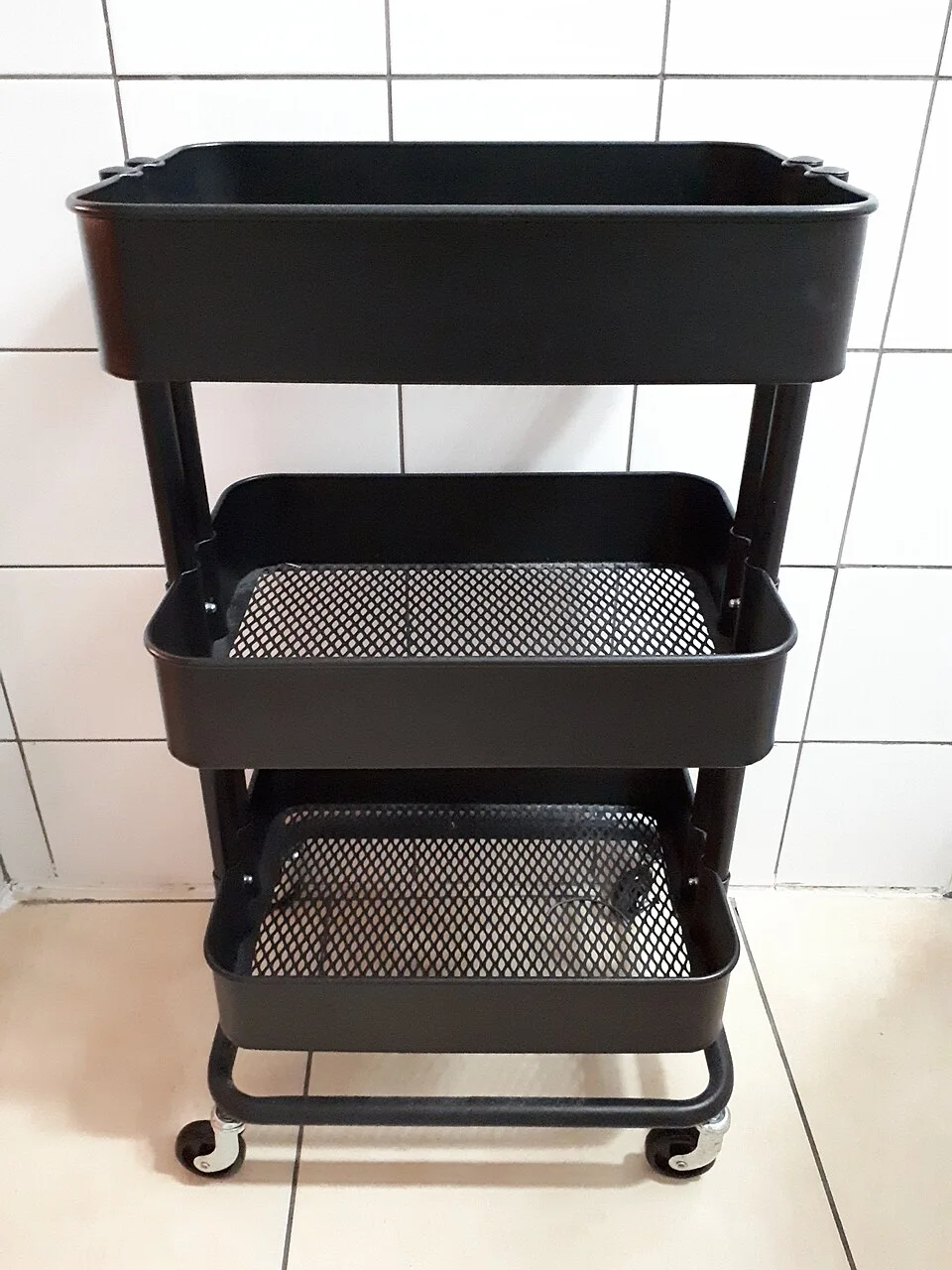
The lower frame and casters extend below the baskets, so the basket width alone is not the whole travel envelope. Measure the actual cart in its intended orientation and check corners, thresholds and rug edges on the route. This stationary example shows no turning trial, obstacle crossing, rated load or suitable parking clearance for another room.
Trace corners on the room sketch and observe the route with a suitable lightly loaded cart if available. Do not force a loaded unit through a marginal opening or lift it over obstacles in ways its maker does not intend. Rug edges, thresholds and uneven floors can change ordinary movement substantially.
The CDC — Check for Safety: A Home Fall Prevention Checklist for Older Adults checklist emphasizes clear paths. Keep the route usable for people when the cart is parked and while it is being used. A cart that fits through a doorway but has to wait there while someone clears a destination is not yet part of a reliable storage arrangement.
Compare an illustrative straight and turning fit
All dimensions in this example are illustrative. A cart's loaded width is 42 cm and a straight passage is 68 cm wide. The total side remainder is 68 − 42 = 26 cm. If centered, that would be 13 cm on each side, but actual movement and hand position still need checking.
At a corner, the cart's 55 cm loaded length also matters. The 26 cm straight-line remainder cannot establish whether the cart can turn, because its corners trace a different path. A handle or protruding folder may be the first part to contact the furniture even though the baskets clear.
Compare a smaller cart with a 34 cm width and 42 cm length. It leaves 34 cm of total width in the same straight passage, but it may hold fewer categories and require extra trips. Record both the movement improvement and the reduced storage capacity. The example is geometry for comparison, not a minimum clearance rule or a claim of safe maneuverability.
Make the parking position usable without rearranging the room
Check that the parking place remains available during ordinary room use. A gap beside a desk may be occupied by the chair when someone stands up. A space behind a door may block the door's intended movement. Mark those occupied states before declaring the gap spare.
Ensure the user can grasp the cart and operate its locks in the parked position. A unit wedged tightly between furniture may be difficult to release without pulling on a basket rim or unstable contents. Follow the manufacturer's intended handling method and allow an ordinary supported approach.
Do not park the cart in front of controls, ventilation or required access to other storage. If it has to move every time a wardrobe opens, count that dependency. Occasional sequential use may be acceptable; a daily conflict can mean the cart adds more movement than it saves. Change its category or destination before buying accessories.
Remove cable dependencies from the travel plan
If the stored kit includes powered equipment, identify what is disconnected before moving. Follow device instructions and allow equipment to cool where required. A connected charger can turn a simple cart movement into a pulled plug, damaged lead or trip hazard.
The CPSC — Safety for Older Consumers: Home Safety Checklist checklist identifies cords in traffic and pinched wiring as problems. Keep the cart's wheels and parking edges away from leads, and do not run a cable across the travel route to make a temporary working position function. Choose a suitable location near the existing power arrangement instead.
Do not treat the cart as a universal charging station without checking the electrical equipment and furniture conditions. Ventilation, cable strain and access to connectors still matter. If power requirements make the unit effectively immobile, evaluate whether a fixed storage position with a portable unpowered kit would be simpler.
Approve one complete delivery and return
Load the cart within its intended limits and perform the ordinary task sequence in good light. Move it from parking, access the assigned supplies and return it. Watch for objects shifting, handles catching, brakes being inaccessible and the user stepping backward into furniture.
Check the room afterward. The cart should occupy its assigned envelope, with no supplies left on the floor and no lead trailing into the route. If it repeatedly parks elsewhere because the assigned place is inconvenient, revise the plan rather than treating the deviation as a small housekeeping issue.
Completion means the same loaded cart can travel, work and park through an ordinary cycle without displacing essential room use. Keep the accepted category list and parking outline. Recheck when new items make the loaded envelope wider or taller; wheels do not make those added dimensions disappear.
THE REFERENCE FILE
Sources & scope
Documentation reviewed 1 Nov 2026. Examples are illustrative; this article does not claim hands-on product testing. Follow the instructions for your actual material, model and location.