Start with a question rather than a cleaning product
A greasy panel under a cooker hood looks like an obvious cleaning job. A dark insert behind it can look equally obvious: perhaps it needs washing too. That second assumption is where a simple task becomes unreliable. The hood can contain components with different jobs, different lifetimes and different treatment permissions. First establish which part you are looking at, then decide whether any household treatment is authorized.
Write a short starting question: “Which filters are installed in this hood, and what does the applicable documentation allow for each?” Keep the answer separate from any complaint about cooking smells. An odour does not identify a filter material or establish that replacement is due. Equally, a bright panel does not prove that all installed components are correctly fitted or serviceable.
Do not remove panels merely to discover what might be behind them. Begin with paperwork, purchase information and accessible identification. This guide concerns user-access filters only. Motors, internal housings, duct connections, fixed wiring and gas appliances remain outside the task. If identification requires access that the owner instructions do not permit, ask the manufacturer for the identification route instead.
1. Match the hood and its installed accessory
Copy the complete model identifier, including any suffix, from an already accessible label or reliable purchase record. Note the country of purchase and whether the hood is believed to discharge outside or recirculate into the room. Mark an uncertain installation route as unknown; a cupboard, grille or sound alone does not settle it. Do not take apart ducting to confirm it.
Retrieve the regional owner manual and record its document number or revision. Bosch UK’s manual finder uses the E-Nr as its lookup identifier. That is a useful example of why a marketing range name is insufficient. Two appliances sold under a similar range description can have different accessories or maintenance arrangements.
Next look for the installed filter kit’s part number in receipts, packaging or permitted accessible markings. A hood manual may describe several optional carbon systems without telling you which one a previous owner fitted. Match both the appliance and the actual accessory. If those records conflict, preserve both references and pause treatment rather than selecting whichever instructions seem easiest.
2. Separate grease capture from the carbon component
A user-removable metal grease filter commonly presents a layered mesh or similar metal assembly. Its role and permitted care must still be confirmed in the manual. A carbon or charcoal component belongs to an odour-treatment arrangement, commonly associated with recirculation. Neither function should be inferred solely from a panel’s colour. Grease staining can darken metal, while accessory casings can conceal the medium entirely.
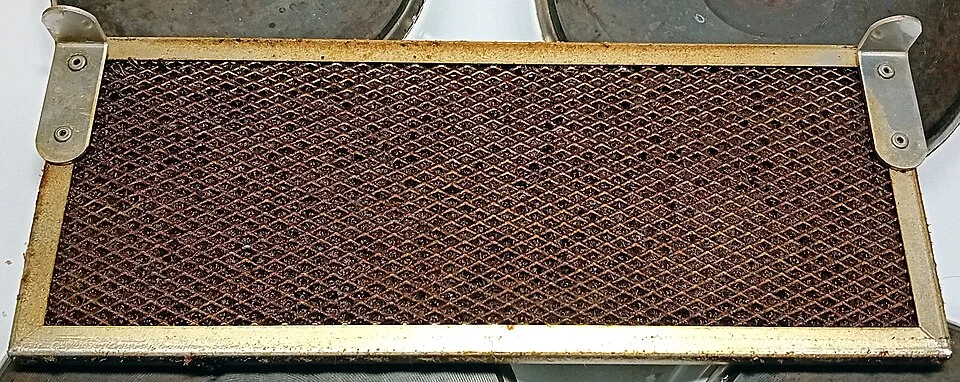
Dark deposits remain visible across the layered metal mesh and frame, giving specific locations to describe in a condition record. Confirm the component’s identity and permitted access in the exact hood manual. Colour and construction alone do not identify a carbon component, determine a cleaning recipe or establish extraction performance.
Photo & usage
Unknown authorUnknown author · CC BY-SA 4.0 · Source. Display copies resized and encoded as WebP; no instructional details were fabricated or removed.
Make one line per documented component: location described by the manual, component name, part number and permitted access. Use the same name as the document, adding a plain-language note if helpful. Avoid labelling everything simply “the filter”; that makes it easy to transfer a grease-filter washing instruction to a different component.
The reference photograph shows residue within one particular metal mesh specimen. It helps illustrate what a visible deposit can look like, but it cannot identify your hood, reveal a concealed carbon insert or authorize removal. A photograph taken after cleaning is likewise an appearance reference, not evidence of measured extraction or a method suitable for another filter.
3. Write the treatment permission in separate columns
Use four headings in your note: clean, replace, regenerate and unresolved. Under each component, record the applicable instruction and its source page. “Clean” should include the permitted method and limits. “Replace” should identify the compatible part and documented interval or condition. “Regenerate” requires an explicit procedure for the exact accessory, not a guess that heating or washing will restore it.
Carbon types vary. Some accessories are intended for replacement, while others have a manufacturer-defined regeneration process. Do not adopt a universal washing rule in either direction. In particular, do not wet an unidentified carbon element, heat it in an improvised way or borrow a regeneration instruction from a visually similar kit. Permission attaches to the identified accessory.
Bosch’s US metal-filter support page distinguishes metal-filter care from carbon-filter replacement advice. Read that regional overview as context, then resolve the actual part through its owner and accessory documents. Any broad interval on a support page must not silently override instructions for a different system. Where two applicable documents appear inconsistent, request clarification before proceeding.
4. Compare complete records, not similar appearances
Consider this invented identification exercise; the figures describe paperwork completeness, not real products. Household A has three required matches: appliance suffix, regional manual and installed accessory number. It confirms all three, so its record is 3 of 3 complete. Household B confirms the appliance and manual but cannot identify the accessory, giving 2 of 3. The difference is one unresolved match, not proof that either hood is cleaner or safer.
For Household A, an instruction allowing cleaning of its named metal filter supports planning that task. Its separate instruction to replace a named carbon component supports ordering that exact compatible part when due. For Household B, the missing accessory identity prevents a defensible decision about the dark insert, even if its visible metal panel is documented.
The arithmetic is deliberately modest: 3 minus 2 equals 1 missing match. Do not turn the fractions into a performance score or suggest that partial identification permits partial treatment of an unknown component. A single unresolved item can be decisive when it concerns material compatibility or access. Use the example to locate the missing information rather than rank the appliances.
5. Confirm accessible details without forcing access
Only after reading the access instructions should you plan an inspection. Follow the exact power-disconnection and cooling directions, let nearby cooking surfaces cool, and ensure a stable working position. A normal fan switch being off is not a substitute for the manual’s isolation requirement. If the required isolation is unclear or would involve fixed wiring, stop and obtain appropriate help.
For a permitted removable panel, support it before operating its documented latch and follow the illustrated movement. Do not assume that all latches release in the same direction. Stop at unexpected resistance, missing clips, distortion or a configuration that disagrees with the diagram. Never reach farther inside to confirm a motor or concealed filter location.
Record accessible labels and the panel’s orientation, then refit according to the manual if no treatment is being undertaken. Do not leave the hood ready for operation with a required component absent. If a part cannot be secured, keep the appliance out of use and seek model-specific advice. An incomplete inspection is preferable to a damaged mounting or improvised fastening.
Finish with an explicit decision for every component
Close the exercise with one of four statements for each part: identified and cleaning permitted; identified and replacement required under its instructions; identified and regeneration permitted under a named procedure; or unresolved and no treatment attempted. Add the next action and who will obtain the missing information. “Looks washable” is not an acceptable completion statement.
Keep the document references with any replacement receipt so the next maintenance task starts from an established identity. Recheck if the hood configuration or filter kit changes. A previous owner’s care habit, an online photograph or the fact that a part physically fits does not establish compatibility. Ask about the exact accessory when ordering rather than asking for a generic hood filter.
The task is complete when the installed parts have a defensible care route or the remaining uncertainty has been clearly handed over. It does not require washing something today. A clean identification record prevents the expensive mistake of treating a replaceable medium as reusable, and the equally unhelpful mistake of discarding a component whose documented care would have been appropriate.
THE REFERENCE FILE
Sources & scope
Documentation reviewed 1 Nov 2026. Examples are illustrative; this article does not claim hands-on product testing. Follow the instructions for your actual material, model and location.