Choose one listening question and one seat
An intermittent sound can be memorable without being constant. A cupboard slam, appliance cycle or passing vehicle may each interrupt a quiet task, yet require very different responses. Start by mapping when events occur and what they resemble. Do not invent an average decibel level from memory or treat an event count as a measure of loudness.
Choose a normal listening place and a practical question, such as whether a late-afternoon reading session encounters more interruptions than a morning one. Record the seat and the activity. An empty-room observation can miss how sounds affect the task, while moving through the house introduces a new set of sound paths.
Pick observation windows short enough to attend throughout, such as twenty minutes. Use a clock and paper ledger. You do not need to provoke sounds or recruit a neighbour. Leave household activities ordinary and agree with occupants that the diary describes events, not blame. Do not record private conversations or try to identify what someone is saying.
Define what counts as one event
Write a counting rule before starting. For discrete impacts, one obvious slam can be one event. For a repeated rattle, one continuous burst can be one event, with a new event only after a specified quiet gap. Choose a gap you can judge with the clock, such as ten seconds, and keep it consistent across sessions.
Give sustained activity a different treatment. A vacuum running for twelve minutes is one activity period with a duration, not hundreds of events. If a continuous hum underlies brief knocks, record the hum as background present and tally the knocks separately. Mixing duration and impact counts into one total hides the distinction you need.
Create a small vocabulary: impact, rattle burst, motor period, vehicle pass and uncertain. Add likely source in a separate column. A hollow knock heard near a party wall may be consistent with several sources; it does not prove neighbour activity. Use unknown rather than forcing every sound into a confident explanation.
Run comparable sessions and record gaps
Write start and end times, door and window positions and whether your own appliances are running. Begin the clock and stay at the selected seat. Tally each event promptly and add its approximate time. Mark an interruption in your observation if you leave the seat, answer a call or become unable to attend.
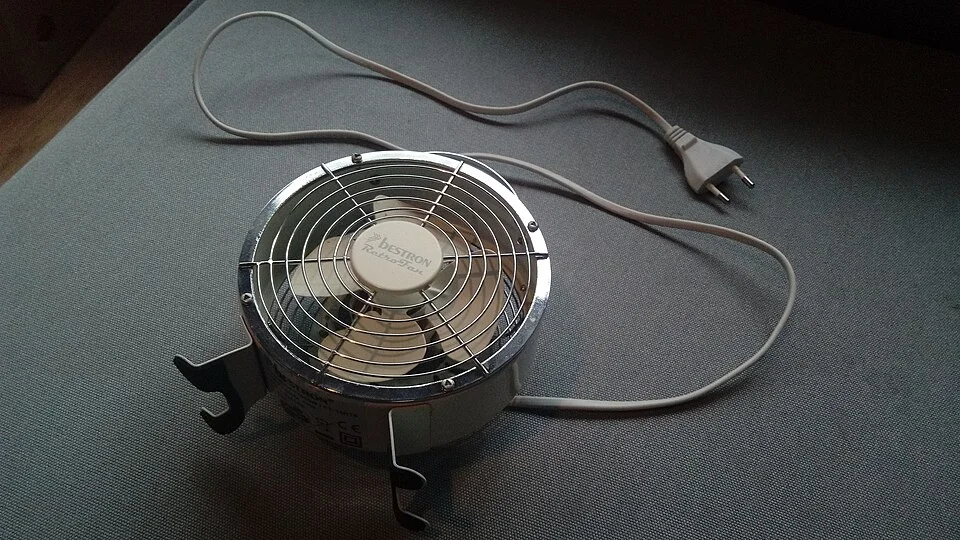
The fan and plug identify a possible source to describe before the timed observation begins. Use your own suitable appliance through its ordinary controls and record whether it starts, stops or remains off during the session. This unplugged display does not supply an operating sound, a measured level or an appropriate placement beside a bed.
Photo & usage
Donald Trung Quoc Don (Chữ Hán: 徵國單) - Wikimedia Commons - © CC BY-SA 4.0 International.(Want to use this image?)Original publication 📤: --Donald Trung 『徵國單』 (No Fake News 💬) (WikiProject Numismatics 💴) (Articles 📚) 16:50, 6 December 2021 (UTC) · CC BY-SA 4.0 · Source. Display copies resized and encoded as WebP; no instructional details were fabricated or removed.
If you miss part of a session, report attended minutes and the missing interval. Do not silently call it a full twenty-minute observation. A period with zero observed events is useful only if you actually listened throughout it. A blank diary cell should mean unobserved, not quiet.
Repeat the same time window on more than one day if feasible. Include an alternative period that fits your practical question. Weather, bin collection, visitors and unusual deliveries belong in the notes because they may explain why a day differs. Keep the record manageable; three carefully attended windows are more useful than an all-day diary reconstructed from memory.
Keep event counts separate from sound levels
The NIOSH app page explains a particular sound-level tool and its scope. An ordinary diary does not reproduce that measurement process. Do not average miscellaneous phone app numbers, convert annoyance scores into decibels or call a count of events an exposure assessment. If a formal measurement is needed, the method and instrument require their own appropriate assessment.
CCOHS and NIOSH engineering guidance provide a useful broad framework of source and sound path. Use the diary to choose a question within that framework: does moving an ordinary household activity away from the shared reading time help, or is the main event clearly outside your control? The diary alone does not identify a defective appliance or a legal nuisance.
You can add a simple task-impact note such as paused reading or noticed but continued. Keep that distinct from the event count. One long motor period might matter more to you than several brief taps, but the preference should remain visible in words. Do not disguise it with a weighted noise score whose meaning nobody can explain.
Calculate an illustrative event ledger
The invented record below covers three fully attended twenty-minute windows at the same seat. Each impact is counted individually; each rattle burst uses a ten-second quiet-gap rule. The motor entry is a separate duration and is excluded from the discrete-event sum.
| Window | Impacts | Rattle bursts | Discrete total | Motor period |
|---|---|---|---|---|
| 09:00–09:20 | 2 | 1 | 3 | None observed |
| 16:00–16:20 | 5 | 3 | 8 | 6 minutes |
| 20:00–20:20 | 1 | 0 | 1 | None observed |
The totals are 2 plus 1 = 3, 5 plus 3 = 8 and 1 plus 0 = 1. Across sixty attended minutes there are 3 plus 8 plus 1 = 12 discrete events. The afternoon window has 8 minus 3 = 5 more than the morning window and 8 minus 1 = 7 more than the evening window. None of those differences states how loud the events were.
The six-minute motor period overlaps the afternoon window but is not added as six more events. Nor does the quietest observed window predict every evening. The sensible next step is to repeat the afternoon and evening periods on other ordinary days, keeping the same definitions, before rearranging a recurring task around them.
Interpret patterns without inventing a source
Review whether a category clusters around a time, an activity or a door position. A repeated timing pattern is a lead for a reversible household comparison. If the suspected source is your own dishwasher, for example, a later ordinary cycle might help establish the connection without changing its installation or covering its vents.
For an outside or neighbouring source, retain the neutral description and observed times. Do not knock on a shared wall, play loud comparison sounds or confront someone based on a source guess. A factual diary can support a calm discussion with the appropriate household member, landlord or building contact if you choose to have one.
Common errors are tallying one repeating sound as several events one day and one event the next, forgetting unattended minutes and calling every low rumble traffic. Correct the affected entry or label it uncertain. An honest uncertainty is better than a detailed invented explanation. Keep ordinary silence and faint sounds in perspective rather than listening indefinitely for evidence.
Finish with a practical next comparison
Write one finding and one next action supported by the record. For example, afternoon sessions had more counted impacts in the attended windows; repeat those periods before deciding on a different reading time. If the record shows no stable pattern, say so. A diary has still clarified what was actually observed.
Completion means every session has attended minutes, every category has a counting rule and unknown sources remain labelled unknown. Preserve background durations separately from event totals. Check the arithmetic and keep the original entries. If the concern requires formal acoustic, equipment or building assessment, the diary supplies context; it cannot substitute for that work or establish a health, legal or compliance conclusion.
THE REFERENCE FILE
Sources & scope
Documentation reviewed 1 Nov 2026. Examples are illustrative; this article does not claim hands-on product testing. Follow the instructions for your actual material, model and location.