Start with the objects that must be stored
A cupboard can offer generous stated capacity while failing to hold the household's ironing board, document boxes or serving dishes. Before choosing cabinetry, list the categories and identify their largest or most awkward objects. Measure those objects in the condition in which they will actually be stored.
Distinguish active storage from reserve storage. Daily equipment needs accessible positions and room to return it. Seasonal objects can occupy less convenient positions if retrieval is still practical. Avoid designing every shelf around one exceptional object unless retaining it is a deliberate household decision.
Review duplicates and items with no intended use before increasing storage. EPA Ireland's circular economy guidance supports rethinking purchases and considering reuse. This is not a requirement to minimise possessions; it is a check that a new cabinet is solving a real need rather than preserving an unexplained pile.
Measure the storage envelope
Record width, depth and height, including handles, lids and protective cases. A box measured without its lid may understate the height needed. A platter stored upright may need a divider or support rather than just a narrow gap.
For soft items, measure the normal folded or packed state without forcing compression that the household cannot repeat. If textiles expand after release, leave the storage decision based on a realistic condition. Do not assume vacuum compression is suitable for every material or permanent storage situation.
Group objects that must remain together. A device and its required accessories need a traceable place even if the accessories fit elsewhere. Note whether the object can be safely rotated or stacked according to its instructions; a mathematical fit in an unsuitable orientation is not usable storage.
Compare internal dimensions and the opening
Obtain the cabinet's actual internal dimensions, shelf adjustment range and door opening details. External width includes side panels and may conceal hinges or centre supports. A shelf can be deep enough while the opening is too narrow to admit a rigid object.

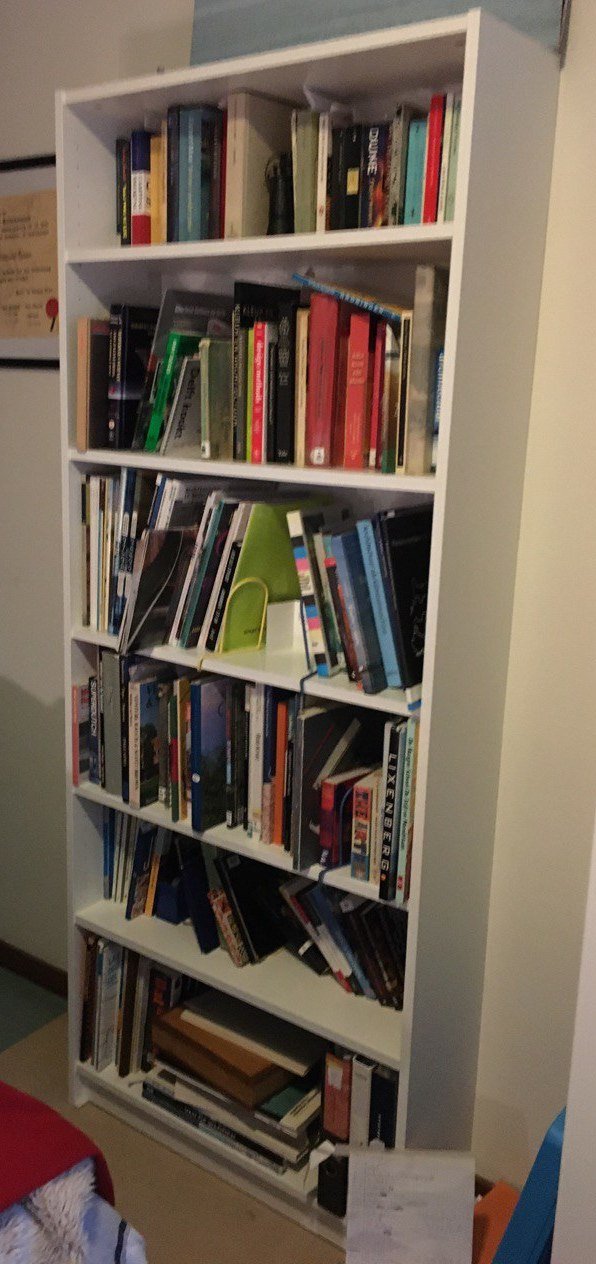
The book row makes the stored formats and shelf fronts visible, but it supplies no dimensions. Before ordering cupboards, obtain clear internal width, depth, adjustment range and opening details for the actual cabinet. Include hinges and supports in the fit check, and use the maker’s load and installation instructions instead of judging strength from the photograph.
Photo & usage
Vanmulondo · CC BY-SA 4.0 · Source. Display copies resized and encoded as WebP; no instructional details were fabricated or removed.
Ask about load limits for shelves, drawers and the cabinet as a whole. Book and paper storage can be dense. Do not infer strength from a thick-looking shelf or use the entire stated limit in a way the manufacturer has not permitted.
Plan assembly and anchoring before loading. CPSC's Anchor It guidance addresses tip-over prevention, and the actual furniture instructions determine installation. In a rental, arrange required permission and suitable fixing advice. A freestanding appearance does not mean the manufacturer intends the unit to remain unanchored.
Calculate a row with honest allowances
This illustrative shelf example has 84 cm of usable clear width. Five document boxes are each 15 cm wide, so they occupy 75 cm. The remaining 9 cm can be considered for retrieval space or another suitable use after testing.
Six boxes would occupy 90 cm and exceed the clear width by 6 cm. Dividing 84 by 15 gives 5.6, but a rigid box cannot be stored as a fraction. The practical maximum for this row is five boxes under the stated dimensions, before considering weight and access.
If hinge hardware reduces one part of the opening to 79 cm, the five boxes may still fit the shelf but need a different insertion sequence. Try the exact arrangement or ask the maker to confirm it. The example establishes a width budget, not shelf load capacity or suitability for important document preservation.
Rehearse retrieval as well as loading
Set up a representative shelf using an existing surface or a paper layout. Ask the person who normally uses the items to take one out and put it back. Include usual mobility needs and the weight of the object. Do not use an unsafe raised surface to simulate a high shelf.
Observe whether another item must be removed first, whether the user can see the label and whether there is a suitable place to set down a lid. Frequent multi-step retrieval is evidence that active items need a better position or more space.
Keep heavy objects in positions appropriate to the user's capability and the cabinet instructions. There is no universal ideal shelf height for every household. A layout that works for one adult may be unusable for another, and the design should be checked with the people who will actually use it.
Choose reserve capacity deliberately
Identify likely changes such as a planned document archive, new household member or replacement appliance. Reserve a named amount of suitable space for those changes rather than buying the largest unit that fits. Unnamed spare capacity can become a reason to keep unrelated clutter.
Do not apply a fixed percentage as though it were a storage standard. The useful reserve depends on the category and its expected change. A stable collection may need only retrieval room, while an active archive may need an expansion plan with a review date.
Compare the cabinet's footprint with the room's other functions. Pottery Barn's furniture measuring guide supports checking the space around a piece. A deeper unit can improve internal capacity while narrowing the route or obstructing a door, so compare the interior gain with the effect outside.
Write a buying brief with minimum usable dimensions
List the critical contents and the internal spaces they require. Include opening constraints, adjustable shelves, load requirements and installation needs. Mark desirable features separately from non-negotiable dimensions so a salesperson can identify genuine alternatives.
Ask for confirmation of ambiguous product information. A listing described as “shelf depth” may refer to an external dimension or a nominal component. Keep the maker's response and dimension drawing with the order, especially when the fit has little tolerance.
If a candidate fails one critical object, decide whether another suitable location exists before rejecting or accepting it. Avoid altering the object or removing cabinet components unless the manufacturer permits that configuration. The brief should record the chosen compromise rather than hiding it.
Check the installed capacity before filling everything
After correct assembly and installation, measure the relevant clear spaces again and try the representative objects. Check doors and drawers under ordinary use. Report a mismatch through the seller's process before modifying the unit or discarding relevant packaging.
Load categories gradually within the instructions, maintaining labels and retrieval space. Keep the reserve area named so it does not disappear during the first tidy-up. Record any object that still lacks a home and resolve it separately.
The storage project is complete when the real contents fit, can be retrieved and returned, and the unit remains properly installed and usable in the room. A cupboard full to its visible edges is not necessarily delivering more useful capacity.
Check whether contents can enter after installation
Some cabinets are easier to load before doors or internal fittings are installed, but ordinary use must remain possible afterwards. Ask how the largest retained object will enter and leave the completed unit. Do not accept a design that traps an item behind a fixed divider unless that arrangement is intentional and appropriate.
For adjustable shelving, record the range rather than assuming every height is available. Shelf pins, hinges and door hardware can limit useful positions. Try the proposed contents against the actual internal drawing and ask the maker to confirm close fits. A cupboard should support future retrieval without dismantling ordinary structural parts or repeating the original assembly process.
THE REFERENCE FILE
Sources & scope
Documentation reviewed 1 Nov 2026. Examples are illustrative; this article does not claim hands-on product testing. Follow the instructions for your actual material, model and location.