
A moving inventory earns its keep when somebody asks, “Where is the kettle?” A list saying “kitchen: assorted contents” cannot answer. A useful record connects what you own, where it started, which package carries it and where it should land.
Build that connection while belongings are still visible. Use the room as your survey boundary, then follow each item through packing and delivery. The method below works with a notebook or a simple spreadsheet; the important feature is a reference that stays with the belongings.
Give every destination a name before opening cupboards
Gather a notebook or spreadsheet, phone camera, removable labels, marker and any available plan of the new home. Keep receipts and existing furniture instructions accessible. Choose one master record and one person to reconcile changes, even if several people pack.
Name the destination rooms in plain language that everyone can recognise: “front bedroom” is more useful than “my room.” If access to the new home is uncertain, write a provisional destination and mark it for confirmation. Do not let a guess become a delivery instruction.
Give each current room a short code, such as KIT for kitchen and BED for bedroom. Add a number for each inventory entry: KIT-01, KIT-02 and so on. These identify belongings before boxes exist. Record destination separately, because a bookcase leaving the bedroom may belong in the new living room.
Use these fields: reference, description and quantity, present location, destination, decision, package reference, condition/photo reference, and status. Decisions can be move, personal carry, donate, leave by agreement, or unresolved. Status changes from surveyed to packed, loaded, received and checked.
Walk each room without turning it into a packing site
Start at the doorway and work around the room in one direction. Open accessible cupboards and drawers, then inspect freestanding belongings and visible storage. Record items where they are now; moving them into piles first makes omissions and double counting harder to spot.
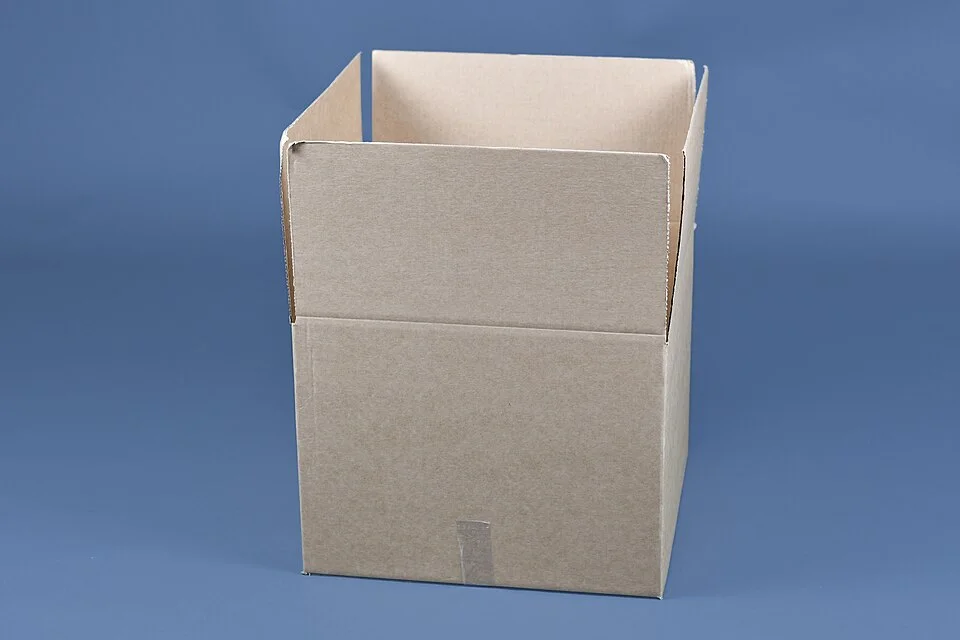
An open carton is the point to connect its intended contents with a destination room in the inventory. Record that decision before sealing, then give the package its own identity. This empty example shows the container only; it has no room label, item list or stated load capacity.
Photo & usage
HireAHelper · CC BY 2.0 · Source. Display copies resized and encoded as WebP; no instructional details were fabricated or removed.
List furniture, electronics, distinctive objects and anything needing separate handling individually. Group ordinary contents only when the description would let someone identify the group later: “six white dinner plates” works; “cupboard stuff” does not. A drawer of everyday socks can remain a group, while a camera deserves its own entry.
Make a final sweep for things that blend into the room: curtains you own, lamps, items behind open doors, cupboard-top storage and belongings temporarily loaned to another room. Add inaccessible storage as an unresolved entry rather than climbing or shifting heavy furniture to investigate it. Arrange suitable help before completing that part of the survey.
Photograph an overall view and any existing marks on individual pieces. Record model and serial information only where accessible without dismantling or moving equipment. For international shipping, the Federal Maritime Commission’s packing guidance specifically recommends identifiable descriptions, equipment details and supporting records. Use that level of identification wherever it would settle an ambiguity.
Follow a kitchen cupboard through a hypothetical move
In this hypothetical example, a household surveys a kitchen cupboard and a nearby trolley. The new kitchen has less storage, and the trolley will become a landing place in the dining room. The inventory catches that destination change before somebody labels everything “kitchen.”
| Item reference | Identifiable contents | Decision and destination | Package |
|---|---|---|---|
| KIT-01 | Six white dinner plates | Move; kitchen | KIT-B01 |
| KIT-02 | Four blue mugs | Move; kitchen | KIT-B01 |
| KIT-03 | Kettle and detachable base | Move; kitchen, opening evening | KIT-B02 |
| KIT-04 | Freestanding trolley | Move; dining room | Unboxed; KIT-04 label |
| KIT-05 | Spare serving bowl | Donate; collection pending | Outside shipment |
There are five inventory entries, two boxes and one unboxed shipment piece. Those totals describe different things. Counting five entries as five packages would inflate the load; counting only two boxes would lose the trolley.
The donation remains pending until somebody accepts and collects it. If collection falls through, change its decision and tell whoever is arranging transport. An intention to remove something is not evidence that it has left.
Keep unresolved and restricted items out of ordinary box totals
Review exceptions before buying packaging or requesting a final transport estimate. Give each unresolved entry an owner and a next action, such as “confirm destination cupboard” or “ask mover whether accepted.” Furniture with no confirmed destination should trigger a fit check before packing begins.
Create a personal-carry list for documents, jewellery and irreplaceable small belongings. Keep its detailed contents in the private master record; use a neutral reference on the outside of the bag. Confirm who will keep it in their possession during loading and travel.
Survey utility cupboards and garages as decision points. Paints, pesticides, oils and some other household products need special disposal care. Follow labels, retain original labelled containers, and never combine leftovers. Ask the local environmental or waste agency about collection options. For corroding containers, stop handling them and seek instructions from the local hazardous-materials official or fire department. These precautions follow the EPA’s household hazardous waste guidance.
Ask the carrier about transport restrictions before allocating such products to a box. For appliances requiring disconnection, record “preparation outstanding” and arrange the appropriate qualified service. An inventory walk does not require opening equipment, disconnecting gas or altering electrical connections.
Close each box in the record as well as with tape
Assign a package reference when you begin filling a box, and write that reference beside every item entry inside it. Label the box with the same reference and destination room. Add a brief contents description useful for unpacking, keeping sensitive details in the private record.

The taped carton has plain front and side faces where a package identity could remain visible. Before handover, add the unique number and destination according to the carton supplier’s instructions, then connect that identity with the inventory. No label or contents list is present in this photograph.
Photo & usage
HireAHelper · CC BY 2.0 · Source. Display copies resized and encoded as WebP; no instructional details were fabricated or removed.
If one group spans several boxes, split the entry or list every package reference. If you reopen a box and transfer something, update the record immediately. Otherwise the most carefully written inventory becomes wrong at the first last-minute reshuffle.
Photograph fragile contents before closure where useful, then mark the package packed. Give unboxed pieces their own visible references using labels suitable for the finish. Keep packed boxes and unboxed pieces in separate totals, and keep personal-carry bags outside the mover’s shipment tally.
Designate an opening-evening package for everyday items you expect to need immediately: bedding, towels, toilet paper, mugs and the kettle, for example. Record its actual contents and travel method. “Essentials” becomes useful only when someone knows which package that means.
Match your record to the load before departure
Save a dated copy accessible offline and keep a backup away from the packed household computer. Give helpers the destination and package list they need; retain receipts and sensitive identifying information privately.
If a mover uses different numbered labels, add a column connecting their numbers to yours. Your household record supports this reconciliation; it does not replace the carrier’s paperwork. Walk through additions and removals before loading so the agreed shipment reflects what is actually travelling.
For U.S. interstate moves, FMCSA’s moving guidance identifies the shipment inventory as a record of items and their condition, and says to notify the mover when the shipment changes. Read documents before signing and raise missing entries or disputed descriptions. Ask for written clarification of unresolved discrepancies.
Use a final empty-room sweep to check drawers, shelves and storage against the survey. Every remaining entry needs an explanation: travelling separately, intentionally staying, already removed, or still unresolved.
THE WORKING FILE / LEDGER
Why “24 boxes arrived” is not a complete delivery check
Imagine an inventory of 24 uniquely identified packages. Twenty-three are loaded; one remains at the origin. At delivery, 22 of the loaded IDs are found and an extra unrecognised box is present. A simple headcount of 23 objects conceals two different exceptions: the package left behind and the loaded package not located.
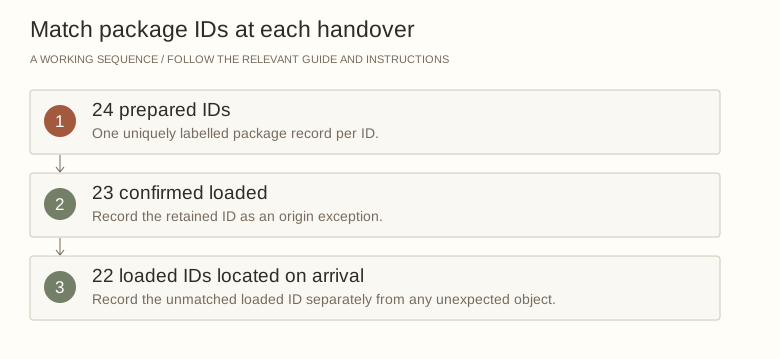
| Stage | Matched IDs | Exception to record |
|---|---|---|
| Prepared | 24 | No loading confirmation yet |
| Loaded | 23 of the 24 | One known ID stays at origin |
| Received | 22 of the 23 loaded IDs | One loaded ID not located |
| Additional object | Not on this inventory | Do not silently use it to balance the count |
Read the result
Compare ID sets, not just totals. Record the retained package separately from the missing-in-transit package and identify the unexpected object with the mover. Photograph relevant packaging and record the discrepancy through the mover’s agreed process. Arrival is not the same as undamaged contents; note visible damage and follow the applicable inspection and claim instructions.
Your ledger record Blank worksheet
Reconcile labelled packages at loading and delivery, including the exceptions.
- Package ID
- ________________________________
- Origin room
- ________________________________
- Destination room
- ________________________________
- Contents summary
- ________________________________
- Restricted-item decision
- ________________________________
- Loaded confirmed
- ________________________________
- Received confirmed
- ________________________________
- Condition
- ________________________________
- Exception and follow-up
- ________________________________
Before closing the file
- Each package has one unique ID.
- Loaded and received records are separate.
- Unexpected objects do not cancel missing IDs.
Finish with a received count and an exception list
At delivery, mark package references as they arrive and direct them to their named rooms. Keep “received” separate from “contents checked”: a box at the new address has not yet proved that its contents are complete and undamaged.
Inspect accessible exterior condition and photograph discrepancies. Record missing references and visible damage clearly, bring them to the mover’s attention and follow its written reporting procedure. For U.S. interstate moves, consult FMCSA’s consumer rights resources and the supplied handbook for the applicable paperwork and complaint process. Other moves require the relevant local guidance and contract.
As you unpack, check contents against the entries linked to each package. Close the move when every shipment piece is accounted for and every exception has a named next action. Keep the photographs, inventory and transport records together; update room destinations afterward so the same record can become your household inventory.
THE REFERENCE FILE
Sources & scope
Documentation reviewed 1 Nov 2026. Examples are illustrative; this article does not claim hands-on product testing. Follow the instructions for your actual material, model and location.