
Count complete working sets
Bedding shortages often reflect timing or mismatched pieces rather than a small total cupboard. A fitted sheet may be available while every compatible duvet cover is drying. Count complete usable sets for each occupied bed, then identify pieces that genuinely interchange.
Write the bed dimensions and the components the household uses: fitted sheet, flat sheet if wanted, duvet cover and pillowcases. Do not assume every retailer's set contains the same items. The reviewed John Lewis linen product listing identifies separate size and pack options, which is a reminder to inspect the exact chosen item.
Keep this calculation separate from cupboard organisation. The existing linen-storage guide addresses access and arrangement; this article decides the quantity that needs a home. Buying more sets before understanding wash turnaround can enlarge storage without solving the point at which clean bedding runs out.
Measure the bed and the bedding requirement
Measure mattress width, length and the depth including any topper that stays under the sheet. Compare the fitted sheet's stated pocket requirements and the manufacturer's guidance. A familiar bed-size name can differ across markets, and depth can make an otherwise plausible sheet unusable.
Check duvet and pillow dimensions independently. A cover and insert sold under the same size name may still need a dimension comparison. Record the actual measurements in the shopping list so a later replacement does not begin with a guess.
Read fibre and care information for the selected product. FTC's textile information describes relevant US labelling context, but it does not make every home textile subject to identical care-label rules. Use the item's supplied instructions and ask the maker where care information is missing.
Observe the full laundry interval
Record when used bedding leaves the bed and when it becomes dry, folded and available again. Include waiting for a suitable load, drying conditions and any outsourced laundry collection. A washing-machine cycle time alone understates the interval.
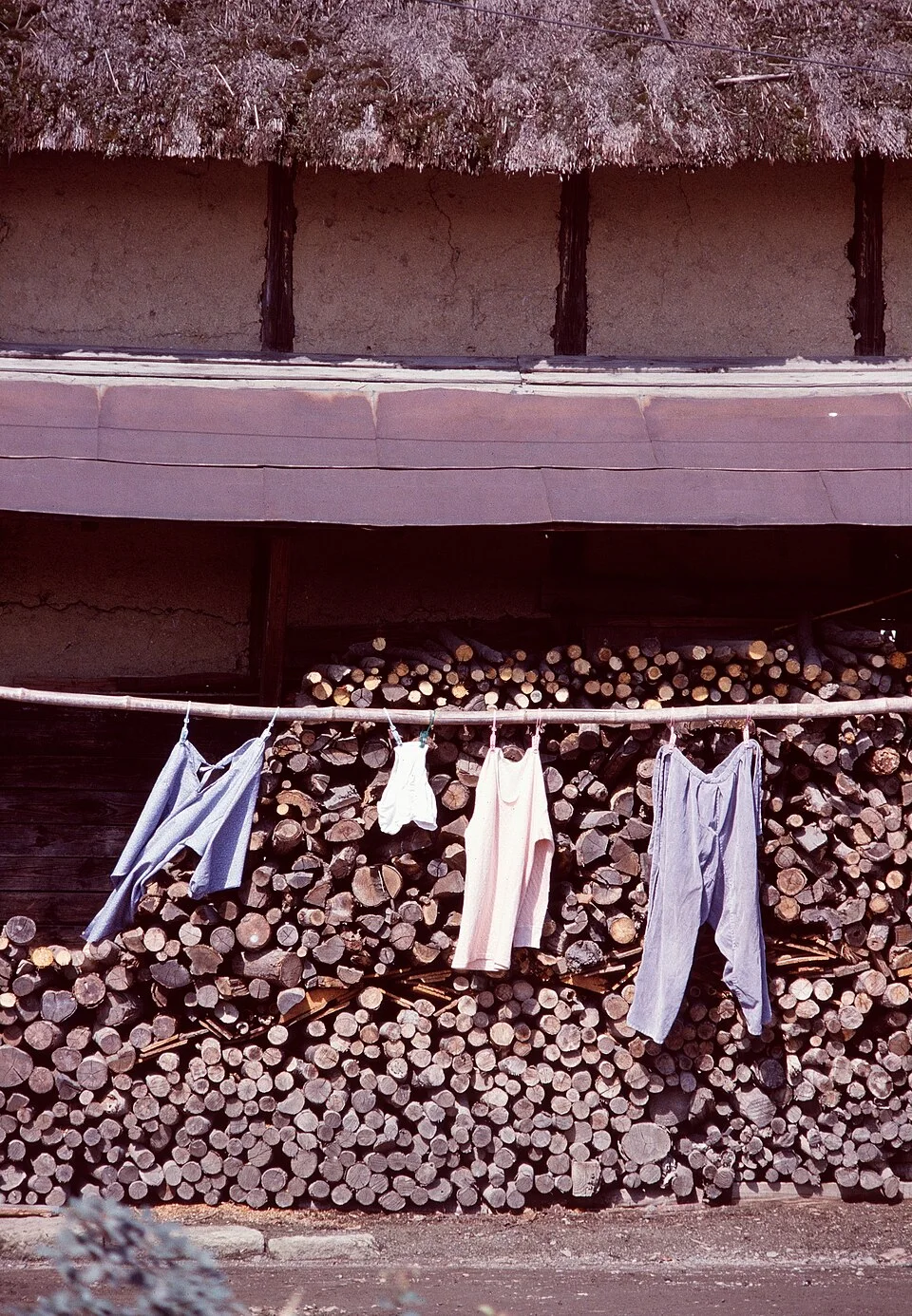
The garments are still hanging at the drying stage, separate from folded stock ready to use. Record that interval for the household’s actual bedding, including delays from weather or the need for another drying method. This laundry reference does not identify bedding fabric or establish how long any piece takes to dry.
Photo & usage
Marie-Sophie Mejan · CC BY 4.0 · Source. Display copies resized and encoded as WebP; no instructional details were fabricated or removed.
Use an ordinary week and note unusual delays. If bedding dries outdoors, consider the household's practical alternative when weather prevents that. Do not assume a second set solves a turnaround longer than the interval between changes.
Count actual available sets rather than all owned pieces. A stained or incompatible set that the household will not use should not silently function as the emergency reserve. Decide whether it needs repair, another use or a suitable release route before including it in the calculation.
Calculate simultaneous use and laundry demand
In this illustrative household, two beds each need one complete set in use. Both are changed on Saturday, and the removed sets are ready again on Monday. Two replacement sets are needed during that two-day turnaround, so the circulating requirement is four complete sets across the two compatible beds.
The household chooses one additional compatible reserve set for an unexpected change. The total becomes five sets: two in use, two in laundry and one reserve. This is a chosen planning arrangement, not a universal hygiene recommendation.
If the beds use different dimensions, one reserve may not serve both. The calculation must be split by compatibility. For example, two circulating sets plus one reserve for each of two different bed sizes gives six sets overall. Check the actual use and turnaround before adopting either total.
Treat guest bedding as a separate demand
List how many guest sleeping places may be occupied at the same time and which bedding they require. Do not add a full permanent circulation stock for a bed used once a year unless the household has a clear reason.
Check whether guest stays overlap ordinary bedding changes. A reserve set already needed for the occupied household beds is not simultaneously available for a visitor. Name the event that creates the extra demand, then decide whether borrowing, a planned purchase or a different change schedule is appropriate.
Keep guest sets identifiable and stored according to their material guidance. Check them before an actual stay rather than assuming a long-stored bag contains all components. A missing pillowcase discovered early is a small purchasing decision; discovered at bedtime it becomes an unnecessary household disruption.
Check the cupboard before ordering
Fold a representative complete set in the way the household will actually use. Measure the space it occupies without forcing compression unsuitable for the textile. Multiply only as a rough planning aid, then try the real arrangement where possible.
Leave room to remove a set without pulling out the whole stack. Deep shelves can hide mismatched pieces, so keep labels and components together in a practical system. Avoid purchasing bulky extra sets if the only available location is damp, inaccessible or already assigned to another essential category.
If storage is insufficient, revisit the reserve rationale, compatibility and laundry delay before buying a larger cabinet. A modest adjustment in how sets circulate may solve the problem, while a permanent reserve may still be justified where turnaround is unreliable. Record the chosen tradeoff.
Buy missing components rather than duplicate bundles
Compare the inventory with the planned complete sets. If the shortage is two pillowcases and one fitted sheet, a large bundle may create surplus duvet covers. Read the exact pack contents, dimensions and care requirements before comparing prices.
For an illustrative USD purchase, a needed sheet costs USD 32 and a pair of compatible pillowcases USD 18, totalling USD 50. A USD 75 bundle would cost USD 25 more and includes pieces not required by this invented plan. That is a needs comparison, not evidence that separate purchases are always cheaper.
Check return terms before washing or using new bedding. Inspect dimensions and contents under the seller's process, then follow the product's preparation instructions. Do not presume that every fibre or finish can be treated with the same wash or drying method.
Confirm the next two change cycles
After buying or reallocating pieces, run the ordinary bedding routine and note whether complete clean sets are available when needed. Record any delay caused by sorting, drying or missing compatible components. Adjust the specific bottleneck rather than automatically increasing stock.
Keep the final bed dimensions, pack contents and circulation count in the household record. Revisit it when occupancy, laundry access or mattress depth changes. A new topper can alter sheet fit without changing the bed's familiar size name.
The quantity decision is complete when occupied beds, laundry and the chosen reserve are covered by compatible sets that fit suitable storage. The goal is a working cycle, not the largest possible linen collection.
Audit partial sets before buying
Lay out the components of each planned set and identify pieces that are incompatible or missing. A cupboard containing six covers and two fitted sheets does not provide six complete changes. Record interchangeable pieces by their actual dimensions rather than by matching colour alone.
Check whether a spare pillowcase count reflects the number of pillows normally used, including different sizes. Keep decorative cases outside the functional circulation count unless the household actually uses them as sleeping bedding.
If one component wears out faster, consider a replacement line that can be bought separately under current availability. Do not promise long-term stock continuity. The record should simply make the next shortage visible early enough to purchase the missing component instead of another unnecessary bundle.
THE REFERENCE FILE
Sources & scope
Documentation reviewed 1 Nov 2026. Examples are illustrative; this article does not claim hands-on product testing. Follow the instructions for your actual material, model and location.