Resolve the treatment on paper before opening a cleaner
A kettle descaling job should start with two documents, not an acid recipe. The appliance manual defines what the kettle permits; the chosen descaler label defines how that particular product is used. A permission sheet brings their requirements together before any chemical enters the kettle. If the documents cannot support one complete procedure, the useful outcome is a paused job and a precise question for the manufacturer.
The sheet should identify the kettle, its regional manual and the actual product, including the label version where visible. “Kettle cleaner” is not enough information. Different formulations can have different doses, temperatures, contact times and material restrictions. Nor does a familiar household ingredient acquire permission merely because another kettle manual mentions it.
Treat visible scale and abnormal operation as separate questions. A mineral-looking deposit may prompt a check of maintenance instructions, but leaking, damaged electrical parts or failure to switch off requires an appropriate service decision. Do not use a descaling session as an exploratory repair for an unsafe appliance. No electrical housing, base connector or internal mechanism should be opened for this task.
1. Extract the exact kettle’s requirements
Record the full model, region and manual revision. Copy the permitted descaling route in your own concise notes, with the page reference. Look for restrictions on cleaner type, material compatibility, liquid level, heating, cooling, filter position, rinsing and repeat treatment. Include the normal minimum and maximum requirements where they apply to the documented process, without assuming an ordinary boiling instruction automatically covers every cleaning stage.
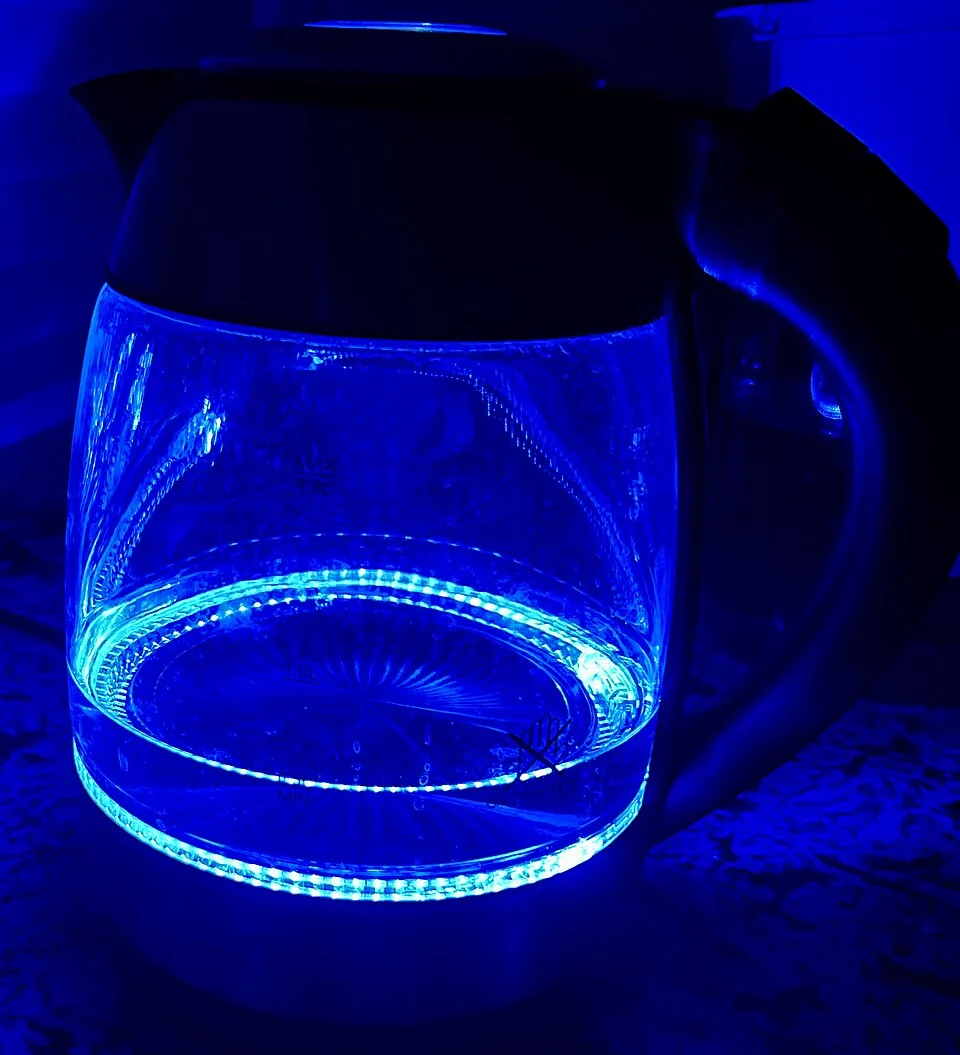
The transparent body makes the kettle’s construction visible, but supplies no cleaner compatibility, dose or heating instructions. Record the exact model and regional manual before extracting the descaling requirements. Keep ordinary fill limits and the documented cleaning procedure distinct; glass construction alone does not authorize vinegar, acid or a heated treatment.
Photo & usage
FASTILY · CC BY-SA 4.0 · Source. Display copies resized and encoded as WebP; no instructional details were fabricated or removed.
The cited Philips HD4686/HD4685 manual describes a model-specific vinegar procedure and also an appropriate descaler route. The Russell Hobbs 25240 instructions instead direct the user to a proprietary descaler and its package instructions. Those examples demonstrate why a recipe cannot be universalized. Do not transplant the Philips method to a Russell Hobbs appliance or assume every Philips kettle shares that manual.
If the kettle has no accessible model identity, resolve that before choosing treatment. A generic glass-kettle photograph can show a base or spout but cannot establish chemical compatibility. Similarly, a previous household habit is not a document. Preserve uncertainty as an unresolved field rather than replacing it with the most common advice found online.
2. Read the actual product label from beginning to end
Before purchase or use, confirm that the product is intended for the appliance type and the relevant materials. Read the preparation, handling, dose, temperature, contact, disposal and rinse directions together. Check whether the product calls for a measured water volume, a final solution volume or a whole sachet. These phrases can imply different preparation steps and must not be treated as interchangeable.
Russell Hobbs’ support page adds product-suitability context, including suitability for plastic products, and directs users to package instructions. Apply that advice within the relevant manufacturer context, alongside your exact kettle manual. A general support page does not supply the missing dose for an unlabelled bottle or establish compatibility for every appliance on the market.
Keep the cleaner in its original labelled container and follow its handling precautions. Do not mix descalers, combine them with other cleaners or add vinegar to strengthen a commercial product. Do not decant a solution into a drink bottle. If the label is damaged, incomplete or in a language you cannot reliably interpret, obtain the correct information before treating the kettle.
3. Reconcile every stage before making the solution
Draw a simple sheet with one row for each decision: product compatibility, dose basis, water or solution volume, temperature, contact time, filter treatment, rinse sequence and any repetition limit. Give each row a manual column, a product-label column and a final agreed instruction. Empty or conflicting rows remain visibly unresolved. Never silently choose the stronger concentration or longer contact time.
Some differences are supplementary rather than contradictory. A manual may allow a suitable commercial descaler without specifying a dose, leaving that detail to the chosen label. Other differences are genuine conflicts: a product might require a heating step the appliance instructions prohibit. In that case, choose a compatible authorized route or ask for clarification. Do not average temperatures or split the difference between two contact times.
Include the filter as its own permission question. A kettle may permit leaving a particular filter in place during its documented descaling process, but another design may require separate care or no user removal. The fact that a filter sits near scale does not authorize soaking it in any cleaner. Do not dismantle it to expose more surface area unless its exact user instructions explicitly allow that action.
4. Check an illustrative calculation without adopting its dose
The following label is entirely hypothetical and is not a recipe for any real kettle: “For an approved appliance, add 20 mL product to each 500 mL of water; use only where that preparation volume is permitted.” Suppose the hypothetical appliance and label both allow preparing the mixture using 750 mL of water. The scale factor is 750 ÷ 500 = 1.5, so the product quantity is 20 × 1.5 = 30 mL.
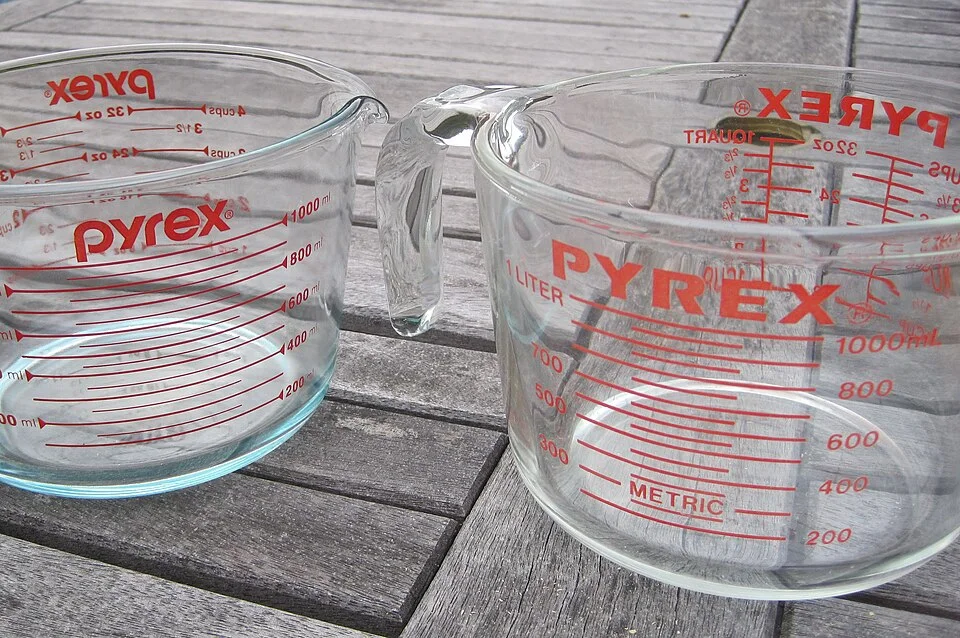
Both jugs carry liquid-volume scales, including metric millilitres, alongside other volume units. Keep the water quantity and product quantity in the hypothetical calculation explicitly labeled. These empty reference vessels contain no cleaner and supply no approved dose, mixture level or kettle compatibility; obtain those requirements from the actual appliance and product instructions.
Photo & usage
Picofluidicist at English Wikipedia · CC0 · Source. Display copies resized and encoded as WebP; no instructional details were fabricated or removed.
Under this invented wording, 750 mL refers to water before adding product. The nominal combined quantities are 750 + 30 = 780 mL; this simple addition is a planning check, not a laboratory guarantee of final solution volume. If a real label instead specifies a final solution volume, this calculation is inapplicable. If a real appliance cannot accommodate the preparation, do not proceed.
Never use the example’s concentration, volumes or implied scalability on your appliance. A real label may require an indivisible sachet, a fixed dose or different restrictions. Confirm all real values from the selected label and manual, including whether scaling is allowed at all. Use suitable measuring equipment and independently recheck units before preparing anything. Correct multiplication cannot rescue an unauthorized chemical or treatment.
Close with a documented result and a stopping boundary
Record the actual product, quantities, treatment date and completed rinse steps. Note what changed visibly and what did not, without claiming a measured energy, health or lifespan result. A cleaner-looking surface is a condition observation. It does not establish electrical safety or prove that a performance complaint was caused by scale. Keep those conclusions outside the sheet.
Stop if there is leakage, visible damage, unexpected material deterioration or abnormal operation. Do not run repeated cycles to reproduce the event, open the housing or probe the base. Preserve the model and treatment details for service. If the documents were unresolved from the start, record “not treated” and the exact missing permission; that is a completed planning outcome even though no cleaning occurred.
Return the appliance to normal use only after all applicable preparation, rinsing and assembly requirements are met and no unresolved fault prevents use. Store the sheet with the manual so the next session can verify the current product rather than assuming it has not changed. The lasting benefit is a repeatable decision process: identify, reconcile, calculate, perform and close within the written permissions.
THE REFERENCE FILE
Sources & scope
Documentation reviewed 1 Nov 2026. Examples are illustrative; this article does not claim hands-on product testing. Follow the instructions for your actual material, model and location.