Prepare for the person who will be home
The useful question before a short power outage is what someone will need to know if they walk into a dark kitchen halfway through it. Was the dishwasher washing or finished? Is the freezer deliberately disconnected? When did the refrigerator lose power? A paper handover card answers these questions even when the router is off.
Gather a pen, flashlight, charged phone, appliance thermometers, a cooler and frozen packs. Save the electricity supplier's outage contact and the relevant owner manuals offline. Find model numbers on accessible labels or existing paperwork; leave heavy appliances in place.
Divide the card into four headings: power lost, cold storage, cycles interrupted, restart owner. Under the last heading, name whoever will check appliances when power returns. If nobody will be home, defer new washing and cooking jobs until someone can supervise their completion.
Deal with essential needs first. The American Red Cross outage guidance recommends planning power-dependent medical needs with care or device providers. Arrange that support before working through domestic appliances.
Give cold storage a known starting point
Before a planned interruption, read the appliance thermometers and record the time. The FDA's power-emergency guidance specifies a refrigerator at or below 40°F (4.4°C) and a freezer at or below 0°F (−18°C). A control dial setting alone cannot confirm either temperature.
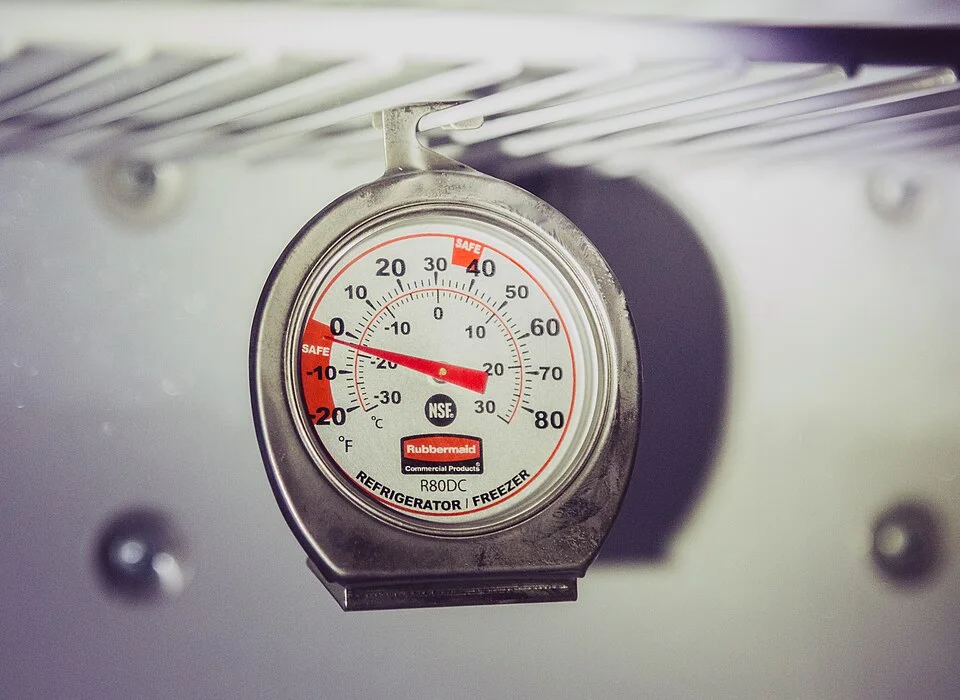
The dial displays two temperature scales and hangs from a compartment shelf. Identify the unit and record the actual appliance reading with its time before a planned interruption. A control setting or this reference image cannot reconstruct the household’s earlier food-temperature history; keep refrigerator and freezer observations separately identified.
Photo & usage
Tony Webster from Minneapolis, Minnesota, United States · CC BY 2.0 · Source. Display copies resized and encoded as WebP; no instructional details were fabricated or removed.
The FDA also recommends grouping frozen food, preparing frozen water containers or gel packs, and having coolers available. Do this while electricity is available. Set aside shelf-stable snacks, drinking water and the utensils needed for the next meal so routine requests do not become refrigerator openings.
Put the cooler where it can be reached without moving furniture. Decide which perishables would go into it first and check that they fit alongside the cold packs. Keep raw foods contained separately from ready-to-eat food. Do not count an empty cooler as backup refrigeration: it needs sufficient ice or frozen packs and a thermometer.
Write the last measured temperatures on the card. If the refrigerator is already too warm, address food protection before treating the coming outage as the problem. A previously warm compartment does not acquire a fresh safe-storage allowance when the electricity stops.
Replace a blanket unplugging list with actual states
Walk through the kitchen and utility area while there is light. For each appliance, record what it is doing, how you can stop it through ordinary controls, and whether its plug is safely accessible. The Red Cross advises unplugging appliances and electronics to reduce overload and surge risks. Work only with dry hands, dry surroundings and readily accessible plugs; leave inaccessible connections to qualified help.
| Appliance group | Record before the outage | Question after restoration |
|---|---|---|
| Refrigerator and freezer | Measured temperatures; whether disconnected | Is power restored to the appliance, and what happened to the food? |
| Washer and dishwasher | Idle or running; selected cycle; visible stage | Did the cycle finish, resume or require a new selection? |
| Cooker, kettle, iron and portable heater | Controls off; accessible plugs disconnected | Can this remain off until someone needs it? |
| Router and other electronics | Shutdown or disconnection completed | Does normal operation return after reconnection? |
Finish existing cycles before a scheduled cut where possible. Cancel delayed starts using the model's normal controls. If a cycle cannot finish, consult the manual's cancellation instructions while power remains available. Do not assume pressing pause means the machine will stay stopped after restoration.
For a refrigerator plug behind the cabinet, write that it remains connected; do not pull the cabinet forward to reach it. For hardwired equipment, use ordinary user controls and record that state. This preparation does not require opening panels or changing wiring.
Start the clock when power actually fails
Write down the actual loss time, even if the supplier announced a different start. If you discover the outage later, record both the discovery time and the last time power was known to be on. Mark the interval uncertain rather than inventing a precise start.
Switch heating and cooking controls off, disconnect accessible nonessential equipment, and note any unfinished cycle. Keep refrigerator and freezer doors closed. Use the flashlight; the Red Cross advises against candles and says not to use outdoor cooking equipment indoors. If you lose necessary heating, cooling or medical power, follow your relocation plan.
Check the supplier's update on your phone, but treat its restoration time as an estimate. Choose a household reminder to reassess cold storage before the expected protection period expires. One person should manage that decision so several people do not independently open the refrigerator to investigate.
An unexpected outage uses the same card, with fewer starting facts. Begin with timing, controls and interrupted loads. Leave the pre-outage temperature blank if you never measured it.
Work through a restoration that slips
Hypothetical example: an announced interruption runs from 10 a.m. to noon. Power actually fails at 10:10 a.m. The card records satisfactory earlier temperatures, a closed refrigerator and a washer stopped during its wash stage. At noon, the supplier extends its estimate to 3 p.m.
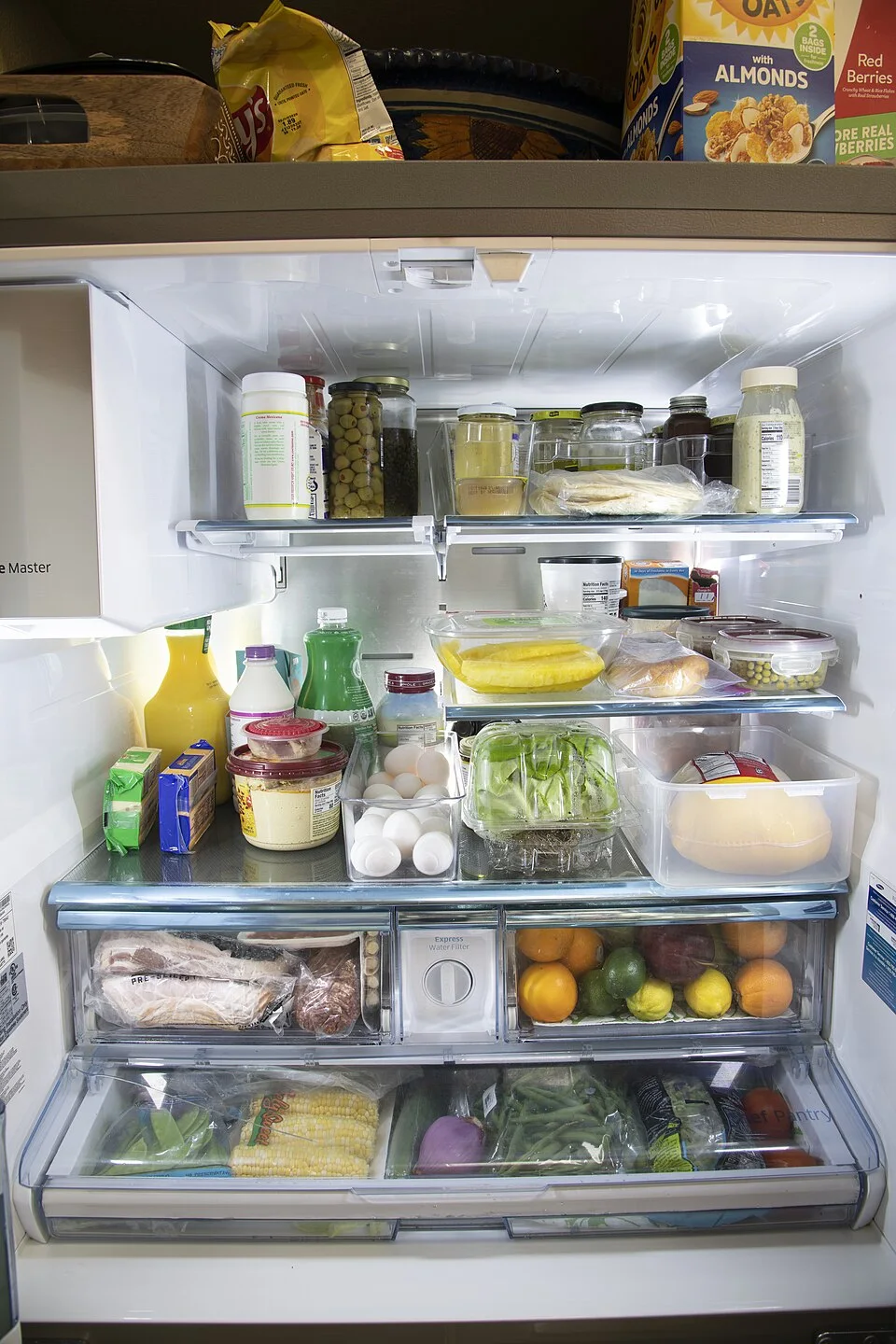
This contents view provides planning context for identifying stored items before an interruption; it shows no outage or measured temperature. In the actual record, retain the interruption start, relevant temperature observations and any necessary transfer time. An organized compartment or later cold reading cannot reconstruct an unknown earlier food-temperature history.
Photo & usage
USDAgov · Public domain · Source. Display copies resized and encoded as WebP; no instructional details were fabricated or removed.
The CDC's emergency food guidance gives an unopened refrigerator up to four hours, a full freezer 48 hours and a half-full freezer 24 hours. These estimates depend on closed doors. In this example, the refrigerator's four-hour point is 2:10 p.m.; noon's revised announcement does not restart it.
Make the transfer decision before that point. Move still-safe perishables into the prepared ice-filled cooler if continued refrigeration will be needed, maintaining 40°F (4.4°C) or below. Record the transfer time and reading. Leave the freezer closed rather than opening it merely because the refrigerator needs attention.
The CDC advises discarding refrigerated perishables after four hours without power or another cold source, and never tasting food to judge safety. Thawed frozen food may be refrozen or cooked if it retains ice crystals or is at or below 40°F (4.4°C). If storage history is uncertain, discard questionable food. A later cold reading cannot reconstruct earlier conditions.
Resolve interrupted loads by model
When power returns, write the time and check the card before restarting anything. If refrigeration was disconnected, restore its normal connection when safe and follow any restart delay in its manual. Then deal with interrupted loads individually, leaving optional cooking and heating appliances off until needed.
Start with the washer's display and the instructions saved for that model. GE's washer control guidance explains that an interruption can lock electronic controls and that some controls require cycle selection again after a reset. That supports checking the model's procedure; it does not establish a universal reset sequence.
Record any code before clearing it. If the washer remains locked, use only its documented user procedure; do not force the door or open a drain component. Confirm how the interrupted wash should be completed before moving clothes to the dryer. Seek appliance service if the documented procedure fails.
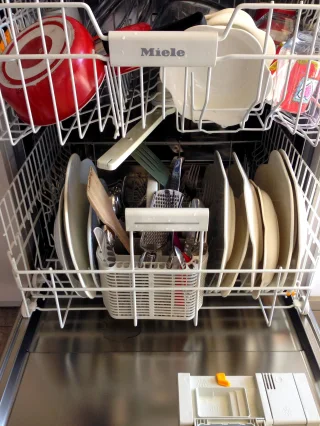
For the dishwasher, check whether the load actually completed. GE's dishwasher code guide identifies PF as a power interruption on applicable models and distinguishes it from leak-related faults requiring service. Follow your model's restart and detergent instructions; an illuminated display does not prove the dishes finished washing.
THE WORKING FILE / DECISION
Two clocks: power interruption and food exposure
In an invented outage, power stops at 14:10 and returns at 17:00, an elapsed 2 hours 50 minutes. That is the power-interruption clock, not proof that every food item spent exactly that long above or below a safe temperature. Door opening, initial conditions and temperature evidence still matter.
Power off
- Hypothetical entry
- 14:10
- Decision it supports
- Elapsed interruption time
Power restored
- Hypothetical entry
- 17:00
- Decision it supports
- 2 h 50 min total
Cold-storage evidence
- Hypothetical entry
- Record available thermometer readings
- Decision it supports
- Use food-specific safety guidance
Interrupted machine
- Hypothetical entry
- Model and stage of cycle
- Decision it supports
- Use its documented restart procedure
Read the result
USDA describes about four hours of refrigerator cold holding during an outage when the door stays closed; that is not a fresh four-hour allowance after discovery or restoration. Keep the door closed where practical and use the applicable food guidance when deciding what to retain. For laundry or dishwashing, a powered display does not establish that the interrupted cycle completed.
Your decision record Blank worksheet
Give the next person a usable outage, cold-storage and restart record.
- Power-off time
- ________________________________
- Restoration time
- ________________________________
- Fridge/freezer opening
- ________________________________
- Thermometer evidence
- ________________________________
- Food action
- ________________________________
- Interrupted model / cycle stage
- ________________________________
- Restart instruction
- ________________________________
- Person taking over
- ________________________________
Before closing the file
- Outage times are written immediately.
- Cold-storage decisions use their own evidence.
- Each interrupted appliance follows its own restart instructions.
Close the card only after the finish checks
Check every disconnected item against the list. Verify refrigeration temperatures, resolve food decisions, confirm interrupted cycles have completed, and correct clocks or schedules that matter. Check heating controls remain off before leaving the house. Keep the record until normal operation is established.
Stop if equipment was submerged or a circuit breaker has tripped. The Red Cross calls for qualified inspection of flooded electrical systems and electrician inspection before resetting tripped breakers. Tell the professional which appliance was operating and what you observed. Do not repeatedly reset equipment to test whether the problem returns.
Finally, add the missing detail you wished you had: a readable model number, an offline manual or a clearer note about the washer. Store the card with the flashlight. Its value next time is that another household member can pick it up and continue the same decisions.
THE REFERENCE FILE
Sources & scope
Documentation reviewed 1 Nov 2026. Examples are illustrative; this article does not claim hands-on product testing. Follow the instructions for your actual material, model and location.
- American Red Cross: Power Outage Safety
- FDA: Food and Water Safety During Power Outages and Floods
- CDC: Keep Food Safe After a Disaster or Emergency
- GE Appliances: Washer — Resetting the Electronic Controls
- GE Appliances: Dishwasher — Error, Fault or Function Codes
- USDA FSIS: How do you keep food safe during a power failure?