Classify the bill before estimating a saving
A water bill can combine supply, sewer service, stormwater, meter fees, taxes and account adjustments. Dividing the amount due by consumption produces an average figure, but that number may not represent the charge avoided by using less water. Start by copying each current charge line and its stated calculation basis.
Mark lines as volume-dependent, fixed for the period, dependent on another property measure or unresolved. Keep previous balances and payments in a separate account section. The classification should come from the utility's tariff and bill explanation, not from the label alone.
EPA's water-bill guide describes different charging structures. New York City DEP and Snohomish publish local examples with their own rules. These sources demonstrate why the structure must be checked; their rates and definitions should not be transferred to another household's account.
Find the sewer billing volume
Ask whether sewer charges use the same metered volume as water supply, a seasonal reference, an allowance or another method. Some accounts have no separate wastewater meter. A charge headed sewer does not prove that the household's actual discharged volume was measured.
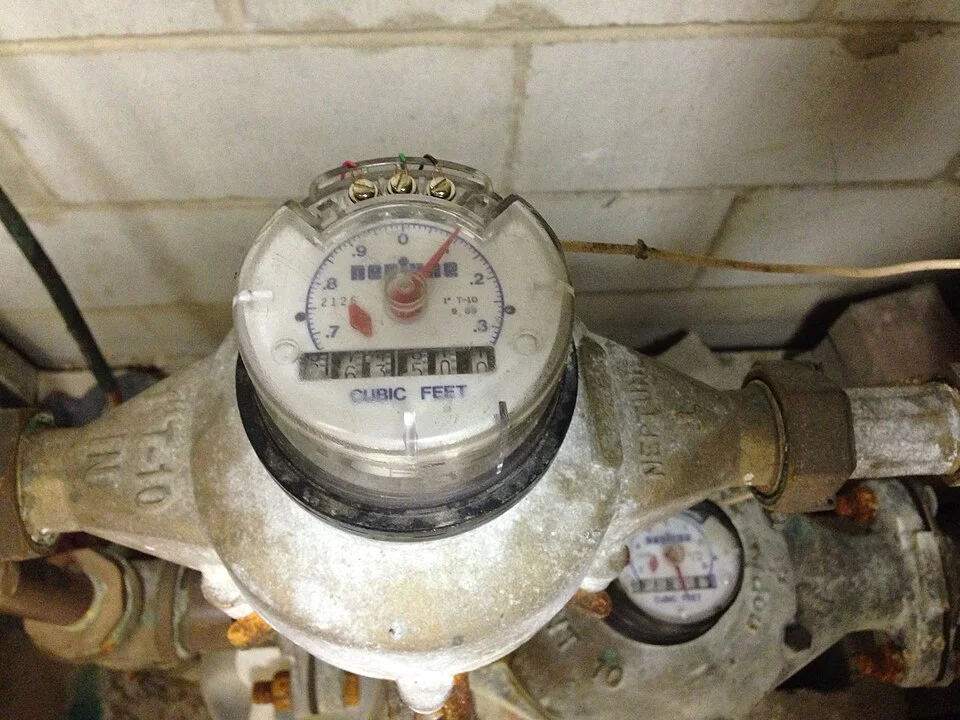
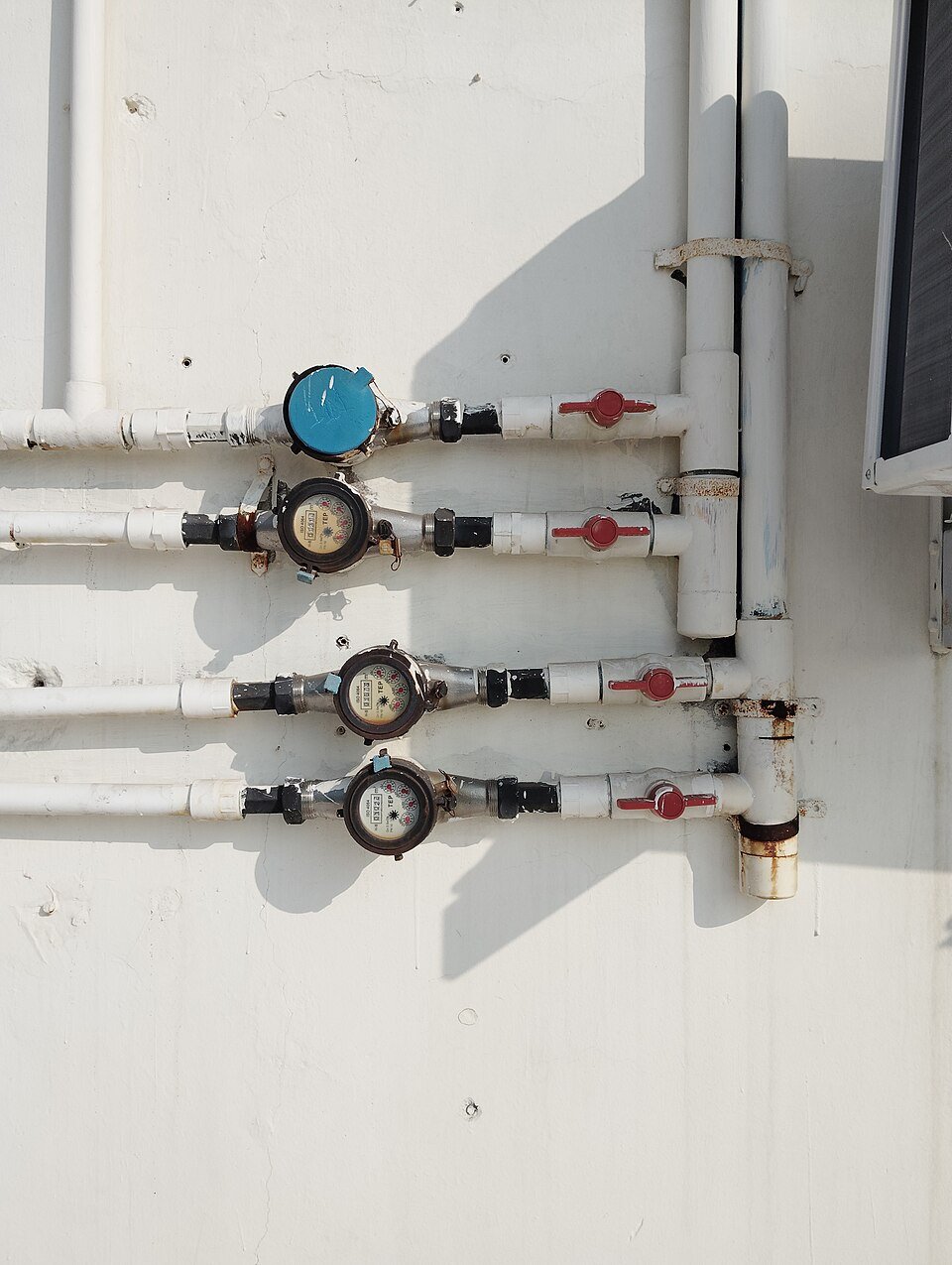
These water-meter registers provide a supplied-water measurement reference, with their unit printed on the face. Confirm which identified supply belongs to the account before using its readings. Sewer charges may use a utility-defined basis; the presence of these meters does not demonstrate separate measurement of discharged wastewater.
Photo & usage
z22 · CC BY-SA 3.0 · Source. Display copies resized and encoded as WebP; no instructional details were fabricated or removed.
Record any cap, minimum or special arrangement that applies to the account. An outdoor-use change may affect water supply and sewer charges differently depending on the tariff. Do not assume a litre that never reaches the sewer automatically earns a sewer credit.
If a separate irrigation or other meter exists, confirm its identity and billing treatment. Keep each stream in its own column. A master total that mixes differently charged uses can obscure the exact effect of a proposed household change.
Align the rate unit with the consumption unit
Write the rate as USD per cubic metre, per thousand gallons or per other stated block. Convert the proposed volume once, keeping the factor visible. A rate per hundred cubic feet cannot be applied directly to litres or individual cubic feet.
Keep taxes and percentage surcharges in the actual order specified by the tariff. Ask the utility if the bill does not explain which lines form the taxable or surcharge base. Do not invent a generic tax adjustment to make a scenario match.
Where rounding occurs by line or whole billing unit, record that limit. A tiny estimated volume reduction may not appear as the same exact monetary difference on the next statement. The household calculation is a scenario under stated rules, not a prediction of the utility's internal rounding.
Calculate an illustrative variable component
Assume an illustrative USD tariff charges USD 2.20 per cubic metre for water and USD 3.10 per cubic metre for sewer on the same volume. A fixed monthly fee is USD 18. At 12 cubic metres, water is USD 26.40 and sewer is USD 37.20, making USD 63.60 variable and USD 81.60 overall.
A reduction of 2 cubic metres would reduce the variable component by 2 × (2.20 + 3.10) = USD 10.60, if the same rates and rules apply. The fixed USD 18 remains unchanged. The new illustrative total is USD 71.00.
The original average total was USD 6.80 per cubic metre, but applying that to the 2-cubic-metre reduction would suggest USD 13.60. That overstates this scenario's change by USD 3.00 because it incorrectly treats part of the fixed fee as avoidable.
Check minimum charges and included units
Some tariff structures include a base amount of consumption or apply minimum charges. Read the account's actual rules before treating every reduced unit as a lower bill. Snohomish's published schedule illustrates that included units can be part of a local structure.
If consumption stays inside an already-paid allowance, a lower volume may produce no immediate change in that line. It can still be useful to record the volume, but do not label a theoretical unit price as a realised bill saving.
Distinguish a minimum bill from a fixed meter fee, and note the service period each covers. A bimonthly base cannot be compared directly with a monthly base without explaining the interval. Keep the tariff wording with the calculation so another reader can verify the boundary.
Separate a changed tariff from changed use
Record the tariff's effective date and the service dates on the bill. If a period crosses a rate change, ask how the utility allocates consumption. Use the actual method rather than assuming all volume is charged at the newest rate.
For comparisons, calculate a same-volume scenario under each tariff where the rules allow it. This isolates the price effect without claiming that household behaviour stayed constant. Then compare actual volume separately.
Do not use the next bill's amount due as immediate confirmation of a small fixture change. Credits, arrears, period length and read type may dominate the difference. Reconcile those fields before judging whether the consumption scenario was reflected in charges.
Use the result within its limits
A variable-charge estimate can help compare the water-cost side of a purchase or routine. It does not include hot-water heating, product price, installation, maintenance or household suitability unless those are added separately with reliable evidence.
Avoid a guaranteed payback claim based on an unverified reduction. Measure or obtain appropriate model data for the actual change, then show a range if use frequency is uncertain. State which charges remain fixed and which sewer assumptions drive the result.
If the tariff is complex or the account has special conditions, ask the utility to confirm the scenario. Provide the proposed volume difference and the relevant lines. A precise question about marginal charges is easier to answer than asking whether a product will “save on the bill.”
Close the map with a reconciliation
Rebuild one actual current-period subtotal from its components, allowing for the utility's rounding. Keep payments and old balances outside that subtotal. If the reconstruction fails, resolve the missing line before using the map for future estimates.
Save the tariff page, effective date and account-specific clarification. Review after a rate notice, meter-size change or new billing arrangement. The map should describe the current account rather than an attractive example from another city.
The task is complete when every relevant line has a known basis and a proposed volume change can be applied only to eligible components. That produces a modest, explainable cost scenario instead of an inflated saving claim.
Avoid adding a combined rate twice
A tariff may publish water, sewer and a combined figure on the same page. Identify whether the combined value already includes both services before adding it to separate lines. In an illustrative USD example, water at USD 2 and sewer at USD 3 per cubic metre produce a combined USD 5 rate. Adding all three figures would incorrectly create USD 10 per cubic metre.
Likewise, a percentage sewer charge may be applied to a defined water-charge base rather than directly to volume. Ask which base is used, especially if fixed water fees or allowances appear. Do not infer the formula from a familiar percentage on another city's bill.
Keep a written explanation beside any derived combined rate. Show the component rates, eligible volume and excluded fees. If a later tariff change affects only one component, that record makes the update straightforward.
Test the map using one actual bill before applying it to a purchase scenario. If the component reconstruction differs, investigate rounding, minimums or an omitted line. Do not create a balancing “other” charge without identifying it. A correct marginal estimate rests on a correct account structure, even when the proposed water-volume change is small.
THE REFERENCE FILE
Sources & scope
Documentation reviewed 1 Nov 2026. Examples are illustrative; this article does not claim hands-on product testing. Follow the instructions for your actual material, model and location.