Start with the drying space you actually have
A towel load is not finished when the washer door closes. It is finished when every towel is dry enough to fold and put away. If one large wash leaves you feeding the dryer repeatedly, or draping wet towels over every available chair, the useful batch size is smaller than the washer can hold.

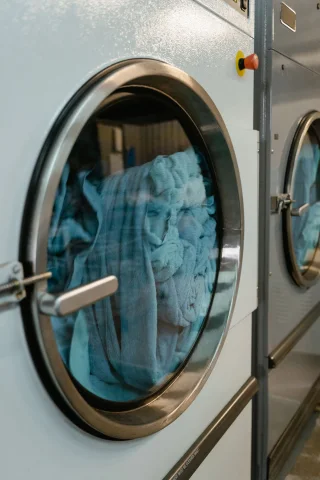
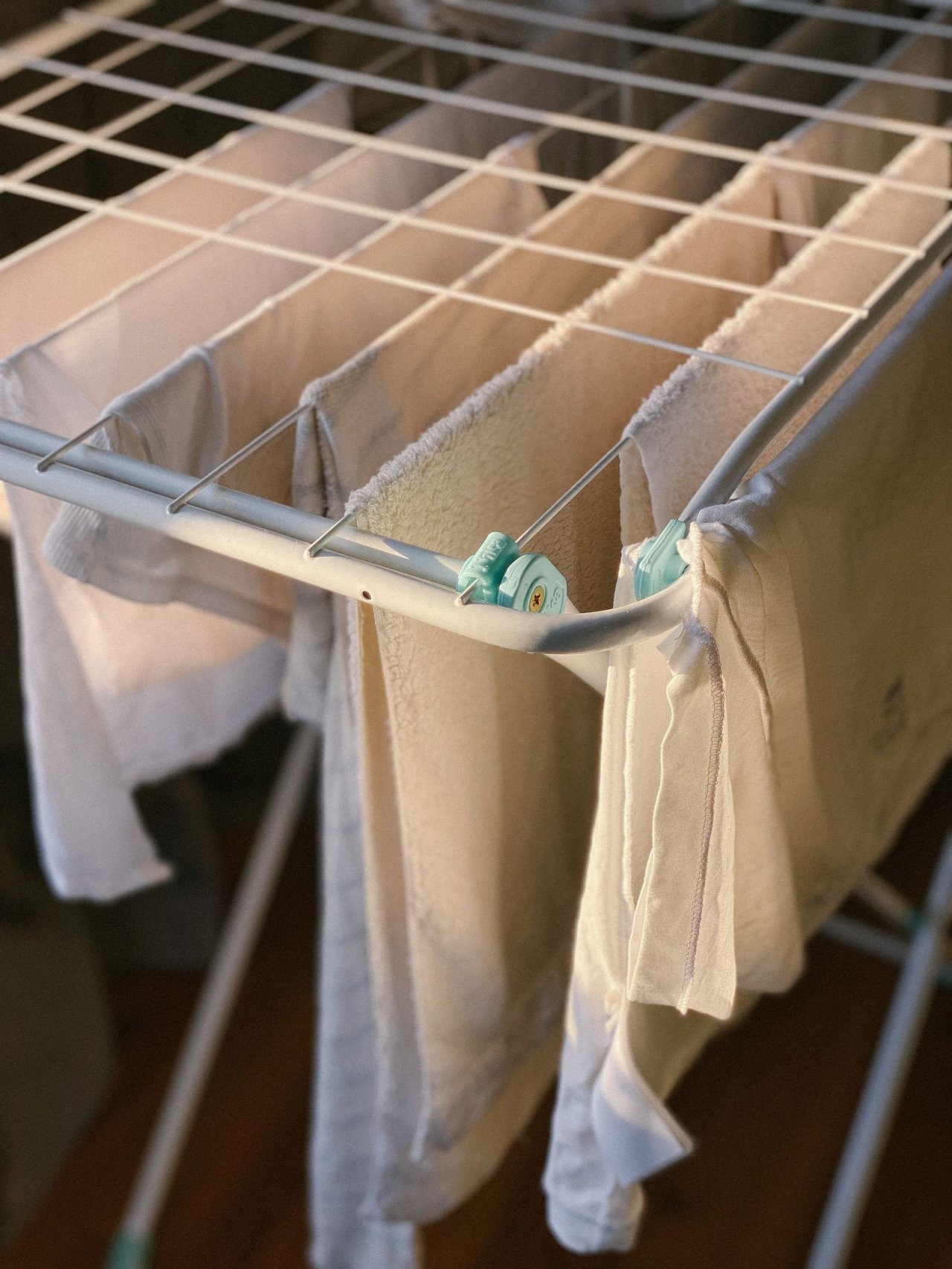
The spread-out textiles show how drying occupies line length and open space beyond the washer. Before starting your towel batch, reserve enough suitable rack or line positions for every item assigned to air drying. Match the arrangement to the towel labels and local conditions; this photograph provides no drying-time or load-capacity measurement.
Photo & usage
John Pavelka from Austin, TX, USA · CC BY 2.0 · Source. Display copies resized and encoded as WebP; no instructional details were fabricated or removed.
Build a repeatable batch around your particular towels and both stages of the job. A count alone is unreliable: a thick bath sheet and a thin hand towel are different loads. The aim is a group that washes without being compressed, spins successfully and has somewhere to dry immediately afterward.
Before starting, gather the towel care labels, the washer and dryer instructions, suitable laundry detergent and an empty basket. Clear enough rack or line space for anything that cannot tumble dry. This guide covers ordinary household bath and hand towels; set aside oil-soaked workshop cloths and towels contaminated with solvents for substance-specific guidance.
Define one compatible batch before loading
Sort by compatible wash temperature, drying method and colour, then compare thickness. Keep a decorative towel with restrictive trim out of a plain cotton batch if their instructions differ. Give oversized bath sheets their own planning attention rather than treating each as one ordinary towel.
Read the machine instructions for the selected programme, including any load restriction. A headline appliance capacity does not establish the allowance for every cycle. If the manual states a dry-textile weight limit, compare it with dry towels, not the weight after washing. Never use weight alone as permission to compress a bulky load.
For a hypothetical planning example, suppose four dry bath towels weigh 0.7 kg each, about 1.5 lb, and four hand towels weigh 0.2 kg each, about 0.4 lb. Their combined dry weight is 3.6 kg, about 7.9 lb. These are invented example weights, not towel specifications or a recommended machine load. Your batch still has to meet its programme limit and fit loosely.
You can weigh a dry batch in a basket on a suitable household scale, subtracting the empty basket's weight. If the towels are already wet, do not pretend that reading represents dry textile weight. Follow the manual's loading guidance instead. Samsung's load-size guidance reinforces that weight and loose placement both matter; its example towel weights are estimates, not a count that transfers to every home.
Use the basket as a check, not a mould
Unfold towels before putting them in. A neatly folded stack disguises how much material is entering the machine and encourages adding another layer. Place each towel loosely and stop before you have to press down, force an item into a gap or push laundry away from the door to close it.

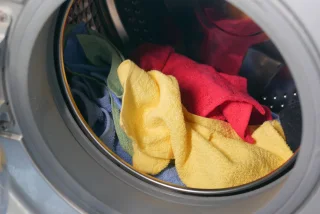
The empty drum exposes the interior surfaces and lifters that towels must move around during washing. Load unfolded compatible towels loosely according to your washer manual, keeping fabric clear of its door and seal. This close view does not show a loaded batch, a permitted fill line or a capacity test.
Photo & usage
Alfonso Pierantonio from L'Aquila, Italy · CC BY-SA 2.0 · Source. Display copies resized and encoded as WebP; no instructional details were fabricated or removed.
- For a front loader, follow its specified fill guidance and keep fabric clear of the door seal. Do not apply a universal fist-sized gap as proof that any load is acceptable.
- For a top loader, distribute towels around the basket as its manual directs. Do not wrap a bath sheet around an agitator.
- If the last towel only fits after compression, take it out. Reassess the remaining batch rather than squeezing the pile flatter.
GE Appliances' top-loader instructions specifically warn that wet laundry can pack down and lead to overloading. They also require room for movement and advise against wrapping items around the agitator. The practical implication is to judge the loose starting load, not the compact pile left after you press it down.
Do not solve an oversized batch by washing one enormous towel alone without checking the manual. A very uneven small load can create a different problem. Keep compatible items available to form sensible batches within the manufacturer's instructions.
Set the wash, then inspect what the spin achieved
Select a programme the manual recommends for the towels and a temperature their labels permit. Follow the detergent label for the actual batch, soil level and water conditions, using an HE product if required. A smaller batch does not need the dose you habitually use for a full basket.
For this first batch, keep a note of the detergent dose and programme so you can interpret the result. Whirlpool's towel-care guide links excess detergent with residue and notes that fabric softener can reduce absorbency. Neither extra detergent nor extra softener makes an overcrowded batch workable.
If the washer bangs or repeatedly reports imbalance, pause it using its normal controls. Wait until the drum has stopped and the machine permits opening; never defeat the lock. Follow the manual to redistribute or reduce the load, then use its approved restart procedure. Repeated failed attempts are a reason to consult support rather than keep restarting.
At the end, separate several towels before transferring them. Check a large towel and a smaller one, including their centres. They should be wet from laundering but not dripping as you lift them. If they are unusually waterlogged, check for an incomplete spin or displayed error and consult the troubleshooting instructions. Do not make the dryer compensate for an unresolved washer problem.
Make a fresh loading decision at the dryer
The washer's successful batch is not automatically the dryer's successful batch. Untangle and open each towel, then place it separately in the drum. Stay within the dryer's programme guidance and leave room for the towels to lift and fall. Whirlpool's dryer-loading instructions emphasise free movement and separating tangled items.
For a hypothetical example, six compatible bath towels might fit loosely in a particular washer, while that household's dryer instructions require splitting them into two groups of three. That is a scheduling example, not a capacity rule. Have a place to spread the waiting group rather than leaving it knotted in the washer. Alternatively, wash smaller batches from the outset if that better suits your routine.
Clean the user-accessible lint filter as instructed before drying and refit it correctly. Choose a label-compatible heat setting and a suitable cycle. If a very small batch stops while still damp, check the manual's guidance for sensor drying and small loads; Samsung explains that too few items can affect moisture sensing. Use only a supported alternative setting.
If drying on a rack or line, unfold each towel across usable space, with air able to reach both faces. Do not drape the next wet batch over the first. The available hanging space is another real batch limit.
Separate a damp hem from a drying fault
Let the cycle finish, then check thick hems and the centre of each large towel. If a few areas are damp, separate those towels and finish drying with a supported setting or on the rack. Remove fully dry towels instead of repeatedly heating the whole batch.
Widespread dampness or drying that takes longer than usual deserves attention beyond load size. The U.S. Consumer Product Safety Commission's dryer alert identifies those symptoms as possible signs of a blocked lint screen or exhaust duct. For a vented dryer, observe an outdoor outlet only if safely accessible from ground level. An outlet that is not releasing exhaust needs investigation before further use.
Arrange qualified service for suspected exhaust restrictions or persistent poor drying after the manual's user checks. Do not pull out a heavy appliance, disconnect ductwork or open its casing for this exercise. A condenser or heat-pump dryer has different maintenance requirements: follow its filter and water-container instructions rather than searching for an outdoor vent.
THE WORKING FILE / COMPARISON
Eight towels washed does not mean eight towels can finish together
Suppose an ordinary batch contains eight compatible towels. In a household’s permitted-use trial, a six-towel drying batch finishes evenly, while the eight-towel batch leaves two thick hems damp. This is a hypothetical observation, not a capacity recommendation or a controlled product test.
| Batch record | Eight-towel attempt | Six-towel comparison |
|---|---|---|
| Care route | Same permitted towel group | Same permitted towel group |
| After spin | Record wetness and any fault | Record under comparable settings |
| After drying | Two hems remain damp in example | Even result in example |
| Next action | Check load, cycle and appliance guidance | Repeat before saving as the household routine |
Read the result
Do not turn the example’s “six” into a rule for every machine. Towel size, fabric, dry mass, programme and tumble space vary. Record a repeatable batch description — the particular towels and permitted settings — instead of only a count. If a smaller compatible load still dries unevenly, move to the appliance’s documented troubleshooting route rather than adding endless time.
Your comparison record Blank worksheet
Save a towel batch that can complete the entire wash, spin and dry route.
- Towel group and dry mass if known
- ________________________________
- Care permission
- ________________________________
- Wash setting
- ________________________________
- After-spin condition
- ________________________________
- Drying route / load
- ________________________________
- Damp location
- ________________________________
- Second comparable result
- ________________________________
- Routine retained
- ________________________________
Before closing the file
- Washer and dryer limits are checked independently.
- The thickest hems are inspected.
- A repeat result supports the saved batch.
Save the batch that actually finishes
Before folding, let towels cool enough to reassess any doubtful damp patches. A towel is ready for the cupboard when its centre, corners and hems are dry. Keep anything questionable spread out to finish.

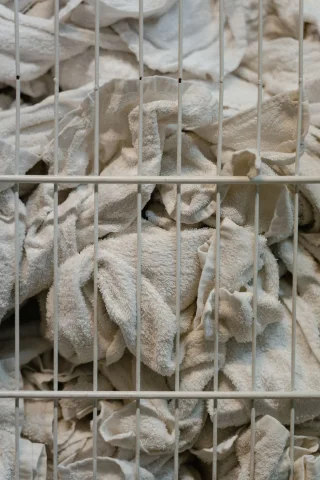
The different folded stacks show why a count alone cannot describe a towel batch: size and thickness change the material handled. Record your own repeatable mix only after each towel’s centre, corners and hems finish drying. The shop display illustrates textile variety and folding; it provides no evidence that a household load has dried.
Record the mix of towels, programme, detergent dose and drying arrangement that worked. For example, describe “the thick blue bath towels with the matching hand towels” rather than relying on an unexplained total count. Recheck the plan when replacing towels with larger or heavier ones. Your useful capacity is the batch that completes the whole job reliably.
THE REFERENCE FILE
Sources & scope
Documentation reviewed 1 Nov 2026. Examples are illustrative; this article does not claim hands-on product testing. Follow the instructions for your actual material, model and location.
- Whirlpool: How to wash & dry towels to keep them soft
- Whirlpool Product Help: Properly Loading a Dryer
- Samsung: The best laundry load size for your Samsung washing machine and dryer
- GE Appliances: Top Load Washer – Proper Loading
- U.S. Consumer Product Safety Commission: Overheated Clothes Dryers Can Cause Fires (Publication 5022)