Aniline leather can develop a richer, uneven color where hands, clothing and light affect it over time. That changing appearance is not always dirt waiting to be scrubbed away. A fresh spill can also darken the surface, and the two patterns may overlap. The useful starting point is a documented leather identity and a distinction between routine dust, a new event and established patina.
This guide concerns upholstery confirmed by its maker as aniline leather, with any protective treatment identified. It does not assume that every product carrying the term aniline has identical resistance. Suede, nubuck, semi-aniline, pigmented leather and coated performance products require their own directions. The aim is careful care that preserves the surface rather than forcing every panel to match a new sample.
Recover the exact leather name and treatment
Find the furniture invoice, upholstery sample or maker's label. Ask the supplier whether a later protector or conditioner has been applied and whether it changes routine care. A leather's trade name can matter as much as its broad category because manufacturers may use different finishing systems.
Carl Hansen & Son distinguishes several leather categories and their care instructions. La-Z-Boy likewise notes leather-specific requirements and describes some aniline products with proprietary protection. Ethan Allen's use-and-care guide adds another manufacturer context. These differences are reasons to obtain the actual specification, not to choose whichever general instruction seems easiest. Do not drip water or alcohol on a hidden area to identify absorbency; that can leave a permanent mark while failing to establish the treatment history.
Read the pattern and the event history
Photograph the dry furniture in broad light, including the whole piece and the local mark. Note whether the darkening follows hands on an arm, a headrest, a cushion edge or the outline of a known spill. Compare panels without assuming they began with identical color and grain. Natural variation can be part of the material.
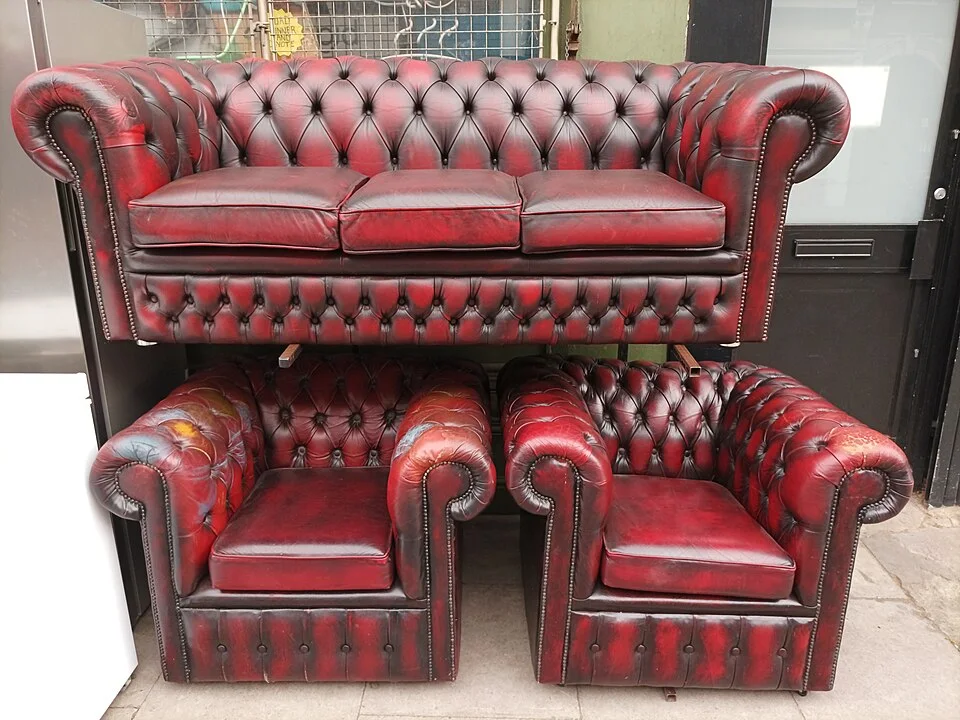
The broad view makes arms, cushion edges and tufted panels visible together, useful reference areas when mapping darkening and contact history. Photograph your own piece in ordinary broad light before selecting a treatment. This furniture’s red-and-dark appearance does not identify an aniline finish, prove a stain or distinguish deliberate colouring from wear; confirm the leather specification separately.
Photo & usage
Dominic's pics · CC BY 2.0 · Source. Display copies resized and encoded as WebP; no instructional details were fabricated or removed.
Write down when the mark first appeared and what touched it. Non-colorfast clothing, oily skin products and drinks create different questions. A gradual contact pattern is not automatically a removable stain, while a fresh wet patch deserves prompt attention even on a well-patinated chair. If the surface is sticky, cracking, flaking or unusually fragile, stop routine liquid care and ask about its condition before selecting a product.
Dust sound leather with restrained tools
Use a clean undyed soft cloth and the maker's permitted dry routine. For accessible seams, use only the authorized vacuum tool and setting, checking for rough edges or trapped grit. Avoid forcing the nozzle into piping or pulling a loose seam open. Keep cloths used for wood polish and kitchen cleaning away from the leather.
Do not brush the surface as if it were suede unless the actual product instructions require that technique. Remove jewelry and hard accessories that could mark the arm while reaching across it. If a decorative cushion or throw sheds dye, separate that issue from leather soil. A dark mark left by fabric contact may require transfer-specific advice rather than a stronger version of the regular dusting method.
Blot a fresh spill before choosing chemistry
Collect liquid promptly using clean white absorbent material, pressing and lifting rather than rubbing. Change to a dry area as it absorbs. Lift loose solids gently without scraping the grain. Keep liquid from spreading into seams, and do not add water around the boundary to dilute it unless the exact leather instructions prescribe that method.
Record the spill and anything already applied. A darkened patch can change as it dries, so avoid declaring a permanent stain during the first minutes. Equally, do not apply oil to the whole panel to make it equally dark. That changes the finish question rather than removing the spill. Where the maker directs professional care, stop after safe collection and provide the identity and event history to a leather specialist.
Follow the product's own panel-cleaning boundary
If the identified maker permits a damp or soap-based method, follow its exact preparation, application and dry-removal instructions. Carl Hansen & Son's guidance for specified natural-surface leathers warns that isolated spot treatment can create blotches and describes a whole-surface approach for those products. That instruction must not be converted into a universal home recipe for all aniline upholstery.
Test only as the actual maker directs on representative inconspicuous leather, complete the whole procedure and inspect after drying. Keep moisture controlled and avoid seams, wood trim and electrical mechanisms. Stop if color transfer, persistent darkening, tackiness or altered hand appears. A method that removes a visible spot while creating a larger boundary has not preserved the panel's appearance.
Compare patina and treatment outcomes carefully
| Observation | Working question | Next action |
|---|---|---|
| Gradual darkening at a frequently used arm | Is this expected patina, accumulated soil or both? | Ask using the leather identity and history |
| Fresh spill patch lightens during permitted drying | How much change remains after drying? | Wait for the specified assessment point |
| Blue contact mark follows dark clothing | Is dye transfer involved? | Seek finish-compatible transfer advice |
| Larger ring appears after local treatment | Has moisture or product created a boundary? | Stop repeating the spot method |
These invented examples are not tests or guarantees. They separate time, pattern and treatment response so a specialist can interpret the problem. Aniline's natural variation should not become an excuse to ignore a damaging spill, but a clean chair also need not have identical color on every panel.
Keep conditioner from becoming a color-matching tool
Use maintenance cream or conditioner only when the furniture maker specifies a compatible product and schedule. The cited Carl Hansen guidance cautions about overly frequent care-product use and color changes on worn or dirty leather. A product can darken an area while making it feel smoother, which does not establish that it removed soil.
Do not substitute cooking oil, hand cream, saddle products, shoe polish or a general leather balm without permission. Their suitability for another leather object does not establish upholstery compatibility. If a recommended treatment follows cleaning, keep the two stages separate in the record and allow the stated drying conditions between them. If a patch changes color after conditioning, the supplier needs to know exactly what was used and where, rather than hearing only that the chair became stained.
Use a panel map instead of a percentage-clean claim
For an illustrative chair, mark four equal-area observation zones on paper, two on the seat and two on the back. Suppose gradual darkening appears on one seat and one back zone. Two of four is 50 percent of those equal zones, but it does not mean half the leather is dirty or that cleaning will restore a uniform shade.
The map simply helps preserve location. Note the character of each zone: gradual contact darkening, fresh spill outline, clean-looking variation or damaged seam. Take photographs with the same lighting and avoid rotating cushions between comparisons without recording it. Keep any dimensions descriptive rather than converting them into a conditioner dose. The actual product instructions, surface condition and construction decide application.
Decide what to accept and what to refer
Ask the maker which changes are expected for the named leather and which require cleaning or repair assessment. A stable patina may be acceptable and desirable. A recent dye transfer, sticky coating or sharply changed texture asks a different question. For significant staining or uncertain identity, use a specialist experienced with the leather category rather than a generic carpet-cleaning process.
Discuss likely limits before treatment, including the possibility of persistent color variation. Keep heat, strong sunlight and non-colorfast textiles away as the maker recommends, without claiming that one placement change can reverse existing marks. Completion means loose soil and manageable spills have been handled within the finish's limits, the panel is dry under the authorized conditions and any remaining patina or stain has an informed acceptance or treatment decision.
THE REFERENCE FILE
Sources & scope
Documentation reviewed 1 Nov 2026. Examples are illustrative; this article does not claim hands-on product testing. Follow the instructions for your actual material, model and location.