Viscose rugs often have a silky reflection that changes with pile direction. A spill can alter both color and texture, and an attempt to rinse out a small mark can enlarge the visible boundary. Before using a carpet spray or extraction machine, identify the fiber and check the rug's explicit instructions. The label bamboo silk may describe a regenerated fiber rather than conventional silk.
The household task is limited but useful: collect the fresh spill, prevent additional disturbance, record the construction and arrange the appropriate next step. This guide does not promise that a water mark can be reversed. Some appearance changes can persist even after deposited soil is removed, so the definition of success must include preserving the remaining pile.
Identify regenerated fiber and blends
Read the full composition and care label. Look for viscose, rayon, bamboo silk, Tencel or other named fibers, and ask the retailer to clarify trade terms. A wool-viscose rug cannot automatically receive the same method as a wool-only rug. Note the percentage blend, backing and binding, but do not assume a small proportion of sensitive fiber is unimportant.
WoolSafe's fine-fiber guidance says blends should be treated according to the most sensitive component, explicitly discussing wool-viscose combinations. Warwick's viscose care label prohibits liquid spot cleaners, including water, for its viscose and bamboo-silk rugs while directing spills to immediate blotting and professional care. Nordic Rug supplies its own viscose instructions. Use the actual product's stricter relevant requirement rather than selecting the most convenient permission from another brand.
Collect liquid without scrubbing the pile
Blot promptly with clean white absorbent material. Press and lift gently, changing to a dry area as it wets. Do not rub from side to side or massage liquid into the fibers. Lift loose solids with a suitable soft edge only when this does not catch the pile. Leave firmly adhered material for a specialist if removing it would pull fibers.
Do not add water to chase the boundary. Avoid dish detergent, bleach, vinegar, solvent and general carpet spot products unless the actual rug instructions specifically authorize a named process. For a Warwick-labelled rug covered by the cited instructions, household liquid spot cleaning is outside the permitted route. Immediate blotting removes existing liquid; it does not imply that adding a new cleaning solution is safe.
Record the mark before changing its orientation
Photograph the dry or drying rug from more than one direction, noting the pile orientation and spill location. A patch can appear lighter or darker as the viewpoint changes, so a single image can misrepresent the condition. Include an overall view showing furniture, edges and nearby seams as well as a close view.
Write down the spill substance, approximate timing and anything already applied. If someone rubbed the area with a wet cloth, say so. A new ring may relate to the attempted treatment as well as the original spill. Do not hide that history by turning the rug before a specialist sees it. Orientation changes can make the mark less visible without correcting the underlying texture or color change.
Check backing and floor with supported handling
Where safe and practical, inspect beneath the affected area without sharply folding or dragging the rug. Ask for help with heavy furniture or a large rug. The floor and underlay may require their own response if moisture has passed through. Do not infer that the underside is dry because the visible pile has begun to lighten.
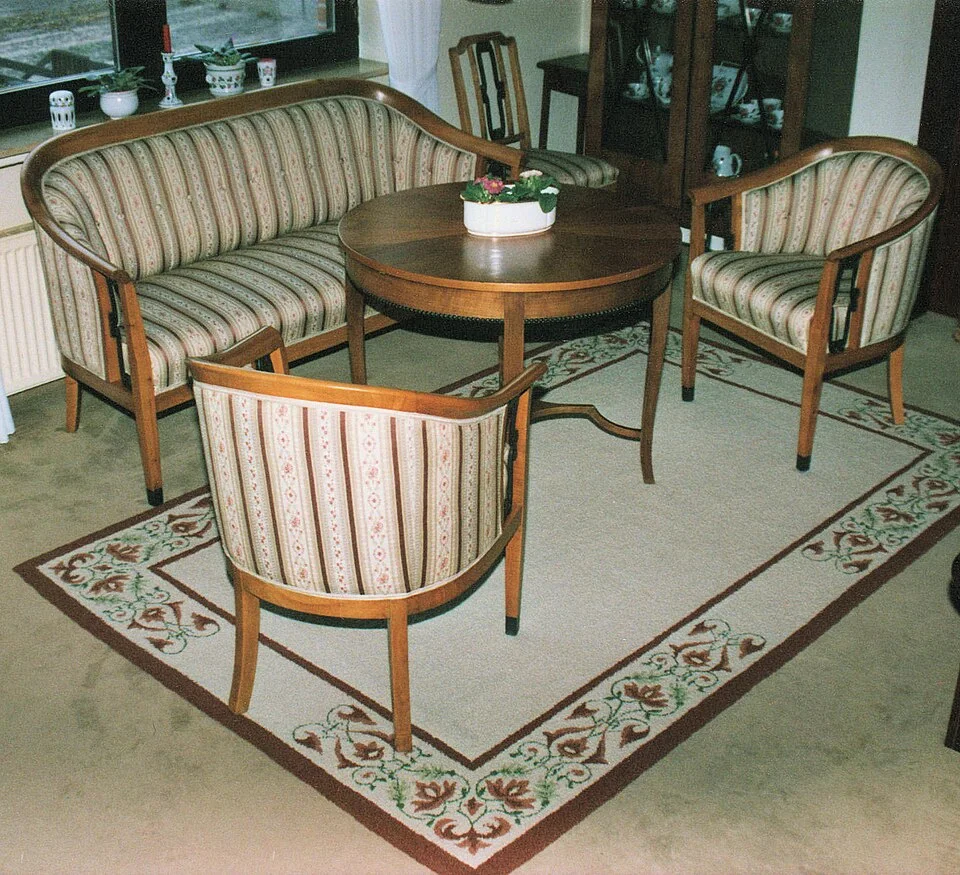
The reference shows the relationship between a rug, table and seating. It does not identify viscose, show a water mark or demonstrate safe lifting of a wet rug.
Photo & usage
Kinna2 · CC BY-SA 4.0 · Source. Display copies resized and encoded as WebP; no instructional details were fabricated or removed.
Follow the rug supplier's support and drying instructions. Avoid leaving a wet patch trapped under a solid protective sheet or a heavy object. Keep the area out of use while the condition is unresolved. If you cannot inspect safely, tell the specialist that moisture below the rug has not been checked. That is a useful limitation, not something to conceal behind a claim that the rug has dried completely.
Vacuum only as the product permits
For dry routine debris, choose the stated low-suction setting and appropriate attachment. Warwick specifies low suction in one direction for the products covered by its label. Check that the nozzle is clean and smooth, and avoid fringe, loose edges and damaged pile. Do not use a powered brush simply because the vacuum manufacturer labels it suitable for rugs generally.
Keep ordinary dry vacuuming separate from spill collection. Do not pass a dry household vacuum over wet material. If the tool pulls fibers or the pile changes under light contact, stop. Fine loose fibers on a new rug may be described by the maker as expected shedding, but a sudden localized bald or rough patch after rubbing is a different observation. Report that distinction rather than vacuuming repeatedly until the surface looks uniform.
Compare the remaining appearance without another treatment
| Observation | What remains uncertain | Useful next step |
|---|---|---|
| Mark reverses light and dark with viewpoint | How much is pile direction versus deposited soil? | Send photographs from both directions |
| Boundary grows after a water wipe | Has moisture moved soil or changed fiber appearance? | Stop liquid treatment and disclose the sequence |
| Fibers feel rough or flattened at the spill | Is a persistent pile change present? | Request specialist assessment |
| Backing or underlay remains damp | What drying method suits the assembly? | Arrange prompt construction-specific advice |
These invented examples guide observation, not a diagnosis or removal guarantee. A specialist may identify several contributing causes. Keep the fabric composition and earlier products available so their proposed process can address the actual rug rather than a generic silky carpet.
Choose a specialist by material experience
Ask whether the cleaner handles viscose and the particular blend, backing and dye system. Request an explanation of the proposed process and its limits, including possible persistent texture or color differences. A person skilled with synthetic fitted carpet may use different techniques and equipment from those appropriate to a fine-fiber rug.
Where the maker specifies professional dry cleaning, share that requirement explicitly. The term dry cleaning can describe different processes, so confirm the proposed method complies with the product instructions rather than relying on its name. Ask how the floor and surrounding furnishings will be protected if treatment occurs in the room. Do not promise that professional attention will make every mark disappear; the purpose is an informed compatible treatment decision.
Use measurements to describe change honestly
Imagine an illustrative spill boundary initially measured as a 10-by-10-centimeter rectangle and later as 15 by 15 centimeters after an attempted water wipe. The bounding areas are 100 and 225 square centimeters. The latter is 2.25 times the former, an increase of 125 square centimeters or 125 percent.
These invented measurements demonstrate why length and area changes are different. They are not data from a tested rug and do not establish how deeply moisture travelled. If your actual mark changes, record its outline, time and treatment history with photographs. Do not keep repeating the water wipe to improve an expanding boundary. Growth in the visible zone is evidence to stop the experiment and seek advice.
Close the response with a realistic endpoint
Keep the rug out of use until the authorized drying and treatment requirements are met. Inspect pile, edges, backing and floor where practical without claiming internal dryness from appearance alone. After professional work, compare under the same lighting and orientation used in the starting record.
A remaining water mark or pile difference may require acceptance or replacement advice rather than another spot product. Record that outcome separately from removed soil. Future care should use the documented routine, prompt blotting and sensible placement away from likely spills. Completion means that the event has been handled within the rug's limits and the remaining condition is understood, not that a silky-looking material has been forced to behave like washable synthetic carpet.
THE REFERENCE FILE
Sources & scope
Documentation reviewed 1 Nov 2026. Examples are illustrative; this article does not claim hands-on product testing. Follow the instructions for your actual material, model and location.