A hard-to-push head is a reason to reassess
A floorhead that grips a rug can make extra pushing seem like the simplest solution. Stop before forcing it. Excessive resistance, a stalled brush or unusual noise deserves a check of the surface and tool instructions. Do not repeatedly drive a powered brush into the same resistant patch or bypass a protective shutdown.
Identify the rug's care requirements and the exact vacuum head. High pile, loose fibres, fringes and delicate construction may have restrictions that the vacuum's general all-floor description does not resolve. A compatible fitting on the wand establishes connection, not suitability for every textile.
Dyson DC47 operating manual instructs users of the covered DC47 to follow floor and carpet guidance and limits maintenance to documented actions. Its model context matters. A suction-release or brush control on one head is not necessarily present or appropriate on another. This guide helps choose a user-level response without opening the head or modifying it.
Record enough detail to ask the right question
Write the machine model, head name or compatible part identifier, and the surface where resistance occurs. Note whether the same head moves normally on another permitted surface. Keep fringes and loose edges clear as the rug and appliance instructions require. Do not test the head on a valuable delicate area simply to see what happens.
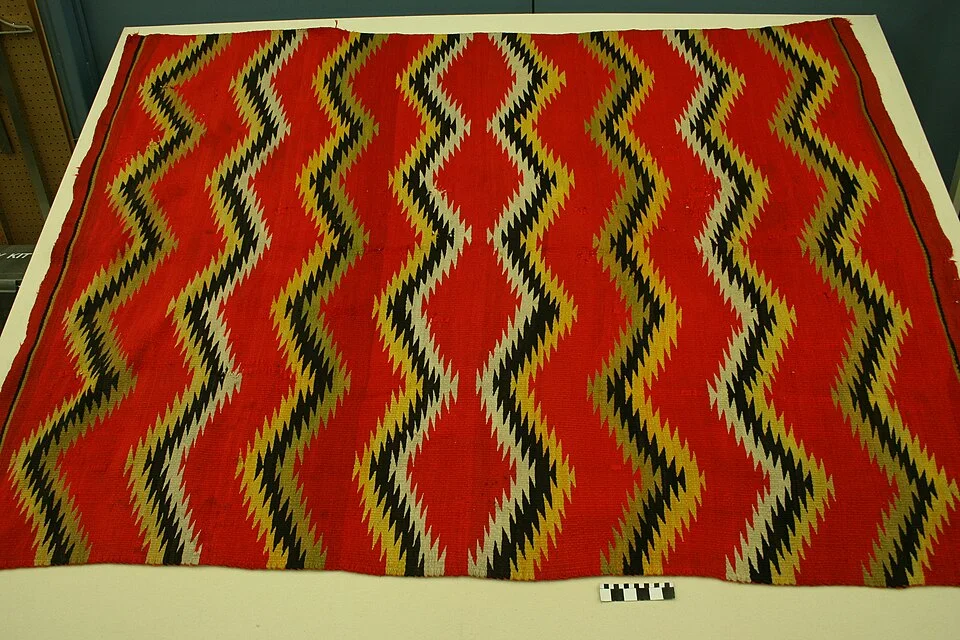
The flat rug view exposes its woven field and edges, features to identify before asking about resistance or tool choice. Use the actual rug’s care instructions and the vacuum-head manual to establish permitted contact. This museum textile reference is not a cleaning demonstration and supplies no compatible head setting or suction measurement.
Photo & usage
Unknown authorUnknown author · Public domain · Source. Display copies resized and encoded as WebP; no instructional details were fabricated or removed.
Photograph the accessible head label or control if useful, with the machine off and isolated as instructed. Do not remove a service cover to find a part number. If the head is damaged, has exposed wiring or will not attach correctly, stop and obtain suitable support rather than proceeding with a settings comparison.
Dyson V15 Detect owner guide, Singapore distinguishes hard-floor and carpet-oriented heads in its V15 Detect owner guidance. That is a useful example of tool specialization, not a universal compatibility chart. The exact head and regional variant supplied with your machine may differ. Confirm through the actual manual or manufacturer rather than a visually similar online listing.
Adjust the permitted user setting once
If the actual instructions provide a suction control, floor-type setting or head adjustment for the surface, follow it. Record the original and revised states. Do not assume lowering motor power and opening a head's suction gate are equivalent changes. They can affect different aspects of operation and are not available on every product.
Dyson model-specific troubleshooting, product 447329-01 notes that some covered floor tools have a suction-control slider and that brush stopping on certain carpets can be protective. Keep that statement attached to the covered equipment. It does not authorize adding a hole, removing a seal or using a screwdriver to create a homemade release.
With the machine assembled correctly, try only a small ordinary area that both surface and appliance instructions permit. Keep the test brief. Stop for continued excessive resistance, brush stopping, damage or unusual behavior. Do not make finishing the room a condition for accepting that this head-and-surface combination needs another approach.
Compare behavior without assigning a suction number
The scenarios are illustrative and invented. They are descriptive observations from hypothetical permitted use, not tests of rug damage or vacuum performance. No force or suction-pressure measurement has been made.
| Setup | Observation | Next question |
|---|---|---|
| Original permitted setting on rug | Excessive resistance | Is another documented setting or tool suitable? |
| Documented alternative setting | Moves normally on small area | Does ordinary pickup remain acceptable? |
| Alternative setting but brush stops | Protection or fault indication remains | Stop and consult the model guidance |
Easier movement does not prove a measured improvement in cleaning or establish that every part of the rug is suitable. The final row should not be interpreted as an invitation to keep lowering resistance until protection no longer operates. It is a boundary for user-level experimentation and a reason to ask for the appropriate next step.
Movement and pickup need separate observations
If a documented setting permits normal movement, inspect the ordinary visible debris result on the small allowed area. A head gliding easily while leaving debris may not provide a satisfactory routine. Do not add sand, powder or other material to quantify pickup. This household comparison does not need a manufactured challenge or a percentage-removal claim.
Check the rug for visible disturbance using ordinary observation, and stop if fibres pull, edges lift or the surface changes. Follow the rug maker's care advice. A vacuum manufacturer cannot override a textile restriction simply because its tool attaches and runs. Seek clarification for valuable or unfamiliar materials.
Keep power mode, head setting and technique in the record. If several change together, describe the final workable combination without attributing success to one control. Do not claim that reduced resistance means reduced electricity use or less wear; neither has been measured by a pushability observation.
Do not turn a surface problem into disassembly
If the manual provides a user blockage check, follow its isolation and access precautions separately. Keep hands away from powered brushes and do not reach into moving parts. Do not cut components, lubricate a head or open a motor housing because it seems to drag. Those actions exceed an ordinary setting decision.
If the same head is unusually resistant across multiple permitted surfaces, or it behaves differently after damage, contact support. Provide the exact head, settings, surface and alerts. A surface-specific record helps distinguish a compatibility question from a wider equipment concern without diagnosing an internal part.
Do not use a dry-only vacuum on a damp rug or attempt to clean liquid left from another treatment. The surface must meet both care and appliance requirements. If no compatible permitted head or setting is available, choose another appropriate care method rather than forcing the existing tool to complete the job.
Leave a surface-specific instruction the household can use
Make a short map linking the actual rug or floor area to the permitted head and setting, with the relevant manual reference. Include restrictions such as fringes, delicate edges or a different tool requirement. Keep the note with the accessories so the correct choice is easy to repeat.
A successful endpoint is normal manageable movement, an acceptable ordinary visible result and no concerning surface or appliance behavior under the documented setup. If the result is unresolved, the completed household task is a precise compatibility or service enquiry. It does not require proving a measured suction defect.
Recheck after a rug, head or machine replacement. A setting that worked for one combination should not survive automatically as a universal house rule. The practical achievement is a correct tool decision and a clear stop boundary, not a method for overpowering every surface the vacuum encounters.
Use a concise setup description
A useful enquiry states the machine and head identities, the rug's known care restrictions, the original setting, the documented alternative and what happened on the small permitted area. Include a still image of the head control if accessible. Ask whether that exact combination is supported and what alternative is recommended.
Avoid sending only a video of someone forcing the head across the rug. That demonstrates resistance but leaves the important compatibility facts unknown and risks further damage. A concise record allows the manufacturer or rug specialist to answer the relevant question without asking the household to repeat unsuitable operation.
THE REFERENCE FILE
Sources & scope
Documentation reviewed 1 Nov 2026. Examples are illustrative; this article does not claim hands-on product testing. Follow the instructions for your actual material, model and location.