Two appliance labels can show different annual dollar estimates because they use different price assumptions or describe different products. Comparing the printed dollars alone can obscure the energy difference. Start with equivalent service, the annual energy figure and a common stated electricity rate.
This guide is a record-building method for comparison, not a recommendation to purchase a particular appliance. Use official model information and preserve the label's test basis. Household use and tariff structure can differ from the assumptions behind an annual label estimate.
Check that the products provide comparable service
Record the exact model, useful capacity and functions for each candidate. A smaller appliance doing less work may use less annual energy without being the right replacement. Keep features affecting the household's task visible rather than reducing the comparison to a single consumption number.
Check the category and label system. Do not treat annual kWh from one test regime as directly equivalent to a per-cycle figure from another without a stated conversion and comparable assumptions. Washing-machine, refrigerator and television labels can use different service bases.
The FTC — Energy Labeling Rule describes the role of standardized labeling information. It does not make all products interchangeable or guarantee that two labels from different markets or years have identical comparison conditions. Obtain the relevant current official model label and note any basis mismatch before calculating a cost difference.
Copy energy and price assumptions into separate fields
Record annual kWh where the label actually provides it. Copy the printed cost, assumed energy price and stated use basis separately. Keep the source document or official model page so the figures can be checked without relying on a remembered shelf tag.
FTC — How to Use the EnergyGuide Label to Shop for Home Appliances explains that EnergyGuide operating cost is an estimate affected by local price and use. Repricing annual energy can improve consistency, but it does not turn the result into a forecast of the household's exact bill. Keep that limitation beside the comparison.
Do not derive annual kWh from a rounded dollar estimate when the energy figure is available directly. Working backward through a rounded cost introduces unnecessary error. If only a cost is available, identify the missing information and obtain a better source rather than guessing the label's price assumption.
- Save each exact model’s complete official label, including units and comparison category.
- Keep annual kWh, printed USD cost and the label’s assumed energy price in separate fields.
- Reprice only comparable energy figures at the stated common rate and preserve household-use limitations.
Choose one relevant electricity-price scenario
Use a stated rate in USD per kWh for both models. For a real decision, identify the applicable avoidable energy components from the household tariff. Keep fixed charges outside a simple appliance comparison because they generally do not change merely because one model consumes less energy.
If the tariff varies by time or tier, a single rate is a simplifying scenario. State that clearly and consider a plausible rate range when timing or marginal block is unknown. Do not present a whole-bill average as the exact price of every future appliance kWh.
EIA — Measuring Electricity distinguishes energy from power. An annual kWh label is already an energy amount over a defined year; do not multiply it by operating hours again. Conversely, a watt rating alone is not an annual energy label and cannot enter the same column without a supported time model.
Work through an illustrative annual comparison
All figures here are illustrative. Model A is listed at 410 kWh per year and Model B at 335 kWh per year under an assumed comparable test basis. Their difference is 75 kWh per year. At a common USD 0.24 per kWh, the modeled energy costs are USD 98.40 and USD 80.40.
The annual difference is USD 18.00, also calculated as 75 × USD 0.24. At USD 0.16 per kWh, the same energy difference is USD 12.00. At USD 0.32, it is USD 24.00. The energy comparison is unchanged; the monetary scenario changes with price.
These are not current product specifications or promised household savings. They exclude differences in actual usage, maintenance, installation and other ownership costs. The useful conclusion is the energy and cost difference under the stated common basis, not a claim that the printed label dollars will match an individual bill.
Handle per-cycle labels without inventing annual use
If a source gives kWh per cycle or per hundred cycles, keep that unit explicit. Convert to energy per comparable cycle first, then multiply by a supported or clearly assumed annual cycle count. Different household frequencies can change annual energy substantially.
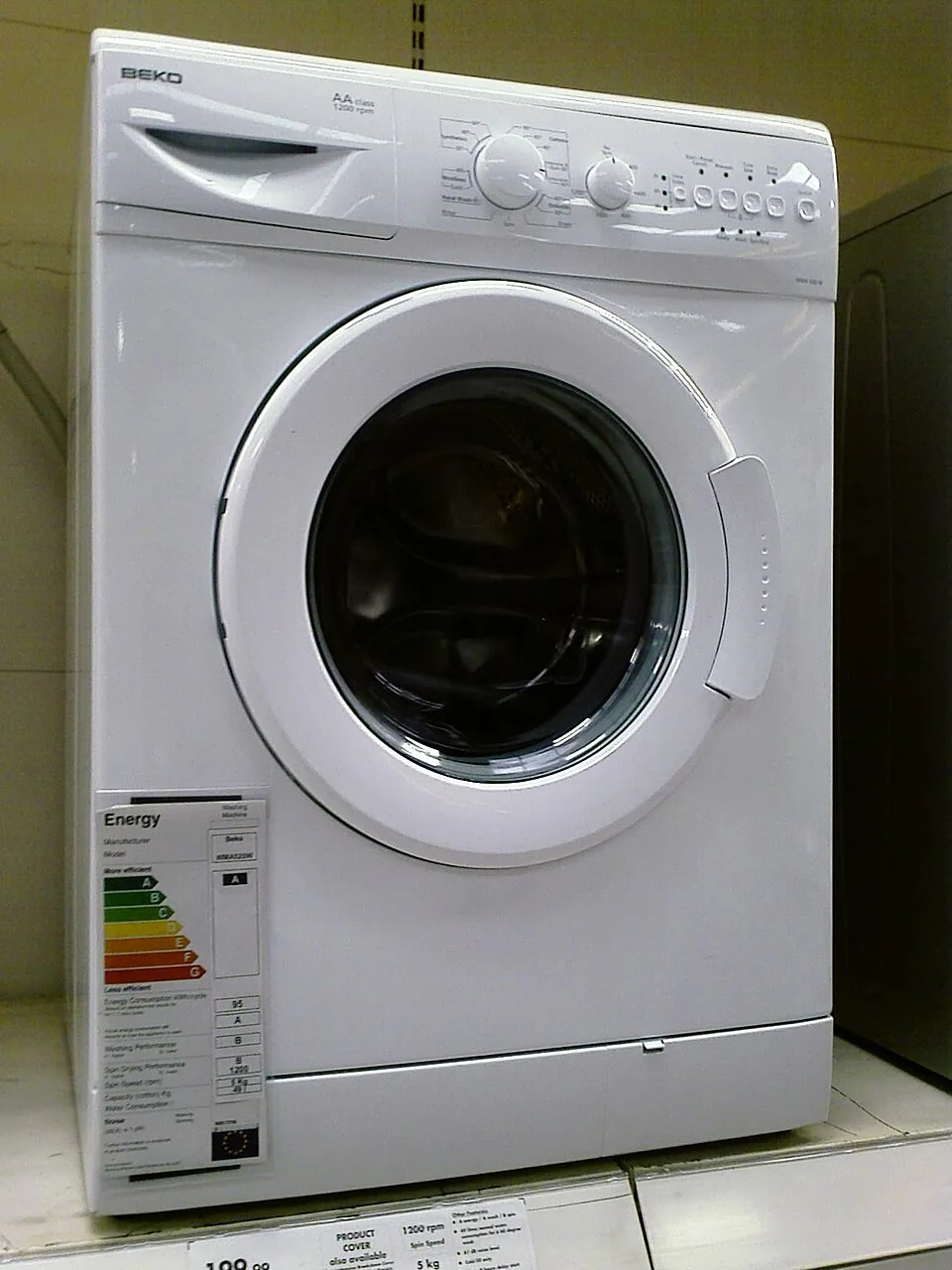
The attached label separates a coloured efficiency class from numeric consumption and performance fields. Preserve the actual official model information and read its energy unit and test basis at a legible size. Do not turn a class letter or a field from another appliance into the candidate’s annual energy; retain the supported cycle count separately.
Do not compare a per-cycle number from one program with another program simply because both belong to the same appliance. Capacity, settings and test conditions matter. Preserve those details and avoid claiming equivalence when the official information does not support it.
A checked image of a washing-machine label from another label system can illustrate where units are printed, but it cannot serve as the specification for the candidates. Copy the real models' figures from their own official documentation. Keep the visual reference and the evidence source in separate roles.
Add purchase cost only as a separate decision layer
Record verified total acquisition costs for a real purchase, or clearly labeled illustrative USD values. Include necessary delivery, installation or disposal costs where relevant and known. Do not subtract an assumed rebate unless eligibility and terms have been checked for the actual decision.
Compare any incremental purchase price with the modeled annual energy difference, retaining uncertainty. A simple payback is a screening calculation, not a guarantee of appliance life, future tariff levels or realized household savings. Keep service suitability and repair considerations separate.
Do not recommend replacing a functioning appliance solely because another label has lower annual kWh. The decision needs the actual current equipment's condition and consumption boundary, as well as the candidate's service. Label-to-label comparison can support a purchase choice already under consideration without proving that immediate replacement is justified.
Check the comparison range printed on the label
The label’s comparison scale refers to a defined group of similar products, not every appliance on the market. Record the capacity or category description used by that scale. A position near one end does not establish that a model has the lowest absolute annual energy across products providing different service.
Keep a photo or official copy of the complete label rather than cropping only the large dollar figure. The smaller unit, model and use-assumption fields often explain why two apparently comparable numbers differ. A missing label detail is a reason to obtain the full source before ranking candidates.
If one candidate has an annual figure and another reports energy per one hundred cycles, first determine whether a genuinely comparable service basis can be formed. An assumed annual cycle count may support a clearly labeled scenario, but it does not erase differences in program, load or test procedure. Pause the direct ranking where the documents cannot establish equivalence rather than choosing the smaller-looking number.
Complete a comparison that another person can reproduce
Save exact model identities, label versions, energy units, test-basis notes and the common rate scenario. Recalculate the difference both from the two model costs and from the kWh difference times rate. Agreement checks arithmetic but does not remove uncertainty in the assumptions.
Write the conclusion with its conditions: Model B has a lower standardized annual energy figure by a stated amount, and that difference corresponds to a stated USD range under the selected rates. Avoid calling that range a measured saving.
Completion means the comparison holds service and price assumptions consistently enough to answer the intended question. Where the labels are not comparable, record the missing information and pause the monetary verdict. A clear mismatch is more useful than a confident ranking built from unlike units.
THE REFERENCE FILE
Sources & scope
Documentation reviewed 1 Nov 2026. Examples are illustrative; this article does not claim hands-on product testing. Follow the instructions for your actual material, model and location.