Two humidity percentages can point the wrong way
An outdoor display says 80% RH while the room meter says 60%. That does not automatically mean the outdoor air contains more water vapour. Relative humidity depends on temperature. Cool outdoor air can have a high percentage and still carry less moisture than warmer room air. Warm, humid air can also make a cool room wetter despite an outdoor percentage that looks moderate.
Before opening a window to tackle dampness, identify the aim: remove an indoor moisture event, improve ventilation during an activity, or cool the room. One opening may help one aim while complicating another. A window is not a repair for rain entry or a replacement for a designed ventilation system.
National Weather Service: Dew Point vs Humidity explains dew point as a temperature linked to atmospheric moisture. You do not need to memorize a psychrometric chart to use it responsibly. Start by recording the outdoor dew point and its timestamp beside the indoor temperature and RH.
Use current local information without pretending it is exact
Use a current local weather observation, preferably from a nearby official station, for outdoor temperature and dew point. Record the station or location and observation time. A station several kilometres away may not describe a shaded courtyard, coastal exposure or a rain-cooled wall perfectly. Treat it as context rather than a measurement at your window.
For indoor dew point, use a meter that provides it or a reputable calculator accepting your room temperature and RH. Keep the original inputs so you can review the result. Do not enter degrees Fahrenheit into a Celsius field. If the meter has uncertain accuracy, the calculated dew point inherits that uncertainty and should not be reported with impressive decimal places.
Take the indoor reading away from direct sun, a heater or the open window. Follow the instrument's settling instructions. A meter temporarily cooled by incoming air can produce a dramatic change that describes the draught instead of the room you intend to assess.
Read two very different airing opportunities
This illustrative comparison uses invented household conditions and rounded dew points supplied as scenario inputs. It is an observation exercise, not a forecast or measured trial. The same room has an indoor dew point of 14°C on both occasions.
| Situation | Indoor dew point | Outdoor dew point | Moisture implication |
|---|---|---|---|
| Cool dry-air opportunity | 14°C | 6°C | Incoming air has lower vapour content at similar pressure |
| Warm muggy afternoon | 14°C | 20°C | Incoming air has higher vapour content at similar pressure |
The differences are 8°C lower outdoors in the first case and 6°C higher outdoors in the second. These gaps are not drying rates. Airflow, opening size, time and surface temperatures still determine what happens. The second case is a reason to reconsider window airing as a drying method, especially in a cool room, rather than to assume that all outdoor ventilation is undesirable.
Make the weather decision include more than moisture
Before airing, check current outdoor-air advice and immediate conditions around the opening. Nearby smoke, vehicle exhaust, construction dust, heavy rain or a security concern can override an otherwise useful dew-point comparison. Follow local incident guidance rather than using this household method as a reason to disregard an alert.
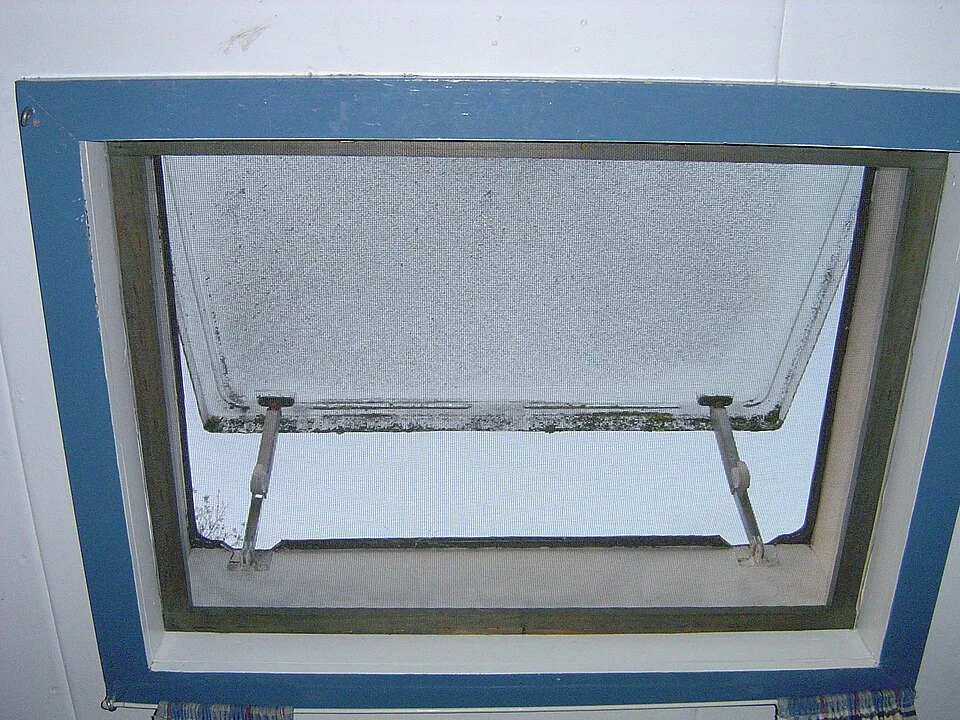
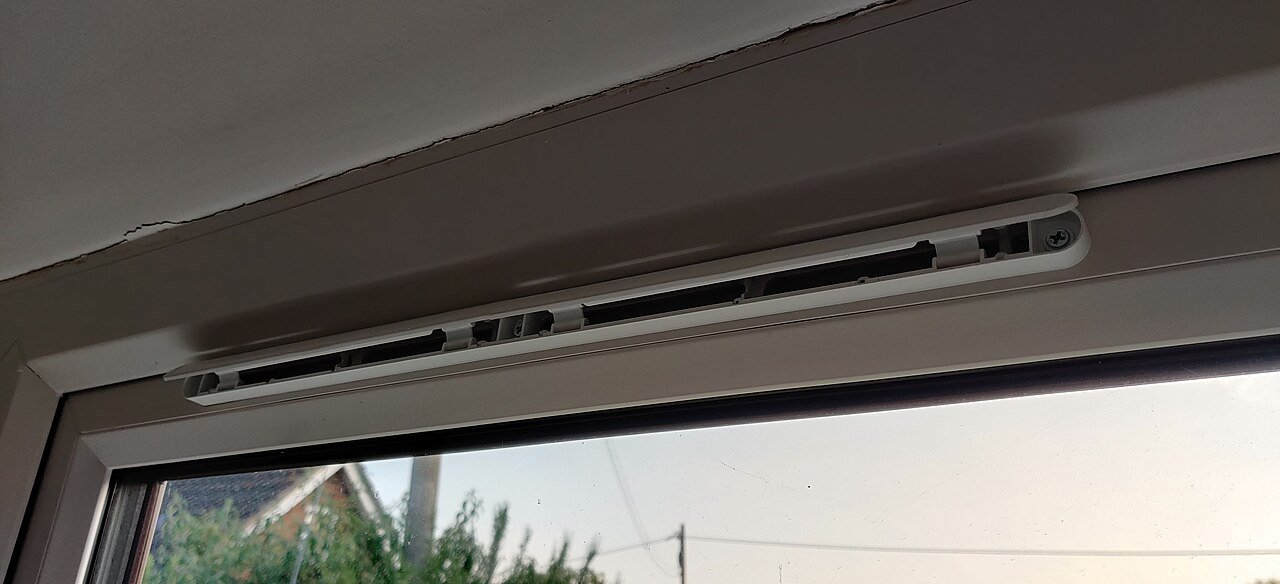
The mesh screen and opening hardware show physical details to consider alongside weather advice. Check current smoke, exhaust, rain, security and permitted operation at your actual accessible opening; a favourable dew-point difference does not override those conditions. The photograph does not establish safe reach, model permissions or outdoor-air quality, and it is not an instruction to alter a restrictor or screen.
Photo & usage
Maniago · Public domain · Source. Display copies resized and encoded as WebP; no instructional details were fabricated or removed.
EPA: Improving Indoor Air Quality notes that outdoor sources matter when considering ventilation. A favourable moisture difference does not certify the incoming air. Conversely, a humidity problem during poor outdoor-air conditions calls for source control and suitable existing mechanical systems, not a claim that the household must choose between two unsafe extremes.
Open only windows that can be used safely and as intended. Do not defeat restrictors, lean outside or prop a fire door to create a cross-draught. Keep children and pets away from openings. These practical limits belong in the plan before you decide how long to observe, because they determine which options are actually available.
Make one opening answer one question
If conditions support airing, note when the opening starts, which other doors are in their ordinary positions and whether extraction or air conditioning is running. Use a short observation interval suited to comfort and conditions. There is no universal number of minutes that exchanges every room's air or removes a specified amount of water.
Observe the original problem: does the shower-related rise begin to recover, does a cool surface become wetter, or does the room simply become colder? Keep the meter away from the incoming jet. Record temperature with RH and allow the room to settle after closing the window before judging the longer result.
Do not leave rain entering to preserve an experiment. Stop if comfort deteriorates or surfaces begin collecting water. Mark the interruption honestly. A stopped observation can still establish that this particular airing method was unsuitable under those conditions, which is a more useful result than continuing toward a neat but misleading graph.
Be particularly cautious around cool materials
A basement or heavily cooled room can contain surfaces colder than the incoming air's dew point. Moisture may then collect on those surfaces even though opening the window feels refreshing. Observe accessible pipes, masonry and floor edges without entering crawl spaces or opening construction. Surface temperature, where measured with suitable equipment, is different from room air temperature.
PNNL Building America: Whole House Ventilation Strategies for Existing Homes specifically treats the humidity load of additional ventilation as a design consideration. Its guidance supports asking a qualified ventilation professional how the home's system should operate in a humid climate. It does not supply a universal window schedule for every basement or apartment.
If warm-weather airing repeatedly coincides with new droplets or damp storage, stop treating more open-window time as the automatic answer. Reduce avoidable moisture sources and request advice on the existing cooling, dehumidification or ventilation arrangement. Persistent water, damaged finishes or rain-related wetness requires investigation beyond a dew-point comparison.
Finish with a conditional household routine
Write a routine with conditions rather than a rigid clock rule. For example: check outdoor dew point and air-quality advice before using this window for drying; record the room's recovery; use intended extraction for moisture-producing activities. Add the situations when the window stays closed, including driving rain and a relevant outdoor-air advisory.
Completion means the household can explain why an opening helped on one day and might not help on another. Keep a few representative entries, including an unsuccessful or interrupted attempt. Recheck the routine as seasons or cooling habits change. A successful cool-weather comparison cannot be assumed to apply to a muggy summer evening.
Do not call the room safe because its dew point fell or its RH reached a preferred range. The result only describes part of the moisture picture. A good airing decision protects the practical purpose of ventilation while recognizing that outdoor conditions and cold surfaces set real limits on window-based drying.
THE REFERENCE FILE
Sources & scope
Documentation reviewed 1 Nov 2026. Examples are illustrative; this article does not claim hands-on product testing. Follow the instructions for your actual material, model and location.