Two periods can use the same electricity total and produce different energy charges when the timing changes. A time-of-use record must preserve when the kWh occurred and which price period applied. A monthly average price cannot explain that difference on its own.
Begin with the account's official plan and interval data where available. This guide is an accounting exercise, not a recommendation to change equipment operation. Keep manufacturer instructions, household needs and any supervision requirements intact when considering whether a task can move to another time.
Copy the clock rules for the applicable plan
Record the plan name, effective dates and the peak, off-peak or other defined periods. Include weekday, weekend, holiday and seasonal distinctions where the actual schedule uses them. Do not assume peak means the same hours on every supplier's plan.

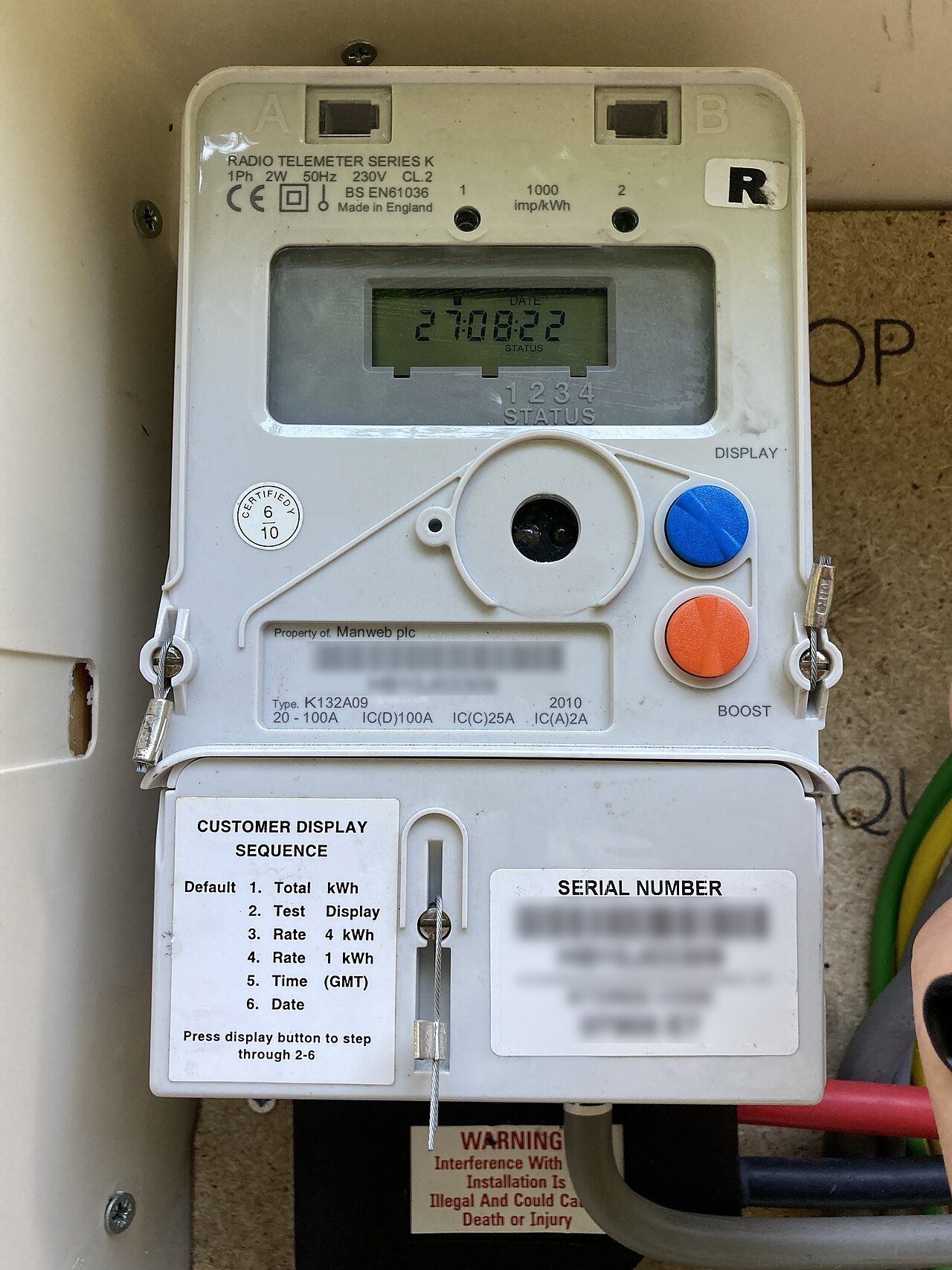
The face distinguishes two kWh registers with the numbers 1 and 2. Preserve those identifiers when copying readings for a time-of-use comparison. Their presence does not reveal the supplier’s peak hours, holidays or seasonal schedule; obtain the applicable plan rules and timestamp convention before assigning consumption to a price period.
Photo & usage
Milicevic01 · CC BY-SA 4.0 · Source. Display copies resized and encoded as WebP; no instructional details were fabricated or removed.
Southern California Edison — Time-of-Use Plans describes time-of-use options with plan-specific timing. Use the official schedule for the account being analyzed rather than importing its example hours elsewhere. Save the relevant version because a later price or clock-rule change can invalidate a comparison built from memory.
Check how the data timestamps represent intervals. A row labeled 17:00 may describe energy beginning then or ending then. That convention affects assignment at a boundary. If the portal or download does not explain it, obtain clarification before classifying an hour as peak or off-peak. One shifted row can matter when a short high-use task sits at the boundary.
Verify the interval file before pricing it
Check that the download covers the exact period and uses kWh for each interval rather than average kW. Record the interval length, time zone and any daylight-saving convention. Keep estimated or missing-data flags where provided instead of deleting them to make the file look complete.
Add the interval energy and compare it with the relevant billed total, allowing for documented scope and precision differences. Do not expect a net-metering or export file to equal ordinary imported consumption without understanding its fields. A cost model built on the wrong energy stream can still produce plausible USD totals.
Portland General Electric — Understanding My Bill explains that time-based energy charges appear in different rate periods for its applicable plans. The principle is to retain those categories in your own record. If only billed period totals are available, use them for a period-level comparison and state that individual task timing cannot be reconstructed from those totals alone.
- Confirm whether each downloaded row contains interval kWh or average kW.
- Retain timestamps, interval length, time-zone convention and missing or estimated flags.
- Reconcile the relevant energy total before assigning quantities to the plan’s price periods.
Define what actually changes in the scenario
For a timing-only comparison, keep total kWh constant and move a stated quantity between price periods. For an efficiency comparison, change energy quantities separately. Combining both can be useful, but label the two effects so reduced consumption is not mistaken for a timing benefit.
Identify whether the task can move in practice without changing its service or violating instructions. A clock-based estimate is not permission to run equipment unattended, interrupt a necessary function or override a manufacturer's operating requirements. If moving the task is unsuitable, retain the timing and examine another option.
The PG&E — Understand Your Bill explanation distinguishes time-of-use and other charge concepts. Check whether an allowance, credit or separate usage component also applies before claiming a full-bill result. Keep fixed charges and unrelated account adjustments outside a simple timing-only energy comparison unless they are explicitly modeled.
Calculate an illustrative unchanged-energy shift
All quantities and prices here are illustrative. A period contains 90 peak kWh at USD 0.30 and 210 off-peak kWh at USD 0.15. The energy charge is USD 27 + USD 31.50 = USD 58.50 for a total of 300 kWh.
Moving 30 kWh from peak to off-peak changes the quantities to 60 and 240 kWh. The charge becomes USD 18 + USD 36 = USD 54. The difference is USD 4.50, also calculated as 30 × (USD 0.30 − USD 0.15).
The household has not reduced total energy in this example. It has changed the modeled timing. The calculation excludes other tariff features and assumes the shift is feasible without changing kWh. If moving a task changes its operating conditions or use frequency, measure or estimate those effects separately rather than claiming the same simple difference automatically applies.
Handle boundaries and partial intervals honestly
A task spanning two price periods needs an allocation of its energy, not merely its start time. A high-power stage at the beginning can make a uniform-by-minute split inaccurate. Use appropriate interval or task data where available and label any approximation.
Do not assign the whole task to the cheaper period because most of its duration falls there. Likewise, do not price all energy at the peak rate simply because the task began during peak. Preserve the evidence that supports the split and state when the available data cannot resolve it.
If an interval crosses a clock boundary, follow the supplier's documented treatment or use finer data where available. Household approximations can support a rough decision but should not be presented as an exact bill reproduction. Keep the original interval data so the assumption can be revised without losing the source record.
Decide whether timing uncertainty changes the choice
Compare a conservative and a favorable allocation when the task energy split is uncertain. Use the same verified rates and state which kWh can plausibly move. If the practical decision changes only under the most favorable assumption, obtain better data before buying a timer or changing a routine for monetary reasons.
Keep convenience and necessary availability visible. A modest energy-charge difference may not justify a complicated household schedule, while a simple permitted timing change may be worthwhile without a purchase. The record should support that judgment rather than imply every off-peak opportunity must be used.
Do not infer device-level savings from a lower whole-house bill alone. Weather, occupancy, rate changes and other tasks may also have changed. Use the timing ledger to identify the modeled contribution and preserve the distinction between that scenario and a measured before-and-after result.
Keep energy quantity distinct from interval demand
A download can contain both kWh and kW columns. Check the field definitions before summing. Energy per interval adds directly across comparable intervals; an average-power field first needs the interval duration to become energy. Summing power numbers and labeling the result kWh can produce a plausible but incorrect total.
For an illustrative half-hour interval averaging 2 kW, energy is 2 × 0.5 = 1 kWh. Four such intervals contain 4 kWh, while the sum of the four average-power entries is 8 kW and is not the energy total. Preserve the half-hour duration in the calculation.
If the supplier exports energy already expressed in kWh, do not multiply by duration again. A file can look identical after export even when a different report option changes the field meaning. Save the report type or header definitions with the data. This check is especially useful before comparing a new download with a previously prepared cost spreadsheet.
Finish by reconciling totals and scope
Confirm that price-period kWh add to the same total in a timing-only scenario. Recalculate the cost difference from the shifted quantity and price gap as a separate check. If those two methods disagree, inspect the allocation before drawing a conclusion.
Save the plan version, time rules, interval convention, quantities and excluded charges. Note estimated rows or unresolved gaps. A later reader should know whether the result uses billed period totals, detailed meter intervals or an illustrative task allocation.
Completion means the record explains how timing affects the defined energy charges without claiming an energy reduction that did not occur. Revisit it when the tariff or household schedule changes. A reliable time-of-use comparison keeps the clock rules attached to the kWh from start to finish.
THE REFERENCE FILE
Sources & scope
Documentation reviewed 1 Nov 2026. Examples are illustrative; this article does not claim hands-on product testing. Follow the instructions for your actual material, model and location.