A vacuum can be compatible with every floor and still be awkward to carry upstairs or impossible to store with its head attached. These are predictable problems if you measure the route before buying. Build a handling record alongside the floor-care shortlist. Focus on stable use, reachable controls and a storage arrangement that the household can repeat without improvisation.
Draw the carrying route in plain terms
Identify where the vacuum starts, which stairs it must negotiate and where it finishes. Note narrow turns, doors, a landing without an outlet and any storage cupboard shared with other equipment. Measure accessible clearances without carrying an appliance on the stairs at the same time.
Record the users' actual requirements. A published weight is useful but does not describe grip position, hose drag or whether one hand must remain free for a rail. Do not assume everyone in the household can handle the same configuration comfortably. If safe handling is uncertain, arrange a suitable demonstration or choose a different cleaning arrangement.
Keep carpet and hard-floor compatibility in the record. CRI's carpet-care guide discusses vacuum selection, while NWFA addresses wood-floor maintenance settings. Neither establishes stair handling safety for a particular machine. The appliance manual and the user's physical route supply that missing part of the decision.
Separate carrying weight from working weight
Find the manufacturer's stated weight and what it includes. A detachable handheld unit may weigh less than the full machine, while a canister may require moving both body and hose. Record each configuration you would actually use rather than comparing inconsistent headline figures.
Check whether the machine is designed to rest on a stair and where the manual permits its placement. Never balance a heavy unit above the person using the hose. Do not pull the body by its hose or cord unless the maker expressly provides that handling method.
If a demonstration is available, evaluate the approved grip on level ground first. Note where controls sit relative to the carrying hand and whether accessories detach as directed. A shop demonstration can establish your observed handling response; it cannot establish long-term comfort or cleaning quality. Keep those limits beside the note.
Work through a clearance example before shopping
All measurements here are illustrative and invented. Suppose the usable cupboard opening is 42 centimetres wide, while candidate A's stored body is 35 centimetres wide and candidate B's is 44 centimetres wide. Assume those widths describe the required storage orientation and exclude no protruding handle.
| Candidate | Opening minus stored width | Result |
|---|---|---|
| A | 42 − 35 = 7 cm | Width allowance remains |
| B | 42 − 44 = −2 cm | Does not fit this orientation |
Seven centimetres of spare width does not prove A fits. You still need height, depth, hinge clearance and space to reach the handle. A negative two-centimetre result excludes B from this particular arrangement without forcing the door. Check all measurements against the assembled appliance dimensions, not a shipping carton or an image scaled by eye.
Check reach without creating a trip route
For a corded candidate, compare the manufacturer-stated cord and hose arrangement with the actual outlet locations. Do not stretch a cord across a staircase or doorway to solve an inconvenient reach. Follow the manual's electrical and extension-cord restrictions; do not invent permission from the length you wish you had.
For a battery model, check stated runtime conditions and whether the intended stair tool is powered. A maximum runtime in a low-power configuration does not establish the runtime for a different head. Record the relevant mode and any uncertainty before using the figure to plan a whole cleaning session.
Choose where attachments will be changed and where the machine can sit stably during the task. Keep loose tools off treads. If the route requires repeatedly setting equipment on narrow stairs, reconsider the setup rather than treating awkwardness as something to overcome through habit. A suitable tool should support the route safely.
Treat storage as a working operation
Measure the storage position with doors, hinges and neighbouring objects in their normal places. Check whether the appliance stands independently or needs a manufacturer-approved support. Do not assume a wall dock is required, optional or suitable for your wall without reading the installation instructions.
If charging is involved, locate a permitted dry charging position with the stated clearances and power arrangement. Keep charging equipment away from water, heat sources and obstructed ventilation as the manufacturer directs. Renting or limited installation access may favour a different storage method, but confirm that the appliance supports it.
Consider the daily action: can the user lift the handle out without removing three other objects? Can the head remain attached without bending a hose or forcing the door? A storage record should describe the assembled configuration. “It fits when dismantled” is useful only if that dismantling is permitted and realistically repeatable.
Include emptying and care in the route
Locate where dust will be emptied and where consumables will be kept. EPA notes that filtration can help retain some vacuumed dust, but the disposal step still deserves practical planning. Do not empty collected dust beside exposed food or store a dirty attachment against clean linens.
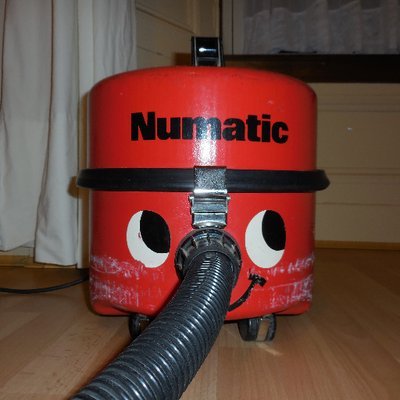
The carrying handle, body latch and separate hose make ownership access points visible before a purchase decision. Check your actual model’s manual for the opening procedure, bag or bin arrangement, filter care and compatible parts. The closed casing shown here does not identify internal consumables or establish washing permission for a filter.
Photo & usage
Wesha · CC BY-SA 4.0 · Source. Display copies resized and encoded as WebP; no instructional details were fabricated or removed.
Check the manual for filter access, washing permissions and drying requirements. An appliance temporarily unavailable while a component dries may need a planned gap in the routine. Do not refit a damp filter to keep the stairs on schedule. A suitable spare is an option only if the manufacturer supports it.
Record who can reach the bin latch or bag collar and whether the cleaning route requires another trip upstairs for parts. Store small tools together in a permitted holder. Maintenance capability belongs in the purchase decision because a machine that is inconvenient to service may spend more time unavailable than expected.
Check the door swing with the stored configuration
A cupboard can accept the vacuum while still trapping its hose when the door closes. Check the full door movement with the appliance placed in its intended position, without forcing hinges or compressing a flexible part. Include accessories in their actual holders and leave access to any required release latch.
Measure the retrieval action too. A handle that fits behind a shelf may be unreachable once the machine is parked. If the only way to remove it involves twisting, dragging a head across a delicate floor or lifting another heavy object first, the storage plan needs revision. Record the changed orientation and recheck all dimensions rather than preserving the original width calculation. A useful storage demonstration ends with a permitted, stable retrieval as well as a closed door. Keep children and pets clear while checking moving doors and equipment.
Sign off the handling record on arrival
When the chosen vacuum arrives, compare the assembled dimensions, included attachments and controls with the shortlist. Test storage fit on level ground before committing to a stair session. Read the manual and verify safe setup, accessory attachment and carrying instructions.
Keep a concise record of measured clearances and observed handling. If the machine cannot be used safely on your route, stop and use the seller's documented process for resolving the mismatch. Do not modify handles, drill an unapproved support or accept unstable storage to preserve the original choice.
The handling check is complete when the vacuum has a permitted stable place, the user can move it along the intended route and attachments have an orderly location. That evidence complements floor compatibility. It does not claim the appliance is universally easier to use or that a short demonstration predicts performance in every home.
THE REFERENCE FILE
Sources & scope
Documentation reviewed 1 Nov 2026. Examples are illustrative; this article does not claim hands-on product testing. Follow the instructions for your actual material, model and location.