Choose the receiving route before filling bags
A donation pile can become difficult to move when it contains unrelated goods that no single organisation accepts. Start with the recipients available in your area and their current criteria. Make separate routes for household goods, textiles and electronics if required. Do not assume a charity shop or community group can process every unwanted possession.
Ask about condition, quantity, delivery hours and collection booking. Habitat ReStore's FAQ states that acceptance varies locally. Use that as a reason to check the branch, rather than copying another location's list onto your project sheet.
Create a small dispatch area with enough room to inspect and label goods without blocking household circulation. Give it a maximum holding period that fits the recipient's schedule. A donation bag is temporary transport packaging; it should not become a new category of long-term storage.
Inspect what the next user will receive
Check completeness and visible condition under ordinary light. Open drawers, locate removable shelves and count parts where appropriate. Describe chips, missing fittings or wear honestly. If a receiving service accepts repairable goods, ask which defects it can handle; do not infer repair capacity from the organisation's charitable purpose.
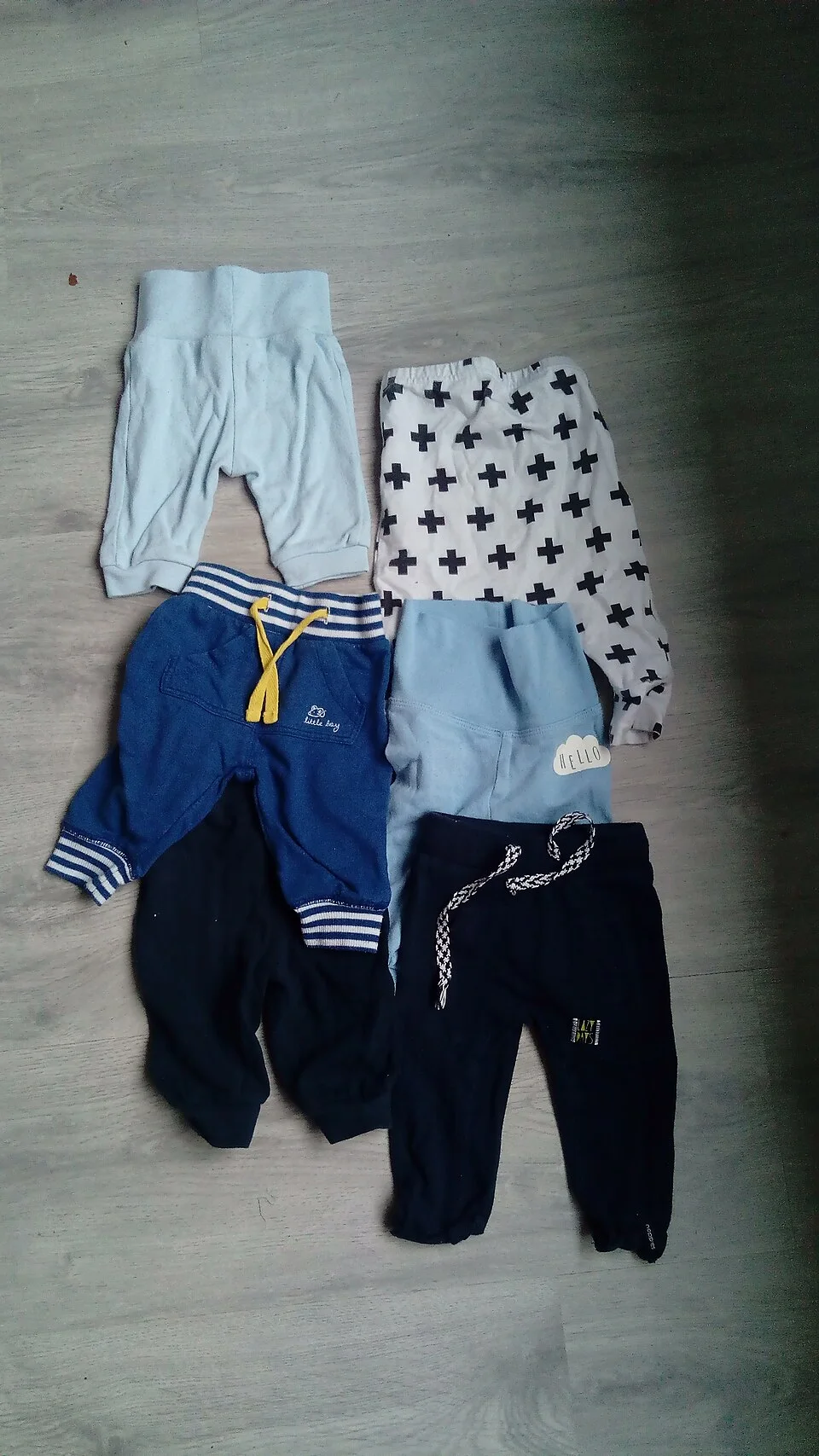
Laying the trousers out separately makes each garment available for inspection rather than concealing it inside a mixed donation bag. Check your actual pieces for the receiving organisation’s requirements, separating unresolved repairs or care questions. Appearance here cannot establish cleanliness, fibre composition, care instructions or acceptance by a particular collection service.
Photo & usage
Donald Trung Quoc Don (Chữ Hán: 徵國單) - Wikimedia Commons - © CC BY-SA 4.0 International.(Want to use this image?)Original publication 📤: --Donald Trung 『徵國單』 (No Fake News 💬) (WikiProject Numismatics 💴) (Articles 📚) 10:10, 16 July 2019 (UTC) · CC BY-SA 4.0 · Source. Display copies resized and encoded as WebP; no instructional details were fabricated or removed.
For textiles, inspect care labels and condition before washing. Use the item's instructions, dry it appropriately and keep the clean goods separate from damp or soiled items. Avoid fragranced treatments intended to conceal a problem. A recipient should know what is being offered.
Set aside recalled, unsafe or unidentified products for a separate decision using the relevant manufacturer or authority information. Do not transfer a known safety issue to another household. If you cannot establish what a product is or whether key parts are present, seek guidance before offering it as usable.
Keep usable sets together
Bag small fittings with a clear link to the parent object, using packaging that will not damage the finish. Include the correct instructions if available. Label whether a furniture item is assembled or requires assembly, and explain any disassembly already performed.
For a set of containers, match lids before packing. For lamps or small appliances, identify the compatible components without using an unsafe improvised connection to demonstrate function. Do not claim professional inspection or testing. Report only the ordinary use or observation you can accurately describe.
Keep spare parts distinct from complete products. A receiving group may welcome a clearly described part, but a bag of unidentified cables is not automatically a useful donation. Ask whether the recipient wants those items and whether they should be sorted by type. Good preparation reduces the chance that useful goods are rejected with unsuitable ones.
Count packages against the booked collection
This illustrative dispatch plan begins with 18 candidate items. The receiving service accepts 12, asks for photographs of three and declines three. Only the 12 confirmed items belong in the booked collection until the pending photographs have been reviewed.
| Status | Items | Action |
|---|---|---|
| Accepted | 12 | Pack and number for collection |
| Pending review | 3 | Send requested detail |
| Declined | 3 | Find a different appropriate route |
If the three pending items are later accepted, the collection becomes 15 items, subject to the service confirming capacity. The three declined items remain separate. Eighteen candidate objects do not equal eighteen approved donations, and filling one extra carton does not change the booking.
Prepare electronics as their own stream
Record the model and the recipient's requirements. Remove personal information following the manufacturer's current instructions, and verify the outcome as those instructions specify. Check accounts, removable storage and accessories rather than assuming an empty desktop means the device contains no personal data.
EPA's electronics donation guidance identifies data removal and battery handling as preparation steps. Follow device-specific procedures for built-in batteries and damaged devices. Do not force a battery out or put an unsuitable device into an ordinary donation carton to avoid arranging another route.
Keep a short record of what was transferred and when, without retaining unnecessary personal information about the recipient. If a device cannot be prepared confidently, use a suitable specialist service or recycling route. A delayed handoff is preferable to giving away a device that still exposes the household's information.
Pack for the agreed handoff
Use containers suitable for the contents and receiving process. Avoid overfilled bags whose handles cannot support the load. Ask the service whether it wants loose furniture, boxed goods or visible contents; packaging that suits a private car trip may be unsuitable for a collection vehicle.
Put the accepted-item list with the collection reference, and number packages where useful. Store them in a dry, secure place until handoff, without obstructing doors or shared routes. A service that collects outside may have weather requirements; obtain instructions rather than leaving textiles exposed overnight.
Confirm who will be present and what access is permitted. Do not expect volunteers or drivers to dismantle furniture or carry from an upper floor unless that service has been agreed. If the accepted item cannot be reached safely under the booking, change the arrangement before the vehicle arrives.
Plan for a declined item on collection day
A driver may identify a condition or access problem that was not visible in photographs. Ask for the specific reason and keep the object in a safe place while choosing another route. Do not add it secretly to another package or leave it beside a donation facility after hours.
Update the dispatch list with what actually left. If twelve items were booked but ten collected, the remaining two need named next actions. Record the new recipient or accepted disposal route and a realistic date. This prevents a partial collection from being remembered as a fully cleared pile.
EPA Ireland's reuse guidance encourages considering repair and repurposing. Those options remain useful when they have a real user and suitable space. Renaming an unwanted cabinet a future craft project without a plan simply returns it to the unresolved group.
Clear the dispatch area after the handoff
Remove empty bags, obsolete labels and rejected packaging through suitable local routes. Check that the area can resume its intended household function. If it immediately fills with another donation group, assign that group a recipient and departure date before accepting more objects.
Keep any receipt or confirmation needed for your records, but do not assume a donation automatically qualifies for a financial benefit. Such decisions depend on the applicable rules and individual circumstances. The practical completion evidence here is acceptance and removal.
Finish when the dispatch record matches what left, declined items have separate routes and the holding space is clear. The donation process should leave usable household space and useful goods with an informed recipient, while keeping uncertainty out of the next person's storeroom.
Prevent sorting mistakes at the dispatch boundary
Use separate labelled containers for accepted, pending and declined goods. Keep the accepted list attached to the collection reference, not simply to the nearest bag. When an item changes status after a recipient's reply, move it physically as well as updating the record. A digital correction alone will not stop a helper loading the wrong carton.
Before sealing, check pockets, drawers and folded textiles for personal papers, keys and small retained objects. Remove names or addresses where they are irrelevant to the donation. Ask another household member to compare the final packages with the accepted list, especially when several similar objects are being retained. This identity check protects both the donor and the recipient from an avoidable mix-up.
THE REFERENCE FILE
Sources & scope
Documentation reviewed 1 Nov 2026. Examples are illustrative; this article does not claim hands-on product testing. Follow the instructions for your actual material, model and location.