Sunset is a reminder to look, not an opening command
Outside air can stay warmer than a room long after the sun disappears. On other evenings a useful cooler period arrives before sunset. If opening a window sometimes helps and sometimes seems to make the room worse, investigate the timing instead of declaring ventilation either effective or useless.
Choose one occupied room and one normal evening period. Write the question as when outside conditions offer a reasonable cooling opportunity. This is different from deciding the home's ongoing ventilation needs. Keep required background ventilation operating and follow existing equipment instructions. The trial concerns optional window opening for comfort, not reducing the supply of fresh air required by the home.
The Department of Energy's natural ventilation material describes the importance of suitable night air and outdoor air quality. That gives the exercise a boundary: a cooler number is a reason to consider opening, not permission to ignore smoke, rain, security or other conditions. The household must be able to reject an opening even on a promising temperature evening.
Build a pair of readings you can trust
Use an indoor thermometer in a stable shaded position and a suitable outdoor reading. The outside sensor must follow its placement guidance, avoiding direct sun and heated enclosing surfaces. A balcony wall that stored afternoon heat can make a poorly placed device misleading. If using a local weather station instead, record its distance and timestamp as context.
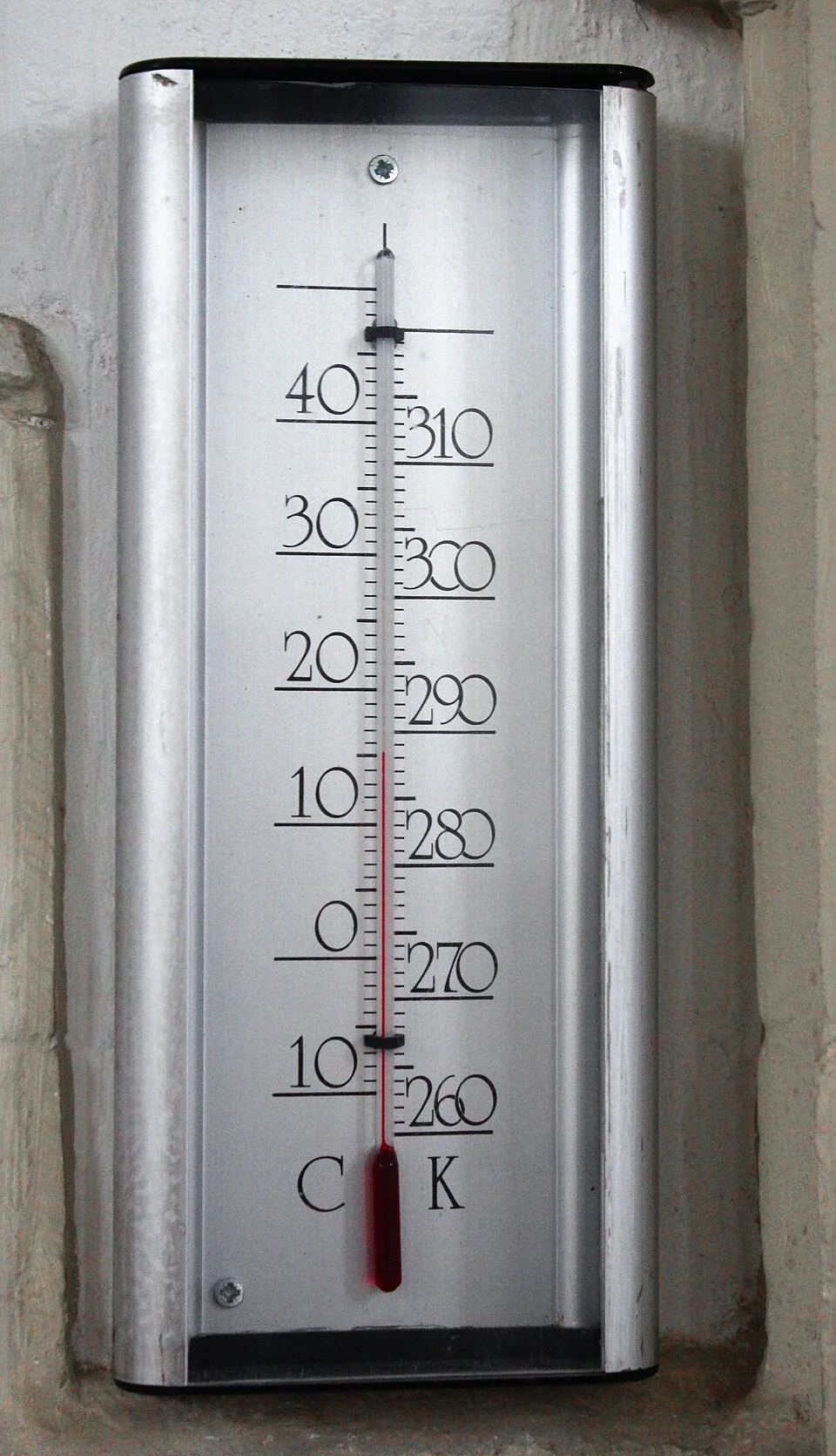
The adjacent scales show why units must be identified before copying a temperature. For the evening crossover, use the actual indoor and outdoor instruments, allow their specified settling times and record current readings close together in time. This is one thermometer with two scales, not a matched instrument pair; its photograph cannot establish the outdoor cooling advantage.
Photo & usage
Martinvl · CC BY-SA 3.0 · Source. Display copies resized and encoded as WebP; no instructional details were fabricated or removed.
Check indoor and outdoor readings at the same time, allowing instruments to settle. Do not carry one sensor between places every few minutes and treat the values as simultaneous. If you only have one instrument, use a clearly identified weather observation and acknowledge that it may not represent the exact air entering your window.
Add humidity if you have suitable devices, but keep it in context. A single relative humidity figure changes with temperature and does not directly quantify how much moisture will enter. You can record that incoming air feels muggy or that condensation concerns exist without inventing a universal humidity cutoff for every home and climate.
Find a candidate crossover with an illustrative series
These readings are invented to demonstrate the arithmetic. They do not establish a recommended temperature or a guaranteed ventilation benefit. Assume shaded simultaneous measurements, the same indoor position, and no major cooking or cooling changes during the record.
| Time | Inside | Outside | Outside minus inside |
|---|---|---|---|
| 18:00 | 28.0 | 30.0 | +2.0 |
| 19:00 | 28.0 | 28.5 | +0.5 |
| 20:00 | 27.8 | 26.5 | −1.3 |
| 21:00 | 27.5 | 25.5 | −2.0 |
The first recorded cooler outside condition is 20:00. The actual crossover occurred sometime after the 19:00 check and by 20:00, assuming the trend was continuous; this record cannot name its exact minute. At 20:00 the difference is 26.5 minus 27.8, or −1.3°C.
An apparent half-degree difference may be difficult to distinguish from ordinary sensor uncertainty. Seek a clear sustained opportunity and check the wider conditions. Do not linearly extrapolate these four points to promise how quickly the room will cool once opened.
Run a short attended opening trial
When outside conditions are suitable, open only the intended window or normal opening pair within its safe operating limits. Keep child protection, insect screens, security and weather in mind. Attend the trial rather than leaving an unfamiliar configuration unattended. Note the start time, opening position and any internal door setting that changes the air path.
After a practical interval, record the room temperature in its original position and the seated experience. A 20-minute check can be convenient, but is not a universal response time. Airflow strength, room geometry and stored warmth affect the result. Stop earlier if rain, noise, pollution or discomfort makes the arrangement unsuitable.
Do not turn off necessary extraction or alter fixed ventilation systems to simplify the comparison. If mechanical cooling is running, follow its operating guidance and record the status. An open-window trial with a changed cooling schedule answers a different question from one with the same settings, so keep the distinction visible in the notes.
Read useful and inconclusive outcomes differently
A person may feel a welcome breeze before the room thermometer changes. Record that as a personal comfort improvement with little measured air-temperature change. HSE's thermal comfort framework includes air movement, which helps explain that outcome without converting it into an unsupported claim about whole-room cooling.
A room temperature that barely changes may reflect weak airflow, warm surfaces releasing heat, or a short trial. Do not immediately widen every opening. First confirm the outdoor opportunity persisted and the intended path was actually open. YourHome's passive cooling material provides context for the interaction of heat gain and heat removal, rather than a guaranteed household cooling rate.
If the trial brings noticeable noise, insects or muggy air, count those as costs. The successful choice may be a shorter opening period or another ordinary opening that avoids the disturbance. Comfort is not improved overall if a small thermal gain makes the room unusable for its intended activity. Write the tradeoff instead of hiding it behind the thermometer.
Turn the finding into a conditional routine
Replace open at sunset with a short sequence: check local conditions, confirm outside is clearly cooler, consider humidity and air quality, then use the documented opening if safe. A clock reminder can prompt this check. It should not substitute for it, especially after a change in weather or season.
Specify a closing trigger as clearly as the opening trigger. This might be bedtime security, a change in wind, incoming rain or the end of the attended trial. If the household normally closes windows at night, design the routine around that boundary. There is no need to recommend overnight opening to make an evening comparison worthwhile.
Repeat on several suitable evenings and include a rejected opportunity in the record. For example, outside was cooler but smoke made opening inappropriate. That note demonstrates the actual decision process better than a log containing only successful openings. It also prevents someone later interpreting temperature as the sole rule.
Complete the check without claiming a universal threshold
The finished record should identify the observed opportunity window, the normal opening arrangement and its practical limits. Verify that the room remains usable, controls are accessible and nobody has to cross an obstructed route to close the window. The person responsible for closing should know when and why to do it.
Keep the original paired readings and weather notes so the routine can be reconsidered. A changing season, new external noise or a shifted occupancy time can remove the useful crossover. If the opening repeatedly provides no benefit under suitable conditions, stop adding complexity and consider a different focused comfort change.
Completion means the household can recognise an appropriate opportunity and decline an unsuitable one. It does not mean natural ventilation is sufficient in extreme heat or that a particular indoor reading guarantees safety. Follow local heat and air-quality advice independently of this modest comfort exercise, and use the record only for the decision it actually supports.
THE REFERENCE FILE
Sources & scope
Documentation reviewed 1 Nov 2026. Examples are illustrative; this article does not claim hands-on product testing. Follow the instructions for your actual material, model and location.