Define the room problem before counting litres
A dehumidifier bucket can become the most persuasive object in a damp room. Water is visibly being collected, which feels like proof that the whole problem is being solved. Begin with a more specific job: reduce recurring room humidity after source control, support a professional drying plan or manage a known seasonal moisture pattern. A bucket alone cannot show which wall, activity or incoming air supplied the water.
Use only equipment appropriate for the space and its temperature. Read the actual model's placement, clearance, electrical and drainage instructions. Do not set the unit beside a drying rack where fabric can obstruct it or near a splash source. Keep the collection method practical enough that someone can maintain it reliably.
ENERGY STAR: Dehumidifiers distinguishes water-removal capacity from bucket size and discusses temperature limitations. An advertised pints-per-day figure is not a promise that your room will produce that quantity or that a larger bucket establishes better moisture control.
Start each observation with a known bucket state
Choose a manageable interval around ordinary use. Record the start and finish, whether the bucket was empty at the start, the setting and the room temperature and RH at a consistent separate meter position. Note open windows, wet laundry, visitors and any other substantial change in moisture load.
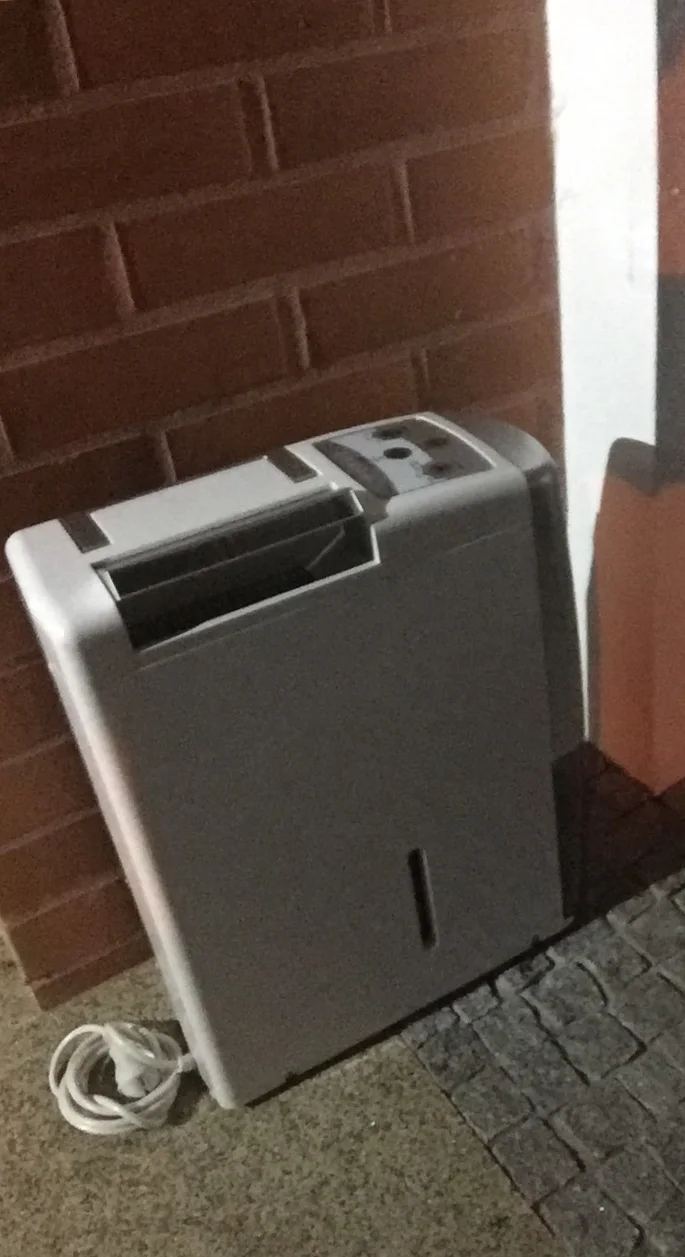
The control panel and front viewing slot identify features to describe when setting up a bucket record. Follow the actual model’s instructions for accessing, emptying and replacing the container, and record start and end times with any stoppage. No litre graduations or collected volume are readable here; a level window is not a measured interval total or the machine’s rated capacity.
Photo & usage
V.B.Speranza · CC BY-SA 4.0 · Source. Display copies resized and encoded as WebP; no instructional details were fabricated or removed.
Measure collected water only with a suitable stable container and safe handling. Do not carry an overfull bucket or pour water near electrical equipment. Follow the model's instructions for removal, emptying and replacement. If the bucket has no accurate graduations, label an estimated volume as estimated rather than inventing a precise litre value.
Record interruptions: bucket full, power off, a timer stop, defrost indication or a deliberate pause. Elapsed wall-clock time is not necessarily active water-removal time. If the device does not report compressor runtime, say that you do not know it. The log remains useful without pretending to measure every internal operating state.
Calculate only the rate your record supports
The following numbers are illustrative and invented. Assume volumes were measured appropriately and the unit was powered for the stated intervals. Its internal cycling is unknown, so the calculated rate is per elapsed powered hour, not compressor hour.
| Interval | Collection | Powered duration | Collection per elapsed hour |
|---|---|---|---|
| A | 1.8 L | 6 hours | 0.30 L/hour |
| B | 1.2 L | 4 hours | 0.30 L/hour |
Both rates are 0.30 L/hour: 1.8 divided by 6 and 1.2 divided by 4. Interval A collected more total water because it lasted longer. Extending either figure to a guaranteed daily yield would ignore cycling and changing room conditions. Neither rate proves a leak has stopped, a wall is dry or the equipment meets its laboratory rating in this room.
Pair the bucket with room and surface observations
Record whether the original wet surface is improving and whether room readings recover under comparable temperature and activity. A rising bucket total alongside continuing rain entry is not a successful source repair. Conversely, a smaller collection after wet laundry is removed may reflect a reduced load rather than a failing machine.
EPA: A Brief Guide to Mold, Moisture and Your Home centres correction of moisture sources. Use the log to keep that priority visible. If a leak, persistent condensation or damaged material remains, arrange the appropriate assessment rather than simply lowering the setpoint repeatedly. The appliance may help manage air moisture while another task remains unfinished.
Remember that the dehumidifier itself can warm the room, affecting RH. A lower percentage without the corresponding temperature is incomplete evidence. Use the same independent meter location for comparisons and follow its settling requirements. Do not compare the appliance's sensor at its inlet with a meter beside a wet window as if they sample identical air.
Separate an empty bucket from a diagnosis
Little collection can have several explanations: the room may be drier, the temperature may be outside the model's useful range, the unit may be cycling at its setpoint, or operation may be interrupted. Check only the user-level conditions and indicators described in the manual. Do not open the case, thaw internal parts with a tool or bypass a bucket switch.
If a continuous drain is used, bucket volume is no longer a complete collection record. Note that arrangement and follow the installation's instructions. Do not disconnect a permanent hose merely to make measurement easier. A pump, trap or drain fault requires the right assessment for that equipment.
Health Canada: Guide to addressing moisture and mould indoors includes dehumidification among moisture-control measures while also emphasizing source correction. A normal room display does not clear hidden construction, and a full bucket does not establish a safe room. Keep the operational evidence separate from claims about material moisture or the complete indoor environment.
Choose a useful next action instead of chasing output
Review a few comparable intervals rather than ranking every day by litres collected. Ask whether the original room problem is less persistent, whether source controls are working and whether the machine operates within its instructions. Record a deliberate change before looking at the result, such as removing wet laundry or correcting an unintended open window.
Do not add water or raise humidity to see whether the unit can fill its bucket faster. That creates an unnecessary load and does not reproduce a standardized capacity test. If performance appears inconsistent after user checks, contact the manufacturer with the model, conditions, indicators and interval record.
Avoid energy-savings claims from the water log. It contains no electricity measurement and cannot show whole-home savings. If operating cost matters, use a separate appropriate energy record and a known USD tariff while preserving the differences in conditions. Water removal and electricity consumption are related operational questions, but one cannot be calculated reliably from the other here.
Finish with source control and a sustainable routine
A useful endpoint is a room whose original wetness is controlled, with any building defect addressed and an appliance routine the household can maintain. Empty and care for the bucket as instructed, keep clearances available and recheck the original surface during relevant weather. Do not retire the log solely because the collection total looks impressive.
Keep a short summary of the normal setting, usual room conditions, collection method and circumstances that require review. Include any unresolved professional drying requirement. A household bucket record should not replace material checks specified by a restoration professional.
Close the file with a precise claim: the unit collected the recorded volume during those intervals, and the observed room pattern improved or remained unresolved. That leaves the bucket doing its proper job as operational evidence. It avoids turning visible water collection into a diagnosis of the building or a certificate for the room.
THE REFERENCE FILE
Sources & scope
Documentation reviewed 1 Nov 2026. Examples are illustrative; this article does not claim hands-on product testing. Follow the instructions for your actual material, model and location.