Define the limited question
A tap that seems slower than before may be difficult to describe to a service provider. A short, repeatable cool-water timing record can document the observation without opening fittings or changing plumbing. The question is how long a defined volume takes under a named ordinary setting, not whether the household has measured water pressure.
Choose a tap that can be used safely with cool water and a vessel that fits securely in the sink. Keep the drain available and the surrounding floor dry. Do not use a fixture with an unresolved electrical, structural or obvious plumbing hazard.
CPSC's scald guidance establishes that hot tap water can injure. This procedure avoids intentionally testing a hot stream. If the control does not provide a reliably cool setting or water becomes unexpectedly hot, stop and arrange appropriate assistance rather than continuing for a complete record.
Choose a readable fixed volume
Use a clean vessel with a clear volume mark and enough spare capacity to avoid overflow during stopping. Check whether the scale is for liquid volume rather than ingredient weight. Read the mark consistently at the appropriate viewing position.
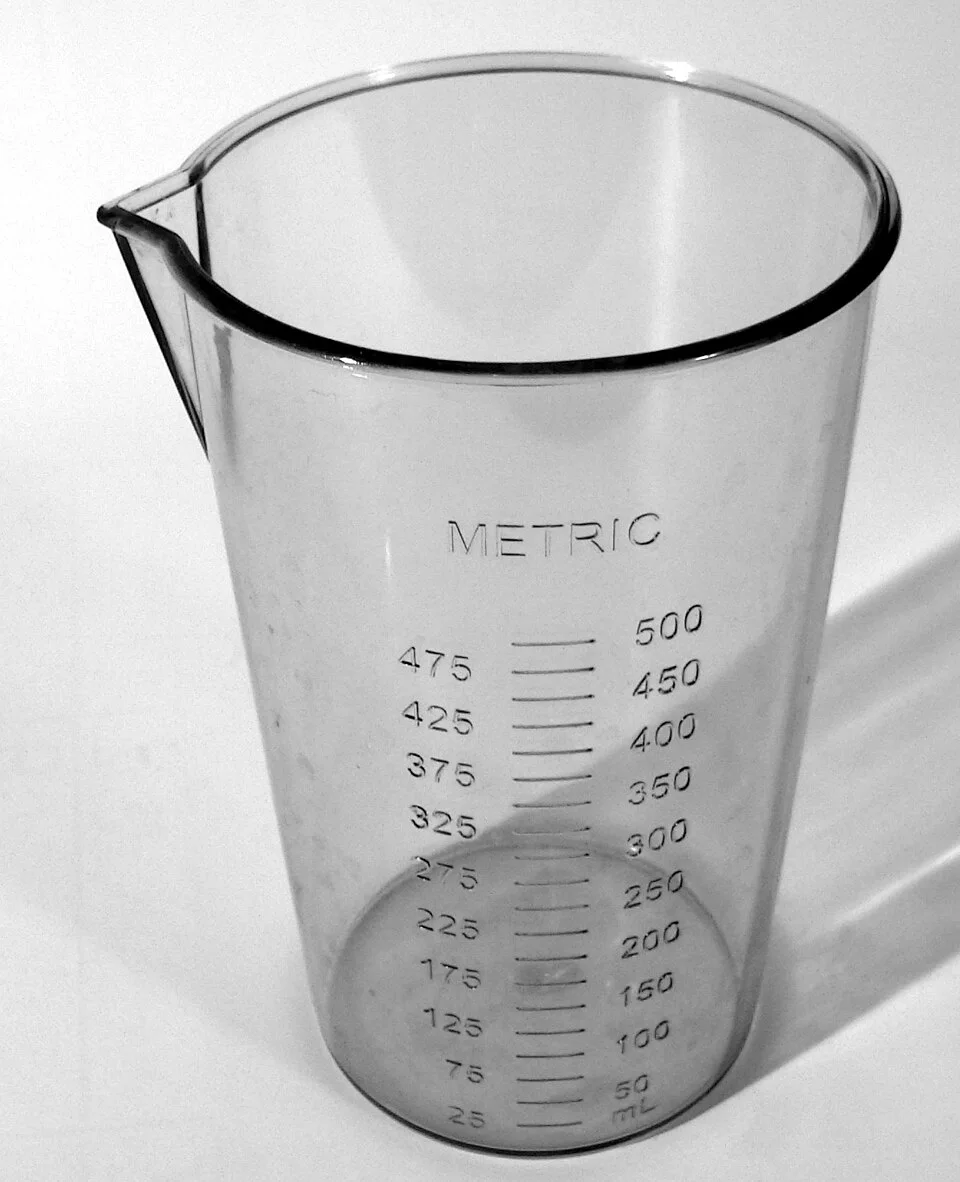
The millilitre markings provide a fixed-volume reference for choosing a modest target with spare vessel capacity. Set the actual vessel level and use a consistent viewing position. This empty jug demonstrates the scale only; it supplies no timed tap result, and its graduation spacing limits any precision claimed for a household observation.
Photo & usage
Photograph: Frank C. Müller, Baden-Baden · CC BY-SA 4.0 · Source. Display copies resized and encoded as WebP; no instructional details were fabricated or removed.
Place the vessel so it captures the intended stream without bouncing out of the sink or requiring a hand beneath the outlet. If the shape prevents complete capture, choose another suitable method or record that this fixture cannot be observed reliably with the available equipment.
Keep the target volume modest and appropriate to the sink. More water is not automatically better evidence. Choose a duration that can be timed reasonably, while avoiding unnecessary repeated running merely to obtain a smooth-looking result.
Record a reproducible ordinary control position
Note which handle or lever setting was used and whether a spray mode was selected. Use a suitable cool-water position and do not force the control beyond its normal operation. A photograph of the control position may help if it contains no private information.
Record whether other household water use occurred. Ask others to avoid beginning a major water use during the short observation where practicable, but do not isolate equipment or operate unfamiliar valves to create test conditions.
Keep the fixture intact. EPA's bathroom-faucet information and Saving Water Partnership's flow guidance provide context for ratings and measurement, but neither makes this household timing record a reason to dismantle an aerator. Maintenance or repair should follow the actual product instructions.
Calculate an illustrative fixed-volume result
This illustrative record uses a 2-litre target. Three valid observations take 20, 21 and 19 seconds under the same named condition. Their mean time is 20 seconds, and their range is 19–21 seconds.
The rates calculated separately are 6.00, about 5.71 and about 6.32 litres per minute. Those values show ordinary method variation in this invented example. Reporting the practical range is more honest than claiming a precise certified rate of 6.000 litres per minute.
If a later matched observation takes 30 seconds for the same 2 litres, the calculated rate is 4 litres per minute. That is a documented difference worth checking, but it does not identify pressure, a blockage or a particular failed component. Record the conditions and ask the service provider what information is useful next.
Reject observations with known capture errors
Mark a run invalid if water missed the vessel, the timer started late, the target was exceeded substantially or the control changed. Keep the reason beside it. Do not average a known spill into the result and call it natural variation.
Check the volume reading after stopping. Foam, a tilted vessel or an obscured scale can make a result uncertain. If the method cannot provide a readable value, stop and revise the setup rather than adding more repeated observations.
Avoid comparing a timed fill from one control position with a product's maximum rating as though the conditions were identical. Keep label values separate. A lower observed rate at an ordinary partly opened tap is not by itself evidence that the product fails its specification.
Compare only records with matching definitions
Use the same vessel, target volume, timing method and fixture state for a later comparison. Note changes in household demand or maintenance. If one condition differs, keep the comparison provisional and describe the difference.
For another tap, record the different outlet and mode. A kitchen spray and bathroom aerator may perform different tasks, so their rates are not a simple ranking of quality. Compare each with its intended function and product information.
Do not interpret a timing change as proof of water quality or safety. Appearance, taste and flow timing do not establish drinking-water compliance. Follow the utility's guidance for water-quality concerns and use appropriate professional assessment where required.
Prepare the observation for a service conversation
Give the fixture location, date, ordinary control setting, target volume, valid times and any visible symptom such as dripping after closure. State what changed and when it was first noticed. Include the model if it can be identified without disassembly.
Ask whether the provider needs further observations and what can safely be collected. Do not remove fittings or adjust supply controls simply because an online suggestion might explain the number. A service professional can decide whether the issue belongs to the fixture, building system or utility.
Keep the response and any completed work with the original timing card. If work is done, make a later ordinary-use observation only when appropriate under the handover instructions. Do not invent a successful repair outcome from a single faster fill.
Close the record with its uncertainty
Save raw times, target volume, conditions and invalid-run notes. Report rounded results consistent with the vessel and timing method. A household worksheet should remain easy to reproduce without implying laboratory accuracy.
Use collected cool water for an appropriate ordinary purpose only where its cleanliness and intended use permit. Do not store it in an unsafe or confusing container, and do not create extra household demand simply to justify a timing exercise.
The record is complete when the observation can be repeated, known errors are excluded and the conclusion stays within flow timing. It can then support a focused maintenance question while leaving diagnosis and invasive work to the appropriate person.
Check the start-and-stop method before comparing small changes
Decide whether timing starts when the control opens or when collection begins, and use the same convention. If the vessel is placed under an already running stream, keep that sequence consistent without creating unnecessary extra running. Do not compare it with a record that includes the time taken to move the vessel into position.
For an illustrative 2-litre fill, a one-second timing difference around twenty seconds changes the derived rate noticeably. At nineteen seconds it is about 6.32 litres per minute; at twenty-one seconds it is about 5.71. A small apparent improvement can therefore be comparable to ordinary timing uncertainty.
Ask a second adult to help with timing only if the setup remains safe and the responsibilities are clear. More people should not mean more hands around the outlet or an unstable vessel. If a simple arrangement cannot capture the stream reliably, stop and use another appropriate source of information.
Write the method beside the raw times so a later observer can repeat it. A result without its start convention is difficult to compare, even when the arithmetic is correct. The record's strength comes from a clear, modest procedure rather than an excessive number of decimal places.
THE REFERENCE FILE
Sources & scope
Documentation reviewed 1 Nov 2026. Examples are illustrative; this article does not claim hands-on product testing. Follow the instructions for your actual material, model and location.