A lower annual energy figure can make an appliance attractive, but it does not answer whether its extra purchase cost is justified. A useful decision record keeps service, acquisition cost and avoidable energy charges separate. It also states whether the household is replacing failed equipment or considering an optional early replacement.
This guide provides a comparison framework with illustrative USD arithmetic. It does not recommend a product, guarantee equipment life or promise a financial return. Use current verified quotes, official energy information and the account's actual tariff for a personal decision.
Define the decision that is actually available
Write the alternatives clearly: two suitable replacements, repair versus replacement, or keeping functioning equipment versus buying new. These are different decisions with different cost boundaries. Comparing only the efficient model's premium is appropriate for two new candidates but incomplete for early replacement of an appliance already owned.
Record the service each option must provide, including capacity, necessary functions and fit. Exclude unsuitable candidates before cost arithmetic. A model that cannot perform the household's task is not made comparable by a favorable annual energy figure.
Keep repair or safety questions with appropriate manufacturer guidance and qualified assessment. A running-cost spreadsheet cannot establish that faulty equipment should remain in use. Conversely, a functioning appliance is not proven defective merely because its measured consumption differs from a standardized label under different conditions.
Gather acquisition costs on the same basis
Use complete verified quotes where available, separating equipment price, necessary installation, delivery and disposal. Note tax treatment and any accessories needed for the intended setup. Do not compare one delivered total with another product's bare shelf price.
Record rebates only when eligibility, timing and conditions are confirmed. An unverified incentive belongs in an optional scenario, not the base calculation. Keep financing costs separate if they apply; a simple purchase-price difference does not account for them automatically.
For early replacement, include the actual new acquisition cost and any relevant repair alternative rather than treating the existing appliance's historic purchase price as a new avoidable expense. State the chosen boundary plainly. The record should make clear which costs change because of today's decision and which have already occurred.
- Define whether the decision compares new candidates, repair or optional early replacement.
- Collect acquisition totals on the same basis and keep unverified incentives outside the base case.
- Compare the incremental cost with supported energy differences over an explicitly chosen planning horizon.
Establish comparable consumption evidence
For two new models, obtain official standardized energy information with comparable service and test basis. The FTC — Energy Labeling Rule explains the role of appliance labeling. A lower number is useful only when its unit and conditions are understood.

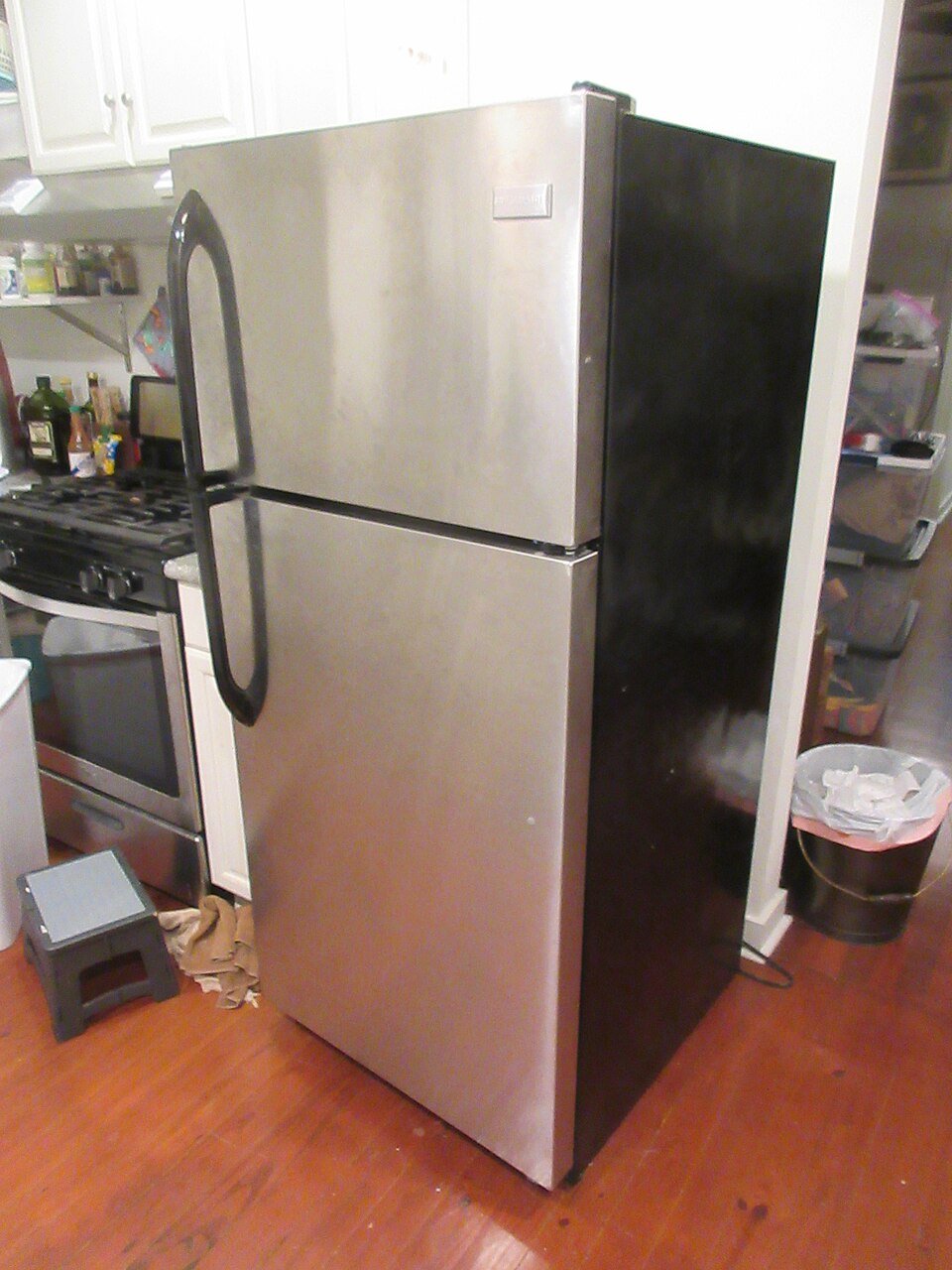
The attached label identifies an annual-use basis with UNITS PER YEAR wording. Retain the exact candidate’s official label and test conditions rather than borrowing this appliance’s figure. Keep a labeled annual estimate separate from measured household consumption, and state any assumed usage or uncertainty when building the replacement decision.
Photo & usage
Srini297 · CC BY-SA 4.0 · Source. Display copies resized and encoded as WebP; no instructional details were fabricated or removed.
For current equipment, use appropriate representative consumption information where safely available. Do not assume its nameplate power is its continuous annual average. If the existing appliance's consumption is uncertain, retain a range or gather better evidence rather than treating the candidate's label as proof of an exact reduction.
FTC — How to Use the EnergyGuide Label to Shop for Home Appliances explains why printed annual operating cost is an estimate dependent on use and price. Keep standardized consumption and household measurements identified separately. Differences between them may reflect conditions as well as equipment performance, so avoid subtracting unlike figures without a clear limitation.
Calculate an illustrative incremental-cost range
All figures here are illustrative. Two suitable replacement options cost USD 620 and USD 800 on the same acquisition basis. The higher-priced option costs USD 180 more. Their comparable energy figures differ by 90 kWh per year.
At an avoidable rate of USD 0.18 per kWh, the modeled annual difference is USD 16.20. At USD 0.30, it is USD 27.00. Simple payback on the USD 180 premium is about 11.11 years at the lower rate and 6.67 years at the higher rate.
This calculation divides an incremental cost by an assumed annual energy-charge difference. It excludes repairs, financing, changes in use, future rate changes and equipment life. It does not promise that either payback will occur. If the decision is early replacement rather than choosing between two new options, the relevant acquisition cost could be much larger than USD 180 and must be modeled separately.
Use the avoidable tariff rather than average bill cost
Identify the energy components that respond to a reduction in kWh. The PG&E — Understand Your Bill explanation shows that an account can contain different charge types. Keep fixed service charges and unrelated balances outside the appliance-saving calculation unless a specific rule makes them change.
For tiered or time-of-use pricing, choose supported allocations or clearly labeled rate scenarios. A candidate's annual energy label does not specify exactly when its household kWh will occur. Do not claim the highest listed price applies to every avoided unit unless the tariff and timing evidence support that.
Retain any relevant uncertainty in the consumption difference as well as the price. A range built from two tariff values but one unsupported annual kWh estimate can still be misleading. State which assumption most affects the decision and whether better evidence could plausibly change the conclusion.
Set a decision boundary without inventing lifespan
Choose a household evaluation horizon and label it as a preference or planning assumption. Do not present it as the appliance's guaranteed life. Compare the modeled energy difference over that horizon with the acquisition premium, keeping non-energy priorities visible.
If the result depends on an optimistic combination of long life, high price and favorable use, say so. A conservative scenario may produce a different conclusion. The record should show that sensitivity rather than selecting only the scenario that makes a preferred purchase look economical.
Consider necessary service, repairability, noise, capacity and fit through appropriate evidence where those matter. Keep unsupported claims out of the energy model. A cost comparison can inform the choice without pretending to be a complete product review or a professional financial recommendation.
Calculate a break-even requirement before refining estimates
A chosen evaluation horizon can reveal the annual energy difference required to cover a purchase premium. Divide the premium by the horizon to find the necessary annual USD difference, then divide by the applicable avoidable USD-per-kWh rate. This is a decision boundary under stated assumptions, not a prediction that the appliance will reach it.
Using the earlier illustrative USD 180 premium, a five-year horizon requires USD 36 per year. At USD 0.24 per kWh, that corresponds to 150 kWh annually. If comparable evidence supports only 90 kWh, the energy-only result does not cover the premium within that chosen horizon under these assumptions.
The household may still prefer the higher-priced option for supported non-energy reasons. Keep those reasons explicit rather than stretching the energy estimate to justify a decision already favored. This reverse calculation can also show whether better measurement would matter: if plausible consumption differences remain far below the requirement, extra decimal places are unlikely to change the energy-only conclusion.
Finish with an explicit keep-or-revisit conclusion
Save the dated quotes, exact models, energy evidence, tariff assumptions and calculation boundary. Record whether the comparison concerns a new-model premium or an early replacement. That distinction should remain visible when the file is reopened months later.
Write the outcome as a decision under conditions: the premium is supported by the household's chosen priorities, the energy difference alone is insufficient under the selected scenarios, or more evidence is needed. Do not turn the estimate into a promise of future savings or policy approval.
Completion means the household can see what extra money is committed and what evidence supports the modeled return. Revisit the record when quotes, tariff terms or equipment condition changes. A useful decision file makes the tradeoff reviewable without disguising uncertain future performance as a guaranteed result.
THE REFERENCE FILE
Sources & scope
Documentation reviewed 1 Nov 2026. Examples are illustrative; this article does not claim hands-on product testing. Follow the instructions for your actual material, model and location.