Give each window its own problem
A living room can need an open curtain at breakfast and a lowered blind before lunch. Calling it a sunny room loses the timing that makes a useful routine possible. Begin with one repeatedly uncomfortable seat and the windows that can send direct sun toward it. The purpose of this exercise is to prepare an operating plan for existing coverings, rather than design new building elements.
Draw the room as a rectangle on paper. Mark windows A, B and C, the normal chair positions, the television, and any surface that becomes conspicuously warm. Add a north arrow if you know it, but do not let a phone compass override what sunlight actually does. Nearby towers, balconies and trees can make windows with similar compass headings behave very differently.
Write the immediate complaint beside the seat: sun on the left shoulder, a bright patch across the book, or an afternoon cushion too warm to use. Keep those complaints separate. A covering that removes the beam from the book may still leave the room warmer later.
Watch the beam at useful intervals
Choose a day when you will be home during the troublesome period. Check at half-hour intervals around the first appearance of direct sunlight, using your usual local clock. Note whether the sky is clear, broken cloud or overcast. A cloudy observation cannot establish the full clear-sky exposure window, though it remains useful evidence about ordinary daylight.
Describe the beam's edge using permanent features: just reaches the rug seam, crosses the chair arm, or ends at the cabinet. Do not stick tape onto finishes without checking removal permission. A hand sketch is sufficient, and avoids collecting photographs with automatic exposure that make different conditions look alike.
Record the first and last checks that show sunlight on the occupied seat. Your timing has the resolution of the checks; a beam first seen at 14:30 might have arrived at 14:06. Narrow the interval on another day if the routine needs that precision. Repeat after a substantial seasonal change, because a November map is not a year-round sun chart.
Distinguish orientation from a local obstruction
Australian government YourHome guidance treats orientation as a relationship with local sun paths and climate. Its north-facing examples describe Australian conditions; they are not instructions to prefer north-facing rooms everywhere. In tropical locations the sun can be on different sides of a home in different seasons. Use the physical observations to ground any compass description.
Look through each affected window from inside without leaning outside. Is the beam interrupted by a balcony, a neighbouring wall or foliage? Record that feature next to the observation. A west-facing window shaded by a tall building may receive less late sun than an unobstructed southwest window. The obstruction can also change as trees grow or lose leaves.
If direct sun never reaches the chair but the window remains painfully bright, treat that as a glare question. If the seat warms after the beam has disappeared, retain the heat timing separately. Neither result makes the sun map a failure; it identifies the next comparison and prevents buying an opaque covering to solve a different problem.
Make a schedule from an illustrative record
The following timings are illustrative observations, not measurements from a tested Ceetv home. Assume checks were made every 30 minutes on two similarly clear afternoons, with the same chair position. The times describe visible sun on the chair, not all heat entering the room.
| Window | First observed beam on seat | Last observed beam on seat | Observed span |
|---|---|---|---|
| A | 09:00 | 10:30 | 90 minutes |
| B | 14:00 | 16:30 | 150 minutes |
| C | No direct beam recorded | No direct beam recorded | Not established |
The two observed spans total 240 minutes, or four hours. They are not four hours of equivalent solar gain: glass area, intensity and angle differ. A practical starting schedule would adjust A shortly before 09:00 and B shortly before 14:00 while leaving C available for diffuse daylight.
A 15-minute lead would mean 08:45 and 13:45. That lead is an editorial trial choice, not an agency requirement. If the first hot surface occurs earlier, move the operation earlier and log why. Avoid reporting the span as exact exposure duration because the interval checks leave uncertainty at both ends.
Test the smallest useful covering change
Operate only the affected covering during the first trial. Close or tilt it just enough to keep the direct beam off the seat while retaining useful light elsewhere. YourHome's shading guidance distinguishes shade choices by exposure, and its lighting guidance separates useful daylight from unwanted direct sun. Those principles support a targeted trial rather than permanent darkness.
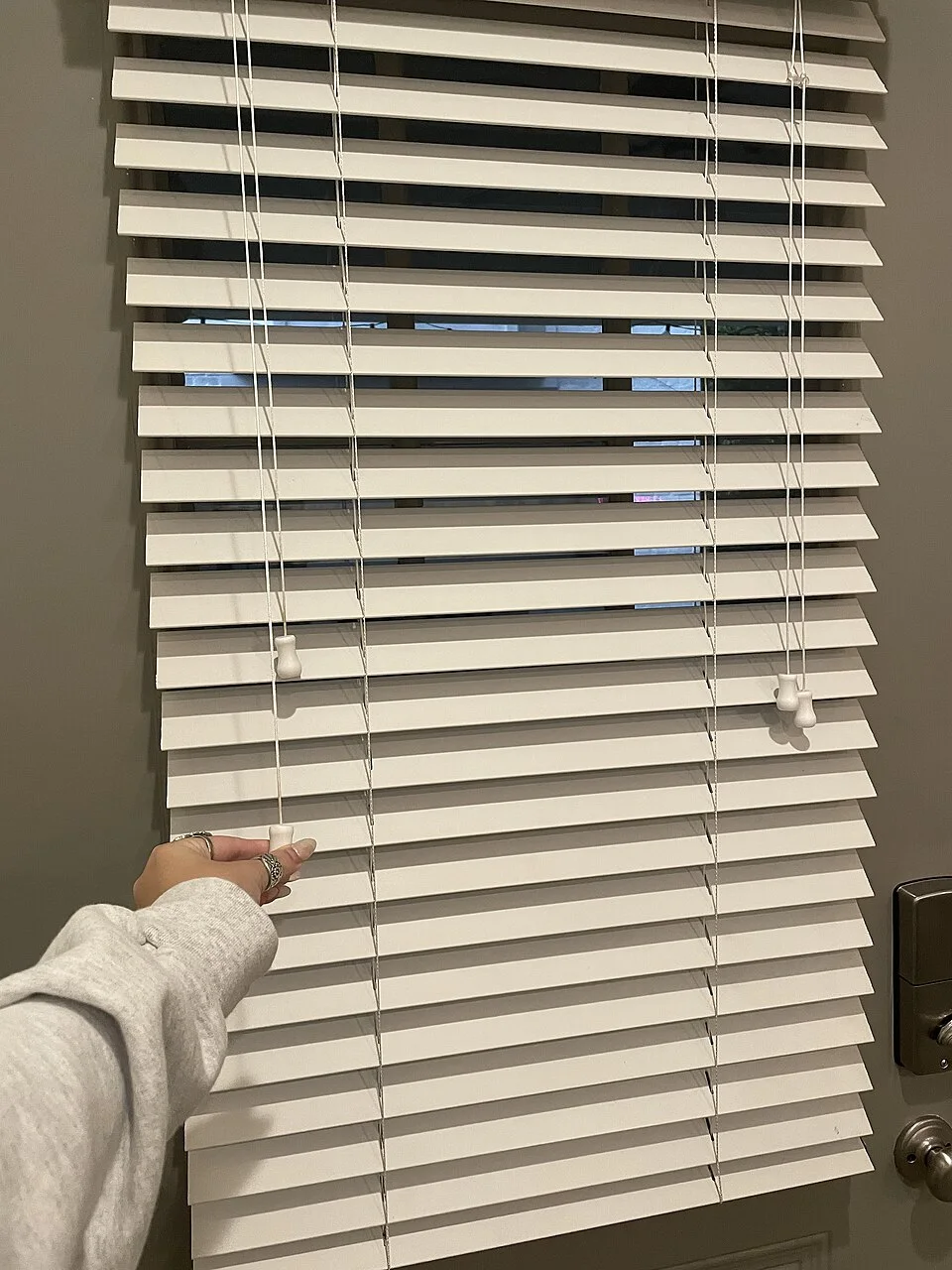
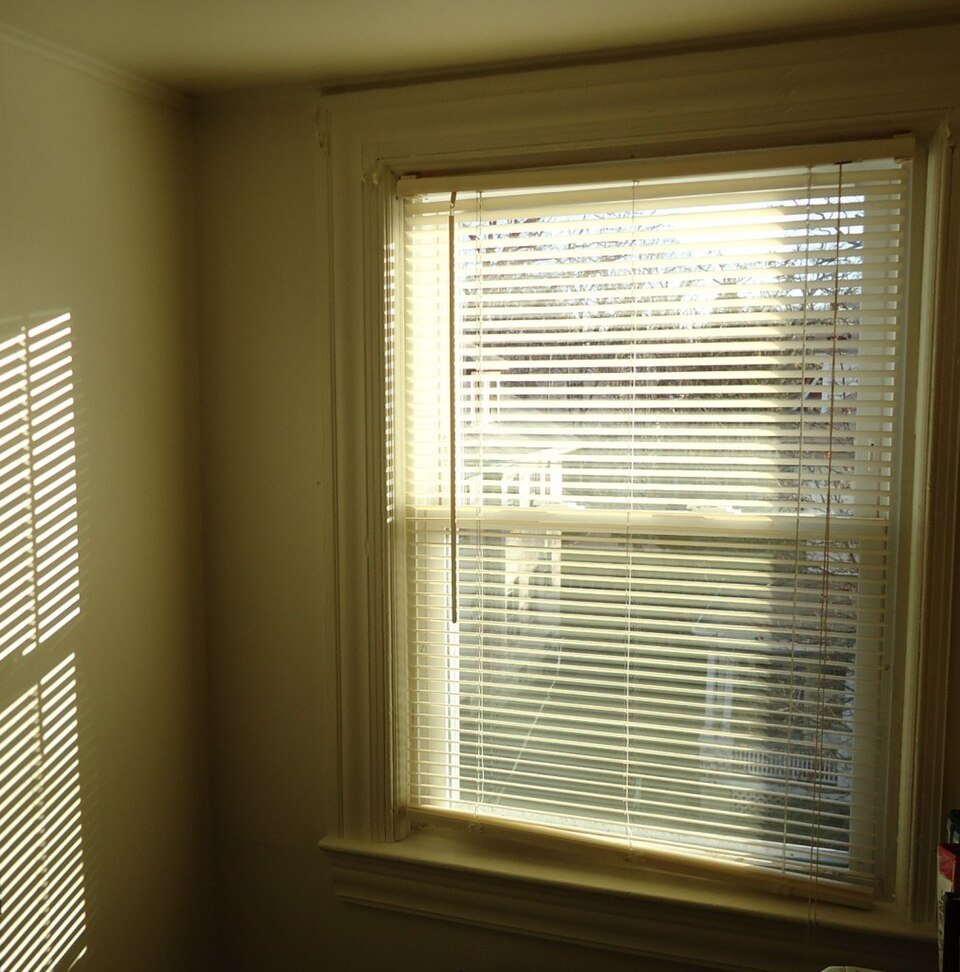
The hand and control show an ordinary way this particular blind is operated. On your covering, use only its intended controls and make one small change while checking where the direct beam falls at the occupied position. Restore the original setting before comparing another option. The photograph does not establish universal control directions, child-safety arrangements or a cooling result.
Photo & usage
SelenaJKruse · CC BY-SA 4.0 · Source. Display copies resized and encoded as WebP; no instructional details were fabricated or removed.
Sit in the actual chair and read a page. Then stand where another person normally sits and check their view. A blind angle that suits one seat can send reflected brightness toward another. Record both positions, plus whether a lamp becomes necessary. Do not assess the result only while standing by the control.
Keep the window opening position and any cooling settings unchanged if conditions permit. Otherwise note the change, since it complicates the comparison. Use existing controls within their instructions, keep cords inaccessible to children, and leave vents and safe access clear. Do not improvise exterior shades or attach unapproved materials to glazing for this observation exercise.
Write rules for exceptions
A useful routine includes conditions under which its default action changes. On a dull cool day, the same closed blind might make the room unnecessarily dim. On a bright hot day, waiting until sunlight reaches a person may allow nearby surfaces to warm first. Write two or three short branches based on observations, rather than claiming one clock time suits all weather.
For example, close B by 13:45 when clear sun is already crossing the floor; leave it partly open on overcast days unless glare appears. If someone uses the television before then, use its separate reflection setting. These rules specify the reason for each position and reduce arguments about whether the curtain should always be open.
When comparing days, include household activity. Cooking, additional visitors or a changed cooling schedule can alter how the room feels. The sun map does not isolate those influences. A delayed heat complaint is grounds for a temperature log, whereas an immediate visual complaint should send you back to the seated sight line.
Finish with a routine another person can follow
Put the final note beside the normal control location or in the household notebook. Identify the window letter, the trigger, the preferred position and when to reopen. Use plain descriptions such as lower to the middle rail, rather than a percentage that the covering cannot reproduce. Keep the sketch with the date and weather notes.
Verify the plan on a second suitable day. The original beam should remain off the intended seat during its occupied period, the task should still be visible, and the covering should operate without moving furniture. Check that reopening has not been forgotten after the exposure ends. A successful morning adjustment should not leave a room needlessly dark all afternoon.
Schedule another look when the season visibly changes, a large nearby tree changes foliage, or the chair moves. Complete the exercise when you have a repeatable local rule and a named exception, not when every window has the same position. That is enough evidence to guide daily use without claiming a full solar design assessment.
THE REFERENCE FILE
Sources & scope
Documentation reviewed 1 Nov 2026. Examples are illustrative; this article does not claim hands-on product testing. Follow the instructions for your actual material, model and location.