A sweater that feels different after washing may have changed shape, been laid out differently or simply be damp. A small measurement record helps you distinguish those possibilities. Measure the relaxed dry garment before care, follow its actual instructions, and compare it after complete drying. Treat the figures as observations rather than targets to force the fabric back toward.
Confirm that home washing is permitted
Read the sweater's care claim before choosing a wool programme or filling a basin. Woolmark tells owners to follow the individual garment instructions; some wool sweaters permit machine washing, others require hand washing or professional care. Fibre content alone does not establish the route.
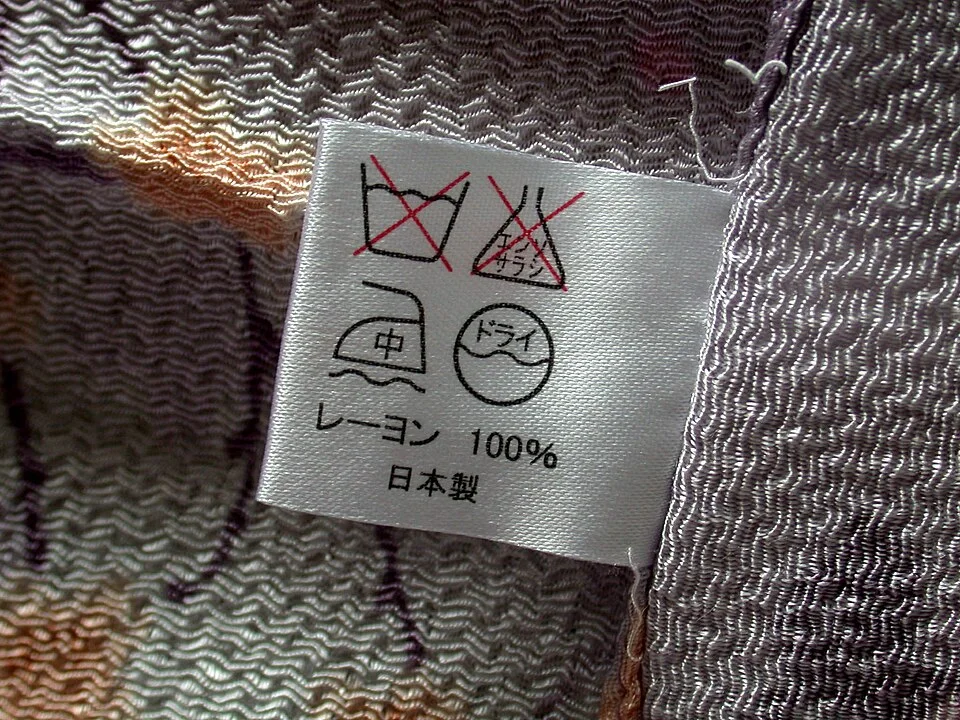
This photographed garment label shows that a textile can carry explicit washing restrictions alongside fibre information and other care symbols. Read your sweater’s own complete label before selecting a wool programme or hand-wash route. The Japanese-labelled garment shown is a care-reading reference, not evidence that a different wool sweater can be washed.
Photo & usage
Dvortygirl · CC BY-SA 3.0 · Source. Display copies resized and encoded as WebP; no instructional details were fabricated or removed.
Inspect seams, cuffs, neckline and any decoration. Photograph existing stretching, pilling or distorted edges before washing. Empty pockets and remove detachable accessories only as directed. A garment already weakened at a seam may need repair or professional assessment before another wet-care cycle.
Keep the label photograph and product identifier with the measurement note. If the instructions are unclear, stop and ask the maker. Do not use the measurement exercise as permission to experiment. Its value comes from comparing a supported process, not from documenting a process that the garment prohibits.
Choose repeatable reference points
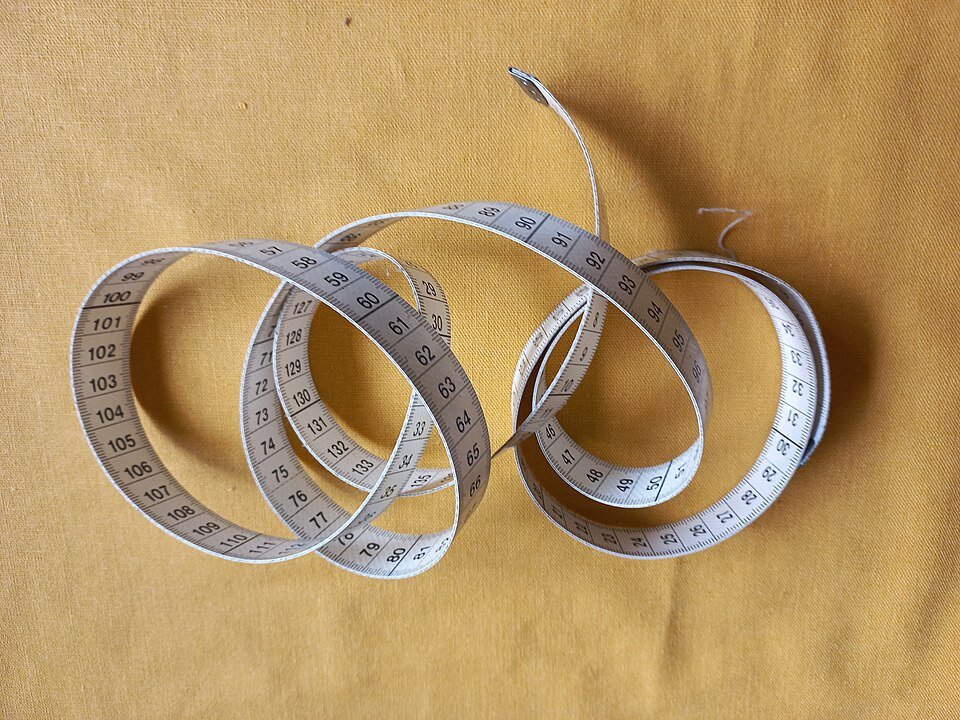
Lay the clean, dry sweater on a flat surface without pulling it into a preferred shape. Smooth only enough to remove accidental folds. Let sleeves rest naturally and keep the same orientation for both measurement sessions. A soft tape is useful if it can be read without stretching the fabric.
Choose a few meaningful points: body length between specified landmarks, chest width laid flat and sleeve length along a defined route. Write down exactly where the tape begins and ends. Do not alternate between shoulder seam and neckline as though they were the same reference.
Take photographs with the tape visible where practical. Measurements taken while the garment hangs under its own weight are not directly comparable with flat relaxed measurements. If a knitted edge curls naturally, note that condition rather than pinning it flat by force. The record needs consistent handling more than a large number of figures.
Reserve the drying surface before washing
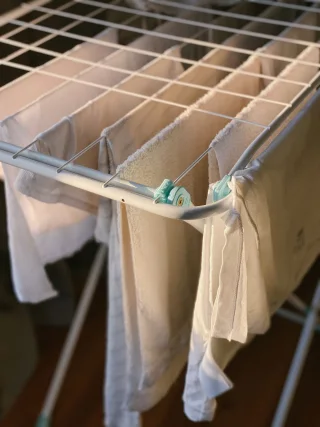
Check how much flat support the sweater needs and prepare the permitted surface before wetting it. Woolmark's drying guidance recommends flat support for knitwear and gentle reshaping. Follow the garment's more specific instructions where supplied. Do not hang wet knitwear from the shoulders simply because the rack is full.
Use a suitable pale, lint-free support where directed and keep the location away from unapproved direct heat or sun. Make sure the sweater can lie without sleeves dropping over an edge. A drying route that requires folding the body into a small space is not ready yet.
Choose a time when you can transfer the garment promptly after washing. A carefully selected cycle is only part of the route; leaving wet knitwear bundled in a basket removes the planned support. Postpone the wash while the garment is still dry if the necessary drying position is unavailable.
Use the permitted process without extra agitation
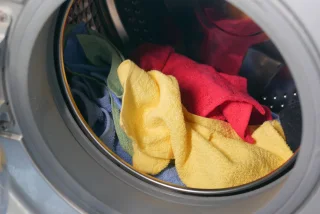
Select the hand or machine route actually authorised. For a machine, read the model's programme instructions and load limit. A control labelled “hand wash” does not automatically override a garment requiring a specific method. Resolve ambiguity before starting rather than assuming a familiar cycle is gentle enough.
Choose a suitable mild wool detergent. Woolmark advises against heavy-duty enzyme detergents and bleaches for wool. Measure the chosen product according to its directions and avoid adding another booster. A stain needing an incompatible treatment is a separate professional-care question, not a reason to disregard the material limits.
Handle wet knitwear with support and follow the label's water-removal directions. Avoid twisting, pulling sleeves or lifting the full wet weight from one narrow point. Lay the sweater into its permitted drying position and gently arrange it as directed. Do not stretch it to the recorded dimensions while it is vulnerable.
Calculate a clearly labelled comparison
All measurements here are invented and illustrative. Suppose a sweater's relaxed body length is 60 cm before washing and 58.5 cm after complete permitted drying. The observed reduction is 60 − 58.5 = 1.5 cm. Relative to the initial length, 1.5 ÷ 60 × 100 = 2.5%.
| Dimension | Before | After | Observed difference |
|---|---|---|---|
| Body length | 60 cm | 58.5 cm | 1.5 cm shorter |
| Chest width | 50 cm | 50 cm | No measured change |
| Sleeve length | 56 cm | 56 cm | No measured change |
The arithmetic does not prove permanent shrinkage or identify its cause. First check measurement landmarks, garment dryness and placement. A small household record is not a laboratory dimensional-stability test. It gives you a concrete observation to discuss with the maker, especially if the garment's fit or surface also changed.
Interpret fit and texture alongside the figures
After drying, compare the sweater's outline and surface with the earlier photographs. Look at cuffs, neckline and seam alignment. A changed body length without a fit complaint may need only monitoring; a dense, stiff or visibly felted surface requires a different assessment. Do not infer cause solely from one percentage.
If the item seems changed, review the recorded programme, detergent, handling and drying route. Include any mistake honestly when seeking advice. Do not promise that hair conditioner, stretching or another wash can reverse felting or shrinkage. A recovery suggestion needs garment-specific support.
Stop measuring if repeated handling begins pulling the knit into a new shape. One careful comparison is more useful than repeatedly adjusting the fabric until it matches the preferred number. Keep the sweater supported and dry while deciding whether professional assessment, continued use or another practical choice is appropriate.
Account for measurement uncertainty before reporting change
Write the tape reading as precisely as you can genuinely repeat, rather than recording extra decimal places from a curled edge. Check that the tape lies along the same route and that its zero point has not slipped beneath the knit. A photograph showing the reference points is more useful than a highly precise number with no defined landmarks.
If two careful readings differ slightly because the garment settles differently, record that spread. Do not choose only the value that supports a suspected shrinkage problem. Let the sweater rest in its relaxed position and make one final supported reading if needed, without tugging the hem.
When contacting the maker, describe both the dimensional observation and the practical effect: for example, a cuff now sits differently or a body seam no longer aligns as before. These details help distinguish a fit complaint from a tape-placement discrepancy. Neither the percentage nor a photograph alone establishes the physical cause of a change.
Use the same measuring tape for the comparison where practical and inspect it for stretching or a damaged starting edge. Keep it flat rather than following a raised wrinkle in the knit. Record which side of the tape was read and retain the same units. These small consistency checks make the observation easier to repeat without manipulating the sweater itself.
Store the record with the care exception
Fold the fully dry sweater according to its care guidance and store it without stretching. Keep the measurement note only if it will inform future care or a manufacturer enquiry. Include the date, reference points and actual process rather than a bare list of centimetres.
For the next authorised wash, repeat the same few observations under similar conditions. Do not treat an unchanged previous result as permission to use a different detergent, hotter process or hanging method. The evidence concerns the route actually used.
The task closes when the garment is dry, its condition is assessed and any change has a clear next step. A concise measurement record turns “it seems smaller” into a specific comparison while preserving the most important boundary: the sweater's care instructions still govern what happens next.
THE REFERENCE FILE
Sources & scope
Documentation reviewed 1 Nov 2026. Examples are illustrative; this article does not claim hands-on product testing. Follow the instructions for your actual material, model and location.