Prepare a prospective handover, not a diagnosis
This is a prospective planning guide prepared and source-checked on November 1, 2026, for publication on November 7. It contains no later observations or completed future tests. Use it to turn existing refrigerator, hood or kettle notes into a short, reviewable service handover. Preparing that handover does not require contacting support, sending a message or conducting another appliance trial.
A strong handover answers a few practical questions: which appliance, what was observed, when it happened, what permitted work has already been done and what remains uncertain. It does not need a theory about a compressor, motor or thermostat. A precise symptom often helps more than a confident but unsupported diagnosis because it lets the service provider decide what evidence and access are appropriate.
Keep one appliance per handover unless a shared event, such as a power interruption, genuinely connects the records. Preserve the original notes separately. The summary should make their meaning easy to find, while the detailed record remains available if requested. Do not expand household access merely to fill a field that can honestly say unknown.
1. Resolve immediate safety and food decisions first
For a refrigerator concern, deal with food safety before planning more observations. FDA guidance uses 40°F or below for the refrigerator and 0°F for the freezer and explains that appliance thermometers are useful because controls may not show actual temperatures. A present reading does not reconstruct an unknown earlier temperature history. Do not delay a necessary food decision while trying to build a prettier timeline.

The blank notebook and pen illustrate a place to retain an observation’s date, time, location and unit before assembling the service handover. They contain no temperature result or appliance diagnosis. Address necessary food-safety decisions promptly, preserve uncertain history as uncertain, and keep actual readings separate from later explanations or professional findings.
Photo & usage
Eric Bailey · CC0 · Source. Display copies resized and encoded as WebP; no instructional details were fabricated or removed.
If perishable food has an uncertain temperature history, use the applicable food-safety guidance promptly and record the uncertainty and action taken. Do not taste food to judge safety or keep questionable food in place as a diagnostic load. A photograph of an orderly shelf and a cold reading later cannot establish that earlier storage was safe. Food disposition and appliance diagnosis are separate decisions.
For any appliance showing dangerous damage, smoke, sparking, leaking near electrical parts or other abnormal operation, stop household trials and use the appropriate urgent help route. Do not create another occurrence for a recording. Follow safe disconnection instructions only where feasible without exposure to the hazard, and leave fixed wiring, gas work, housings and internal tests to qualified service.
2. Put exact identity at the top
Write the appliance type, manufacturer, full model including suffix, region and serial identifier if already accessible. Add the approximate installation or purchase date and any relevant warranty paperwork, marking estimates as estimates. Obtain information from safe accessible labels, receipts or existing records. Do not pull a heavy refrigerator out or remove a hood cover simply to complete the heading.
Whirlpool’s manual lookup and Bosch UK’s E-Nr-based manual finder illustrate why the complete identifier matters. Use the relevant manufacturer’s regional route for your actual appliance. A product-family nickname is not a reliable substitute for a full model. Include the owner-manual document number or revision used for any household maintenance, and keep the retrieved document with your notes.
For a hood, identify the installed filter accessory and known extraction configuration separately from the hood model. For a kettle, note whether its matching original base is established. Mark an unknown accessory or base identity as unresolved. These are important limits on the care already performed, not invitations to identify hidden components by dismantling the machine.
3. Describe the symptom without deliberately reproducing it
Use a plain sentence that another person can understand: the refrigerator thermometer showed a stated reading at a stated time; the hood developed a new rattle during ordinary use; the kettle filter would not seat after the permitted cleaning sequence. Keep the observation distinct from the conclusion. “Rattle at normal setting” does not establish a failed motor, and “water visible” does not identify a leak source.
Add the ordinary operating context already recorded: control setting, recent door use, cooking method, selected kettle fill within its limits or an earlier power interruption. Explain where a thermometer was placed and whether the reading was from an independent appliance thermometer or the control display. Include units and times rather than describing a temperature as merely high or low.
State frequency honestly. “Observed twice this week” means two documented observations, not twice every week. If the household did not watch continuously, say so. There is no requirement to manufacture a repeatable fault before requesting help. Do not hold a loose panel, run an appliance partly assembled or access an energized mechanism to obtain a better description.
4. Build a timeline that preserves gaps
Put dated observations and completed actions in chronological order, using local time consistently. Mark approximate times and unknown periods. A brief table or sequence can distinguish the first noticed symptom, a permitted care task and the next ordinary-use observation. Do not describe “first noticed” as “fault began” unless the evidence really establishes that moment.
Consider this invented timing example. A household records a hood rattle at 18:10, switches it off at 18:15 and writes the note at 18:25. The documented period between noticing and switching off is 5 minutes; the note was written 10 minutes after switch-off and 15 minutes after the initial observation. These are elapsed-time calculations, not evidence of how long the underlying fault existed.
If the previous ordinary use was the evening before, the gap remains unknown. Do not stretch the five-minute observation into a statement that the fault lasted only five minutes, and do not claim continuous monitoring. Accurate gaps help a service provider understand the limits of the record. The same principle applies to refrigerator temperature readings separated by hours: two points do not establish every intervening temperature.
5. List completed work with its permission and result
For each task already performed, record the date, exact manual section, action and observed result. Examples might include a permitted user-removable hood-filter clean, a kettle filter refit or an external refrigerator observation. Distinguish “planned,” “attempted” and “completed.” If a task stopped because instructions did not match the part, that stopping reason belongs in the handover.
Use restrained outcome language: deposits reduced, panel seated according to the diagram, symptom still present during later ordinary use. Do not say professionally tested, electrically safe or extraction certified when no such assessment occurred. A household record cannot substitute for measured service findings. Nor should a completed cleaning task be presented as proof that the original problem was caused by dirt.
Include relevant products or replacement parts used, with their exact names and compatibility basis where known. For descaling, retain the product-label and manual permissions rather than just writing “cleaned kettle.” If no chemicals were used, there is no need to invent a treatment history. Do not perform extra maintenance solely to make the handover look thorough; it may alter useful evidence or exceed the authorized user role.
6. End with one clear request and a review boundary
Draft a compact closing request for the next appropriate service conversation: please advise the model-specific next step for the recorded symptom and unresolved fit or operation question. Keep any preferred appointment details separate from technical evidence. This guide prepares the wording only; it does not contact support, book service or authorize anyone to send the record on your behalf.
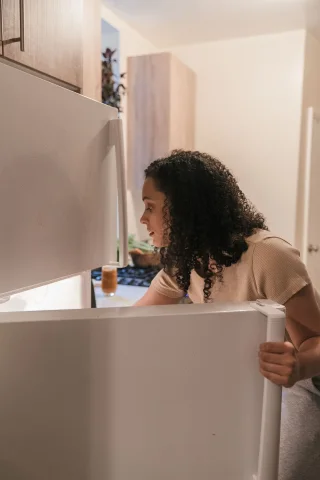
Review attachments before any later sharing. Choose a few relevant photographs of accessible condition, identity or permitted assembly, and remove unrelated household or personal information. Keep original timestamps where useful, but do not annotate a photo to imply a measurement it never contained. The reference refrigerator photograph shows a thermometer being checked; it does not demonstrate your appliance’s temperature history.
The handover is ready when a reader can identify the appliance, understand the symptom and timeline, see the completed permitted work and locate the remaining uncertainty. Stop there. Further diagnosis, intrusive access and electrical testing belong to the appropriate service process. Update the draft only when real new information arrives, dating it honestly rather than writing predicted results into a future publication schedule.
THE REFERENCE FILE
Sources & scope
Documentation reviewed 1 Nov 2026. Examples are illustrative; this article does not claim hands-on product testing. Follow the instructions for your actual material, model and location.