Describe the gap before booking space
A gap between leaving one property and entering the next changes the move. Some belongings will be inaccessible, some may be handled more than once and the delivery date may remain uncertain. Start by recording the earliest possible access date, the latest plausible date and where the household will live in between.
Identify whether storage is arranged by the mover or contracted separately. Ask who has custody at each stage, how goods are identified and whether you can access them. A warehouse shipment that cannot be opened during storage requires a different personal packing plan from a self-access unit.
Keep the booking documents for transport and storage together but distinguish their responsibilities. FMCSA's rights booklet discusses storage-related arrangements within US interstate moving services. Read the actual terms for this move and facility; do not assume that a familiar term such as “storage included” describes access, coverage or final delivery.
Pack for the longest credible period outside storage
List the supplies needed while the main load is unavailable: clothing, work equipment, personal documents, medication and essential household items. Match them to the temporary accommodation's facilities. Bedding is unnecessary luggage if suitable bedding is provided, but essential if the temporary place has none.
Allow for practical changes such as a work trip, school activity or colder weather if the gap could extend. Choose items for actual expected events rather than packing a second full household. Check luggage and transport limits before creating more personal bags than can travel with you.
Keep valuable or sensitive records under appropriate personal control. Store digital copies securely where useful and retain necessary originals. Do not put the only inventory or storage contract inside the stored load. You need those records precisely when access to the goods is unavailable.
Ask how the facility will handle your goods
Obtain written answers about access hours, booking notice, loading arrangements, permitted items, security procedures and responsibility for locks or keys. Ask how an early or delayed collection changes the charge. Verify any required notice period before planning the onward move.
Discuss the nature of the goods without assuming that a general facility description guarantees suitability. Textiles, upholstered furniture and electronics may have particular packing or environmental requirements. Use the item's instructions and the facility's acceptance rules, and ask what conditions are actually maintained rather than relying on the word “climate” alone.
Inspect a self-access space before unloading where possible. Record visible leaks, damp patches, damaged seals or access obstructions and ask the operator to resolve concerns. An observation does not identify the underlying cause or predict future conditions. If the facility cannot answer a relevant question, choose a different arrangement or obtain specialist advice for sensitive objects.
Remove prohibited and unsuitable items deliberately
Read both carrier and facility restrictions. The two lists may differ. Ask about liquids, fuels, batteries and cleaning products instead of treating a sealed carton as acceptance. EPA's household hazardous waste guidance explains why leftover products require local handling arrangements and should not be mixed together.
Keep restricted items in their original labelled containers while arranging a suitable route, following the label and local instructions. Do not drain chemicals into another bottle to make them easier to pack. If a container is damaged or leaking, seek appropriate handling advice before transporting it.
Review unwanted electronics separately. EPA advises removing personal information before donation or recycling and identifies special battery concerns. For a device you are retaining, follow the manufacturer's storage preparation and battery guidance. Do not remove a built-in battery unless the manufacturer provides a safe procedure for doing so.
Price the interval and the handling
The following illustrative USD budget separates storage from transport. A unit costs USD 140 per month, and the planned interval requires two billed months. Initial transport is USD 260, final transport USD 290 and an agreed packing-material purchase USD 45.
Storage is 2 × USD 140 = USD 280. Adding USD 260, USD 290 and USD 45 gives USD 875. If a delay triggers a third billed month, the total becomes USD 1,015, an increase of USD 140. These invented amounts exclude any unlisted charges; they are a method demonstration, not market prices.
Ask whether the actual booking bills calendar months, rolling months or another period. Confirm taxes, access fees, lock charges and cancellation terms before comparing offers. A lower monthly figure may be offset by an extra handling charge or an unfavourable billing boundary. Write those differences beside the quotations rather than hiding them inside an estimated total.
Pack for a later retrieval sequence
Label each carton with an identity and destination, and maintain a register outside storage. Identify the first group needed at the final property. If access is permitted and the facility allows the arrangement, place retrieval priorities where they can be reached without dismantling an unstable stack.
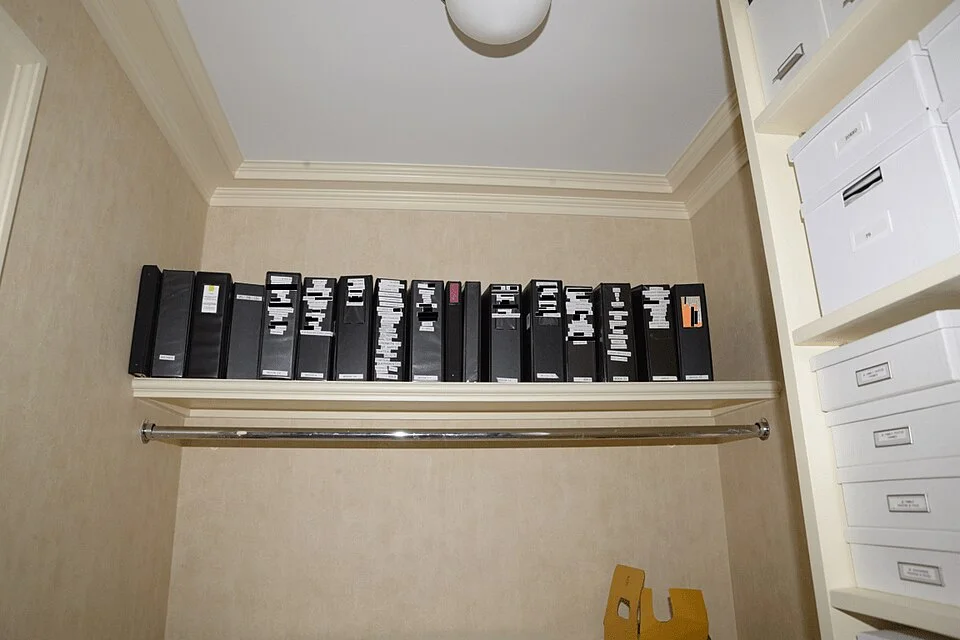
The binders and white boxes show identifiers on outward-facing surfaces, allowing separate groups to remain recognisable in storage. Apply that principle to your own cartons and keep a matching register outside the stored load. This archive-storage reference does not establish custody, permitted stack height, environmental conditions or access rights at a moving service.
Photo & usage
Federal Bureau of Investigation · Public domain · Source. Display copies resized and encoded as WebP; no instructional details were fabricated or removed.
Ask the packing supplier or mover about appropriate cartons, cushioning and stacking limits. Do not infer a safe stack from available ceiling height. Keep heavy and fragile contents in packaging designed for them, and follow instructions for furniture components and textile protection.
Record the packed condition with photographs linked to identities. For self-storage, make a simple placement sketch showing the groups and access path. Avoid writing valuable contents on exterior labels. If the operator controls the loading layout, ask how goods will be traced and retrieved rather than promising yourself access the service does not offer.
Set a trigger for extending the gap
Choose a date to review the onward move before the next billing or notice boundary. Check the destination's actual readiness, the carrier's availability and building access together. A hoped-for key date is insufficient if the receiving lift cannot be booked that week.
If the gap extends, update the personal supply plan first. Decide whether missing seasonal or work items can be retrieved under the contract, borrowed or temporarily replaced. Compare the actual retrieval cost and effort with the specific need. Do not unpack the stored load simply because one inexpensive object would be convenient.
Maintain current contact details with the facility and mover. Record changes in writing and preserve earlier confirmations. An extension should update dates, charges, access and delivery expectations, giving everyone the same version of the plan.
Check retrieval before closing the account
At collection, reconcile the goods with the stored register and inspect visible condition. Record exceptions through the applicable facility and carrier procedures. Keep relevant packaging and photographs where needed, and separate a missing-piece question from a condition question.
For self-access storage, inspect the emptied space, remove permitted waste through the agreed route and follow the operator's checkout process. Return keys or access devices where required. Obtain written confirmation of the end date and any final charge rather than assuming an empty unit automatically ends the contract.
The storage interval is complete when the household has its load accounted for, the onward destination can receive it and custody and billing have ended as documented. Retain the contracts and exception records until any unresolved matters are settled.
Keep custody changes traceable
Ask how the load is identified when it enters storage and again when it leaves. Keep the facility reference linked to the carrier shipment number so a delayed delivery enquiry can reach the right record. If another company performs the final journey, obtain its identity and the handoff arrangement before collection.
Check that the household's carton register still matches the stored load after any authorised access. Record a retrieved carton as removed from storage rather than simply crossing it off the list. Onward delivery should be reconciled against what remained, not the original packed total. This small distinction prevents a personally collected bag from later appearing as a missing warehouse item.
THE REFERENCE FILE
Sources & scope
Documentation reviewed 1 Nov 2026. Examples are illustrative; this article does not claim hands-on product testing. Follow the instructions for your actual material, model and location.