The words “colour-safe” can sound reassuring when a stained garment carries a no-bleach instruction. They do not settle whether that product is permitted. Compare the actual care symbol with the actual detergent and stain-product labels before treating the mark. The useful outcome is a compatible route, not a stronger product chosen because its marketing sounds gentler than chlorine bleach.
Read the complete bleaching instruction
Locate the triangle on the care label and read any words beside it. In the GINETEX system, an empty triangle permits bleaching, two diagonal lines permit oxygen bleach but not chlorine bleach, and a crossed triangle prohibits bleaching. Do not treat the two restricted symbols as equivalent.
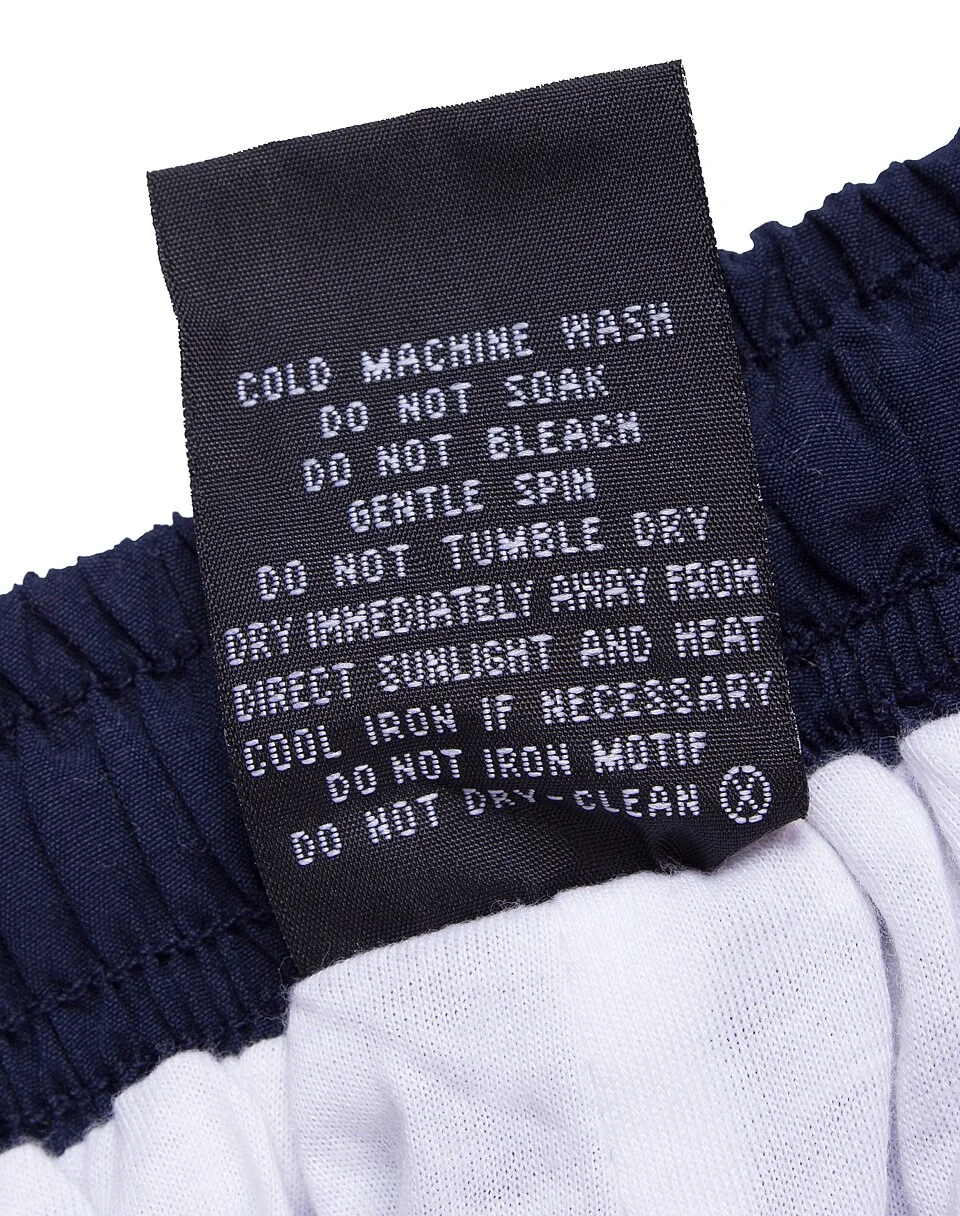
The label explicitly prohibits bleach while also setting washing, soaking, spinning and drying limits. Read all those instructions together before comparing detergents, pretreatments or boosters. A no-bleach instruction still applies when a combined product contains the bleach ingredient; this photographed garment label does not supply permission for a different textile.
Check that you are looking at the care label for the whole garment rather than a fabric swatch, spare button packet or removable accessory. Photograph the label if several products will be compared away from the laundry area. Keep unclear symbols unresolved until you can identify the applicable system and instruction.
Read washing and drying limits too. A permitted bleach type does not authorise any temperature, prolonged soak or tumble cycle. The care route is a set of connected limits. FTC guidance concerns the constructed garment, so decorative parts and linings remain relevant even when the main fabric appears robust.
Inspect all products in the proposed route
Place the detergent, pretreatment and any booster together with their labels visible. Look for bleach ingredients and explicit restrictions on fibres, colours and applications. A combined detergent can contain ingredients that matter even when no separate bleach bottle is added.
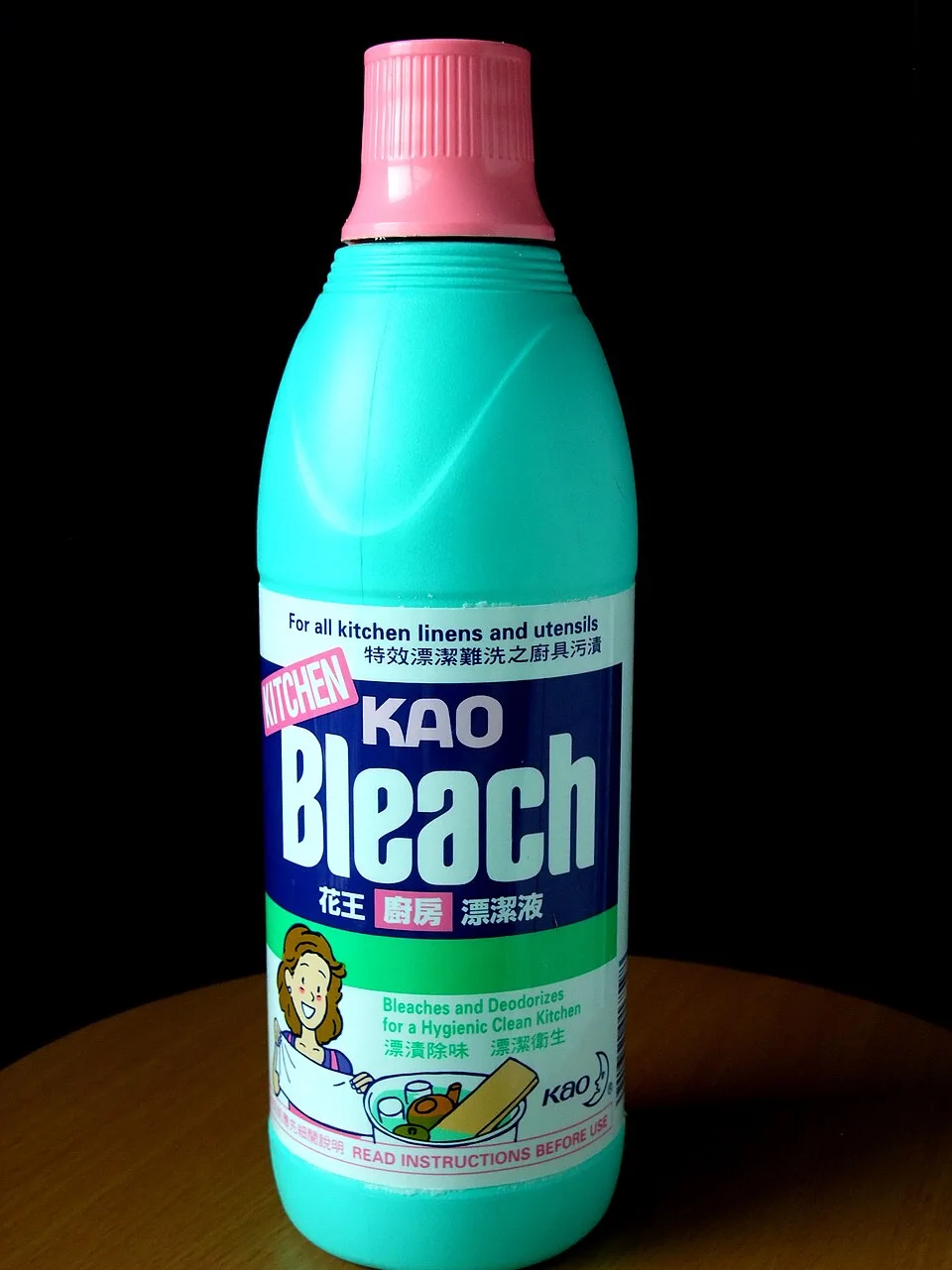
The bottle clearly identifies itself as bleach and directs the user to read instructions before use. Its bleach identity rules it out of a no-bleach garment route; this front view does not show the complete ingredient or warning panels. Check every detergent, pretreatment and booster container in full against the garment’s own restrictions before combining a treatment route.
Photo & usage
Mk2010 · CC BY-SA 3.0 · Source. Display copies resized and encoded as WebP; no instructional details were fabricated or removed.
Do not rely on package colour, a floral scent or the word “gentle.” If the formulation or directions are unclear, contact the product manufacturer with the exact name and version. Products with similar branding can differ. Keep the answer linked to the specific container rather than applying it to every product in that range.
A no-bleach garment needs a compatible bleach-free route. For an oxygen-only garment, the product must still permit that fabric and application. Woolmark's detergent guidance excludes both chlorine and oxygen bleach for wool care. That is an additional material-specific reason to examine a product, not a substitute for reading the actual wool garment's complete instructions.
Make a product-permission comparison
This table is illustrative and invented. It compares fictional product descriptions with different garment instructions. It does not identify real formulations or recommend a product. The point is to separate a marketing phrase from a specific permission.
| Garment instruction | Product information | Decision |
|---|---|---|
| Do not bleach | Oxygen bleach, described as colour-safe | Exclude |
| Oxygen bleach only | Chlorine bleach | Exclude |
| Do not bleach | Bleach-free detergent; fabric permitted | Candidate for directed use |
The third row remains conditional. A detergent may be bleach-free yet unsuitable for a delicate material or for direct pretreatment. Check every relevant instruction before applying it. Do not infer that “candidate” means guaranteed stain removal, nor that a passing hidden colour test overrides a prohibited bleaching process.
Choose a compatible stain route
Identify the likely stain and its treatment history. A fresh food mark, an old unknown stain and a previously bleached patch need different decisions. Record prior heat and products. If the mark may already be colour loss, adding a stain remover cannot be assumed to restore it.
Find a bleach-free treatment explicitly permitted for the garment and intended use. Follow hidden-test, application and contact-time directions. A product designed for dilution in a wash is not automatically safe undiluted on a small mark. Do not make a concentrated paste unless the product directions prescribe it.
If no compatible home treatment is available, consider professional assessment or accept the cosmetic limitation. A restriction is a real boundary, not a challenge to bypass with an unnamed “natural bleach.” Lemon juice, peroxide and other household substances can alter colour or materials too. Avoid translating an inconvenient label into an improvised chemistry experiment.
Keep the wash group compatible
Separate the restricted garment from a load whose detergent or booster conflicts with its instructions. Matching colour is not enough. A white garment can prohibit bleach, and a dark garment can have other specific limits. Check shared products before adding an item to an already prepared machine.
For automatic dispensers, read the appliance instructions and verify what product is in each compartment or reservoir. Do not assume selecting a gentle cycle disables every additive. If you cannot confirm the dispensing route, resolve it before loading the restricted garment. Follow the manual for changing or cleaning reservoirs.
Measure detergent according to the label and use the garment-permitted cycle. Put an inspection hold on the item before heat drying when treating a stain. A compatible wash can still leave a mark, and that result needs observation rather than automatic escalation to a prohibited product.
Respond clearly to an accidental mismatch
If an incompatible product has already been applied, stop adding other chemicals. Read the product's removal and safety instructions and contact its manufacturer or the garment maker where needed. Do not try to neutralise it with vinegar, ammonia or another household cleaner.
Record the product, concentration if known, location and approximate exposure. Photograph any colour or texture change after the instructed safe handling steps. Keep the garment separate from routine laundry until its status is clear. A factual description will help support assess the problem more than saying only that it was “a gentle product.”
If the fabric develops a pale patch or weak area, distinguish damage assessment from stain removal. Repeated washing may remove residue where permitted, but it cannot be assumed to restore dye or fibre strength. Be candid about the limitation and avoid promising that a colour-restoring remedy will return the garment to its original condition.
Finish with a readable product exception
After a permitted wash and drying route, inspect the original mark, seams and trim. Compare colour and texture with unaffected areas under consistent light. If clean and unchanged, return the garment to normal care. If unresolved, keep a clear hold rather than moving it into the ironing pile.
Save a brief note for garments whose restrictions are easy to overlook: “no bleach, including oxygen products; use confirmed bleach-free route.” Include any additional material restriction. Keep products in original containers so the next person can verify the formulation rather than relying on an unlabelled household bottle.
The decision is complete when the garment and every product in its care route agree. That may lead to a compatible treatment, a professional handover or acceptance of a remaining mark. It should never depend on assuming that a reassuring marketing phrase cancels an explicit care prohibition.
THE REFERENCE FILE
Sources & scope
Documentation reviewed 1 Nov 2026. Examples are illustrative; this article does not claim hands-on product testing. Follow the instructions for your actual material, model and location.