
Set up a receiving position
Unpacking feels productive, but it can distract from the moment when a household needs to know what has actually arrived. Before delivery, choose a receiving position with the carrier inventory, household carton list, a pen and a charged phone. Keep the entry route clear and avoid making the receiver responsible for assembling furniture at the same time.
Identify the person who will ask questions and record exceptions. Other household members can direct room placement, provided they use the agreed names. If several people sign or annotate different copies without coordination, the final record can become harder to understand than the original delivery problem.
Read the carrier's delivery and claim instructions before the vehicle arrives. FMCSA's materials concern US interstate household moves; other moves have different rules and contract terms. This article describes a household receiving method, rather than a universal claim deadline or a guarantee that a particular note settles liability.
Check identities as well as totals
Mark cartons and furniture against their actual identifiers. A total of twenty boxes is insufficient if one belongs to another shipment and one of yours is missing. Compare carrier tags with the household labels, and make a translation note where the numbering systems differ.
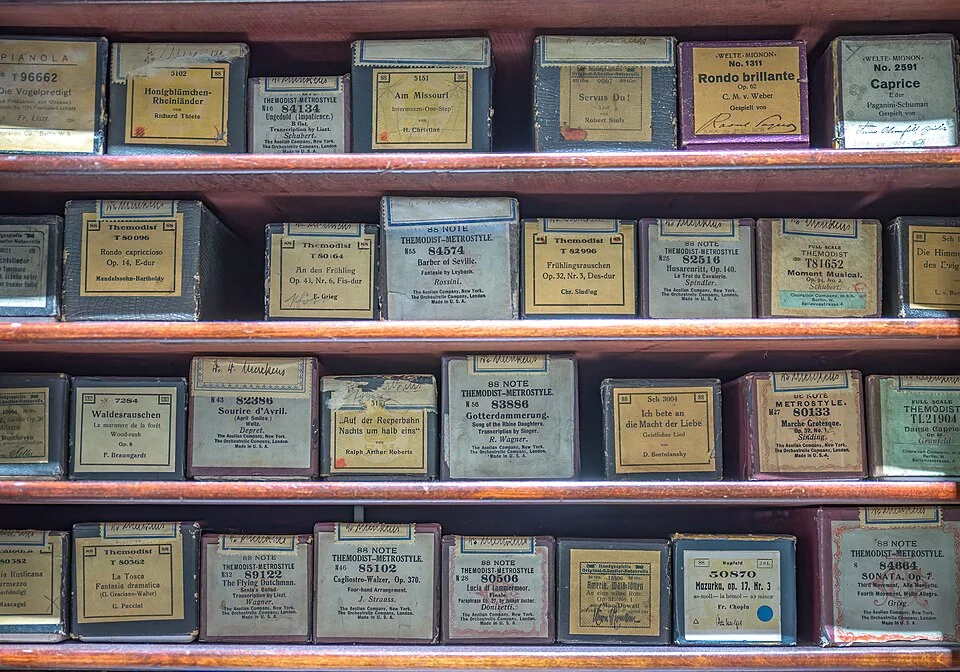
The outward-facing ends carry different titles and numbers, illustrating why a total alone cannot identify a collection. For a household delivery, compare each actual carrier tag with the receiving list and record any translation between numbering systems. These are archive boxes, not a photographed shipment or evidence of a successful delivery count.
Ask the crew where exceptions should be recorded on the delivery documents. Keep your own notes as a supporting record. If a box arrives without a readable label, identify it with the crew before it disappears into a stack. Avoid writing a new identity that makes the original tag impossible to trace.
Use a pending column for objects that have not yet been located. A pending mark means a search is needed, not that a loss has been established. Check the vehicle process with the crew and search the destination rooms before recording a final discrepancy. Record who checked and what was found.
Describe condition in observable terms
Use descriptions that someone else could recognise: a split seam on the lower right side, a crushed top corner or a fresh-looking abrasion beside an existing mark. Separate what is visible from what is inferred. “Carton wet along one bottom edge” is an observation; “contents destroyed” needs further evidence.
Photograph the whole object, its identifier and the affected area. Keep the original files and note the date and context. A close-up without a recognisable object can be difficult to connect to the delivery, while a distant room photograph may not show the mark.
Compare the departure condition record where available. If the same scratch appears there, record the match. If the new image is inconclusive, say so. FMCSA's checklist calls for missing and damaged goods to be noted before signing delivery documents; follow the carrier's procedure for uncertainties that cannot be resolved at the doorway.
Reconcile a small exception list
This illustrative receiving example uses 46 recorded shipment pieces: 34 cartons and 12 furniture items. The first pass finds 33 cartons and all 12 furniture items, so 45 pieces are physically accounted for and one carton remains pending.
| Identity | Observation | Next check |
|---|---|---|
| K14 | Not yet located | Compare tags and destination rooms |
| B07 | Crushed upper corner | Record packaging and inspect contents |
| F03 | Mark on left leg | Compare departure photograph |
Finding K14 behind bedroom cartons brings receipt to 46 of 46 pieces. It does not resolve B07 or F03. The final list therefore has zero missing pieces and two condition questions. Keeping these totals separate prevents “everything arrived” from becoming an inaccurate statement that everything arrived undamaged.
Keep packaging connected to the item
For a damaged carton, ask about the carrier's inspection requirements before discarding packaging. Keep relevant labels, cushioning and photographs together with the affected item's identity. Do not retain leaking, contaminated or otherwise hazardous packaging in an occupied room merely for evidence; seek handling instructions and document the problem safely.
Open immediate-use boxes where doing so does not interrupt receiving duties. Photograph the packaging arrangement if damage is discovered. Avoid rearranging several cartons into one pile before identifying which container held the affected object. A later statement that “one of the kitchen boxes” was damaged is less useful than a traceable sequence.
Record the condition of contents separately from the carton. A crushed corner may leave the contents intact, while an apparently sound box can contain breakage. Neither appearance alone proves what happened. Your job is to preserve a clear account of what was observed and when.
Resolve document wording without guessing
Read the documents offered for signature and ask what each statement means. If a record is incomplete or inaccurate, raise that issue with the crew and company while they are present. Do not sign blank forms or rely on a verbal assurance that an exception will be added later.
Keep copies of the final annotated documents and relevant correspondence. FMCSA's rights booklet explains US interstate moving paperwork and the distinction between reporting a problem and submitting a claim. Consult that publication and the actual carrier's instructions for the applicable process, rather than assuming a delivery note completes every requirement.
If the delivery is rushed, maintain the minimum useful record: identities received, visible exceptions, time, people involved and copies of what was signed. Detailed unpacking can continue afterwards. Trying to photograph every undamaged plate at the doorway may consume attention needed for an unresolved missing furniture piece.
Move from receiving to controlled unpacking
Transfer unresolved items to a short follow-up list with one responsible person and the carrier contact. Record any required action and the actual deadline supplied by the applicable documents. Check that the deadline refers to the right process and jurisdiction before relying on it.
Unpack by household need while marking contents checked in the register. When a later problem appears, retain the connection between item, carton and delivery date. Contact the carrier promptly through its stated channel, with a factual description and supporting material. Avoid embellishing uncertainty into an allegation the evidence cannot support.
Finish receiving when every expected piece is accounted for or listed as unresolved, visible condition issues are recorded, and the household has copies of the relevant paperwork. Unpacking can remain unfinished. A clear receiving record should survive the eventual disappearance of every moving box.
Check assemblies and paired components
Some delivery discrepancies hide inside a correct piece count. A table may arrive while its separately packed legs or fixing bag remain elsewhere. List the components needed to make each essential assembly usable, and ask the crew how those components are identified in its record. Do not change the carrier's count yourself; keep a household assembly note alongside it.
For paired furniture, identify left and right pieces by the manufacturer's terminology or a clear photograph. Check that both are present before moving them into different rooms. A matching finish can make distinct components look interchangeable, especially when protective wrapping conceals their connections.
Where assembly is included, confirm what completion means before the crew leaves: correct components, specified fittings and any required anchoring arranged under the service terms. Do not use incomplete furniture because it appears stable when unloaded. Record a missing fixing as an unresolved assembly issue, and obtain the correct replacement rather than substituting an unidentified screw from another carton.
THE REFERENCE FILE
Sources & scope
Documentation reviewed 1 Nov 2026. Examples are illustrative; this article does not claim hands-on product testing. Follow the instructions for your actual material, model and location.