A revised estimate is not elapsed time
A dryer that adds minutes can seem to be failing a promise. First establish what the display represents. On an automatic programme, remaining time may be revised as the appliance responds to the load. Record the actual start time separately so the initial estimate, later estimates and real elapsed duration do not become one confused number.
Whirlpool: Dry Time Keeps Going Up explains that automatic drying estimates can change with sensed conditions. It is guidance for the covered products, not a declaration that every extended run is normal. The fabric endpoint, errors and unusual operation still matter. A machine that repeatedly leaves appropriate loads wet deserves more than reassurance about its countdown.
Find the exact model and programme guide before comparing runs. Note whether the selected cycle is automatic, timed or a special programme. An adjustment on an automatic run is a different observation from a timed run failing to end as its manual describes. Keep those cases in separate records.
Write what the estimate is responding to
Record load composition, whether the preceding spin completed normally and the accepted dryer settings. Include selected dryness, heat where available and any energy or extended-tumble option. A load of dense towels should not be compared directly with a few lightweight tops merely because both started with a 50-minute display.
Whirlpool: Using Auto Dry, Timed Dry and EcoBoost describes an EcoBoost option on certain covered models that can lengthen drying time while changing operation. Do not apply its published timing example to another appliance. The practical step is to check whether your actual machine has an option enabled that the household forgot about.
Confirm normal user maintenance according to the model. A required screen must be in place, and user filters must be maintained as instructed. Do not open internal ducts or service panels to investigate a changing estimate. Record maintenance dates and any indicator, keeping the actual action separate from the assumption that a clean-looking screen proves the entire airflow path is clear.
Observe without repeatedly interrupting the programme
Choose a small number of timepoints during ordinary operation. Note the clock time, displayed remaining estimate and current status. Do not repeatedly open the door just to make a denser log; interruptions change the process and may introduce restart or cooldown requirements. Observe controls from a normal safe position.
Copy errors exactly and record unusual heat, noise, smell or shutdown. Stop and seek appropriate help for concerning abnormal behavior. Do not run another full load merely to see whether a fault repeats. A clear event record can be enough for manufacturer support.
If the display enters an extended-tumble or wrinkle-management stage, identify it through the manual rather than adding it silently to active drying time. The household may care about the total time before unloading, but the machine's stages have different purposes. Record both the normal programme finish indication and the time someone actually unloads where that distinction matters.
Mark the moment the task changes stages
If the appliance reports cooling, wrinkle prevention or another post-drying stage, write the exact status and time. Do not combine those minutes with an assumed heating interval. The household's total waiting time can include all stages, but a service enquiry about prolonged drying needs to distinguish them. A quiet period can also be part of normal operation, so use the documented status rather than sound alone.
When comparing a later run, use the same timing endpoint. One entry ending at the drying-complete indication and another ending when extended tumbling stops would produce a false duration difference. Keep actual unloading time in a separate field. This small distinction lets the record answer both practical scheduling and equipment questions without pretending that the household measured heater-on time or internal sensor behavior.
Calculate elapsed time independently of the estimate
These timings are illustrative and invented. They show a hypothetical automatic programme with no door interruptions. No dryer has been tested, and the figures do not define an acceptable duration for any model.
| Clock time | Displayed remaining time | Elapsed since start |
|---|---|---|
| 14:00 | 50 minutes | 0 minutes |
| 14:30 | 30 minutes | 30 minutes |
| 15:00 | 15 minutes | 60 minutes |
| 15:15 | Normal completion | 75 minutes |
Actual elapsed time is 75 minutes, which is 25 minutes longer than the initial 50-minute estimate. At 14:30, the display's estimated finish was 15:00; the later revision changed that expectation. These calculations describe the interface and clock. They cannot establish energy use, airflow, sensor accuracy or whether the final fabric endpoint was appropriate.
Judge the laundry after the normal finish
After normal completion and any required cooldown, unload safely and inspect the load's relevant areas. Note whether the items are ready for their next care step, unevenly damp or generally wetter than expected. Keep the result tied to the original load description. A long run ending appropriately is different from a long run that never reaches a useful endpoint.
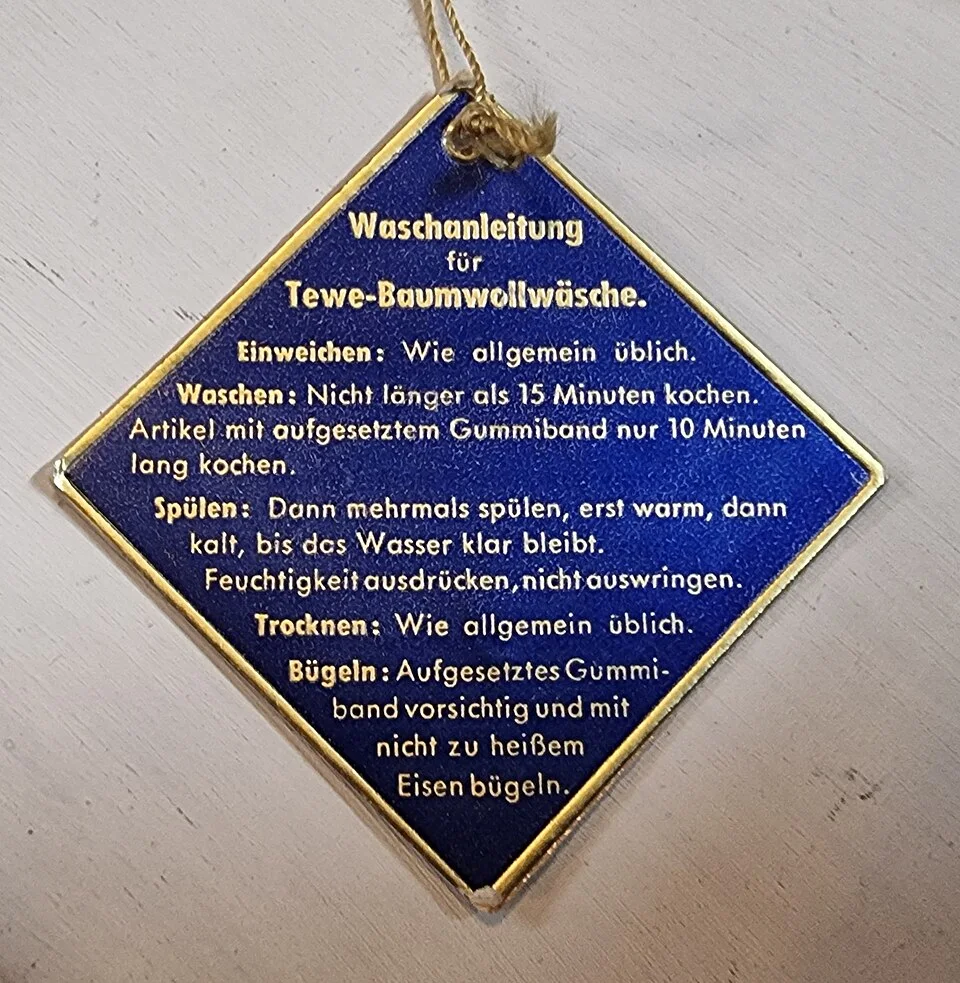
This historical physical tag separates washing, rinsing, drying and ironing instructions in text. It illustrates why the actual item’s full care guidance belongs with any endpoint decision. Do not adopt the historical treatment as a modern recipe; after the documented dryer finish, judge the real garment’s relevant seams and layers within its current instructions.
Photo & usage
Bernd Schwabe in Hannover · Public domain · Source. Display copies resized and encoded as WebP; no instructional details were fabricated or removed.
Whirlpool: Auto Dry or Timed Dry on a HybridCare Electric Dryer discusses automatic and timed drying for the covered HybridCare system. If the manual provides an approved dryness adjustment or particular small-load route, follow that model-specific guidance. Do not replace an unresolved automatic problem with repeated maximum timed runs without understanding the permitted follow-up.
Do not infer a health or material-safety result from the finish indication. It tells you how the appliance ended its selected programme, not the condition of every fabric layer or every indoor pollutant. The household observation remains practical: which items are ready and which need another appropriate care decision.
Know when the pattern deserves support
Use naturally occurring similar loads for a limited comparison, keeping accepted options and normal maintenance documented. Record differences in starting extraction, fabric composition and room or installation conditions relevant to the manual. Do not create extra drying work to build a larger dataset.
If estimates vary but ordinary appropriate loads finish well, keep the timing as a planning range rather than a fault diagnosis. If comparable loads repeatedly become much longer, remain wet or show errors, consult the exact troubleshooting and contact support. Abnormal heat, burning smell or unstable operation should not wait for a multi-load comparison.
Provide the model, programme, settings, few timepoints and final result. Ask which user checks are appropriate and when service is needed. Do not prescribe a moisture sensor, heater or control board from the countdown alone. A changing estimate can have several explanations, and a non-invasive household record does not distinguish internal faults conclusively.
Leave the display in its proper role
Summarize the ordinary observed duration range for the specific load and settings, with the conditions and number of runs. Label it household experience rather than a guarantee. Use it to plan unloading with a margin, and check the actual completion indication before handling laundry.
Keep any manufacturer advice and maintenance changes alongside the record. If a service action occurs, mark that date before comparing later timing. A shorter run afterward may be useful evidence, but different loads or options still need to remain visible. Do not rewrite earlier estimates as actual durations.
Completion means the household understands the estimate, can distinguish programme stages and knows which repeated symptoms justify help. The outcome may be a more realistic schedule or a focused service request. Neither requires claiming that every added minute is harmless or that the shortest countdown proves the best drying performance.
THE REFERENCE FILE
Sources & scope
Documentation reviewed 1 Nov 2026. Examples are illustrative; this article does not claim hands-on product testing. Follow the instructions for your actual material, model and location.