Stay with visible pipework and ordinary conditions
A cold-water pipe can become a wet line across an otherwise dry utility area. Before wrapping it or blaming the room, choose one accessible length to observe. Keep away from hot pipes, electrical equipment and inaccessible voids. Do not remove existing insulation or a cover to find a more photogenic example.
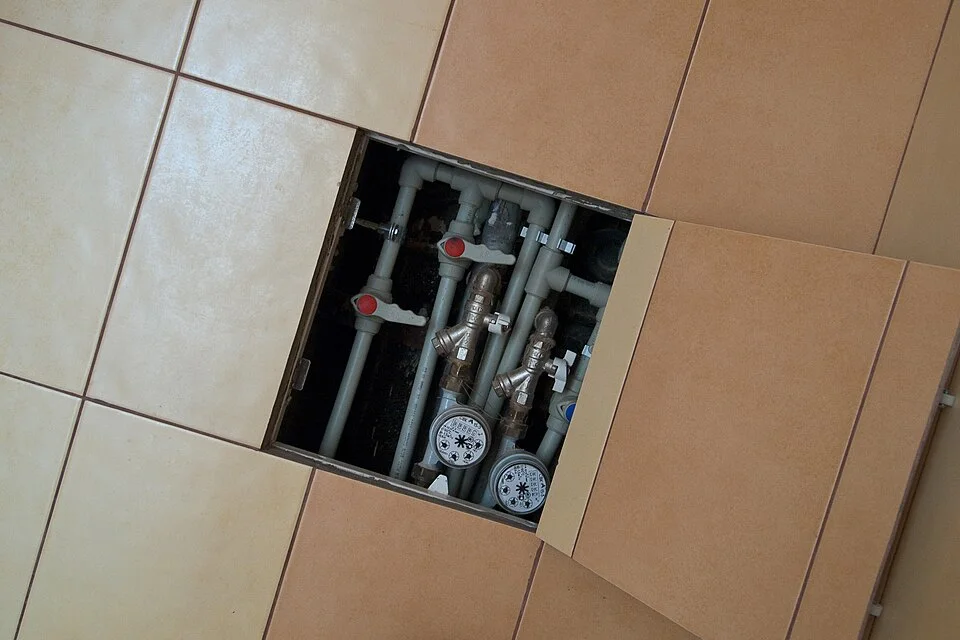
The open hatch reveals separate pipe runs, valves and meters, illustrating why location and service identity should be recorded carefully. Use only pipework already accessible in your home; do not remove a panel or insulation to reproduce this view. Appearance does not identify the cold supply, prove condensation or distinguish it from a leaking joint.
Photo & usage
Vyacheslav Argenberg · CC BY 4.0 · Source. Display copies resized and encoded as WebP; no instructional details were fabricated or removed.
Write the location and what you know about the pipe's service. If you cannot confidently identify it, call it the visible pipe near the sink rather than cold supply. Some pipes carry other services, and appearance alone is an unreliable identification method. Ask the property manager or plumber where necessary.
EPA: A Brief Guide to Mold, Moisture and Your Home includes condensation on pipes among moisture conditions needing prompt attention. Protect and dry affected accessible surfaces appropriately while investigating. The purpose of the record is to explain recurring water and prevent damage, not to leave a wet pipe dripping until the notebook contains a preferred number of observations.
Follow the highest visible wet point
Look for broad beading along the pipe, isolated water near a joint, a run from above or wet material beneath it. Record the highest visible wet point rather than only the final hanging drop. Gravity can bring water to a joint that is not itself leaking. Do not touch fittings or tighten them to see whether the pattern changes.
If ordinary clean water can be wiped safely from an accessible exterior, note when you do so. Watch whether new beads form across a length or whether a localized point becomes wet first. Stop if active leakage appears. Do not run a tap for an extended period solely to cool the pipe or create droplets.
Keep nearby events in the record: normal water use, a recent shower, window opening, a humid day or appliance operation. These events can change air or surface conditions, but a time association alone does not establish a mechanism. The pipe and the room need separate descriptions.
Use dew point as context, not a leak detector
Condensation can occur when a surface is cold enough relative to the surrounding air's dew point. National Weather Service: Dew Point vs Humidity explains that relationship. A central room reading may not represent a closed cabinet or a pipe beside a cool wall, so label the meter position clearly and record temperature with RH.
A surface thermometer, if already available and suitable, has its own limitations on reflective or curved materials. Do not assume an infrared reading on shiny metal is exact. You do not need a surface-temperature measurement to report visible water or request assessment. Avoid buying tools simply to turn an obvious wetness problem into a more technical-looking one.
The key boundary is that condensation conditions can coexist with a leak. Even a plausible dew-point comparison cannot prove a fitting is sound. If water appears concentrated at a connection or continues unexpectedly, include that observation and ask for plumbing assessment. Room humidity does not absolve a joint from investigation.
Read a pattern without assigning a repair
The following invented entries are illustrative. They show separate hypothetical observations, not a sequence from a tested pipe. The table deliberately uses ordinary descriptions because no water-flow or material-moisture measurement has been made.
| Observation | What it supports | What it cannot establish |
|---|---|---|
| Fine beads reform across a cold length after normal use | Investigate surface condensation | That all joints are leak-free |
| Only one connection becomes wet first | Investigate a localized water source | The exact failed component |
| Water runs down from above the visible length | Trace a higher source professionally | That the visible pipe is responsible |
A wrap chosen from the first row could conceal the second or third problem if the observations were incomplete. Keep the evidence and remedy as separate stages. The right outcome may involve pipe insulation, room-moisture control, leak repair or more than one of those actions.
Check moisture sources before treating the pipe alone
Note ordinary sources nearby: drying laundry, an open humidifier, a recently showered bathroom or warm outdoor air entering a cool utility area. Use intended extraction and keep permanent openings clear. Do not close every vent to make the pipe warmer or disable normal water use for a prolonged household trial.
PNNL Building America: Whole House Ventilation Strategies for Existing Homes treats additional humidity from ventilation as a design consideration, especially in humid climates. That supports a conditional approach to window airing. More outdoor air is not automatically a drying method when the incoming air has a high moisture content and the room contains cold surfaces.
If the pipe droplets repeatedly appear during warm-weather airing, record the timing and seek advice on the existing ventilation and moisture-control arrangement. If several cold surfaces become wet, describe the wider pattern. If only one connection is affected, preserve that local detail. The room contribution should not erase evidence of a separate plumbing problem.
Do not insulate over unexplained wetness
Ask a suitable professional to confirm the pipe service and assess uncertain leaks before adding insulation. Pipe insulation needs appropriate material, continuity and treatment of joints for the actual system. A partial improvised wrap can leave cold gaps or conceal water, and some services have requirements that a general household article cannot specify.
Do not use adhesive, expanding foam or a towel as a universal solution. A wet absorbent wrap can hold moisture against materials and make recurrence harder to see. Keep valves and service points accessible as required. Follow the relevant insulation and pipe instructions rather than copying dimensions from an unrelated installation photograph.
Provide the professional with the location sketch, first wet point, ordinary use association and any room notes. Ask which outcome will demonstrate that the source has been addressed. If surrounding cabinetry or wall material has been repeatedly wetted, include drying and restoration in the discussion instead of treating a dry pipe exterior as the whole repair.
Finish through the original ordinary trigger
After appropriate action, revisit during the normal water use or weather that previously produced droplets. Check the pipe's accessible exterior, visible joints and the surface below. Where new insulation is installed, follow the professional's advice for checking its condition without opening or damaging it.
A successful result is no recurring unexplained water and no continuing damage beneath the pipe. Keep the service note and the household observation together. If wetness returns at a different point, record that rather than assuming the original cause has returned unchanged. The first repair may have resolved one contributor while revealing another.
Close the task with a practical maintenance cue: inspect this accessible area during ordinary cleaning or after the original seasonal trigger. Do not claim that an RH display or a dry-looking wrap certifies concealed material. The useful achievement is a traced water path, an appropriate remedy and an observation routine that does not hide recurrence.
THE REFERENCE FILE
Sources & scope
Documentation reviewed 1 Nov 2026. Examples are illustrative; this article does not claim hands-on product testing. Follow the instructions for your actual material, model and location.