Start with water protection and access
A puddle under a sink usually reaches its final resting place after travelling over a pipe, bottle or cabinet edge. The wettest point may therefore be far from the source. Begin by stopping unnecessary use, protecting the accessible cabinet appropriately and moving ordinary stored items out of the way. Keep cleaning chemicals upright and separate, following their labels.
If water is actively escaping, use a known accessible shutoff only if you can operate it safely and are authorized to do so; arrange plumbing help. Do not force a seized valve. Water near electrical equipment, a waste connection with suspected contamination or a rapidly growing leak needs prompt appropriate assistance rather than a prolonged observation exercise.
EPA WaterSense: Take the 10 Minute WaterSense Challenge specifically includes under-sink pooling and joint corrosion among places to check. Use those as visual clues, not as instructions to tighten every connection. This record does not authorize dismantling plumbing or diagnose a component from a photograph.
Identify the visible paths without touching them
Sketch the accessible arrangement: hot and cold supplies, faucet underside, drain body, trap and any appliance connection you can identify confidently. Label uncertain items as unknown rather than borrowing a name from an online diagram. Different sinks and appliances have different arrangements. Avoid putting hands behind sharp cabinet hardware or hot pipework.
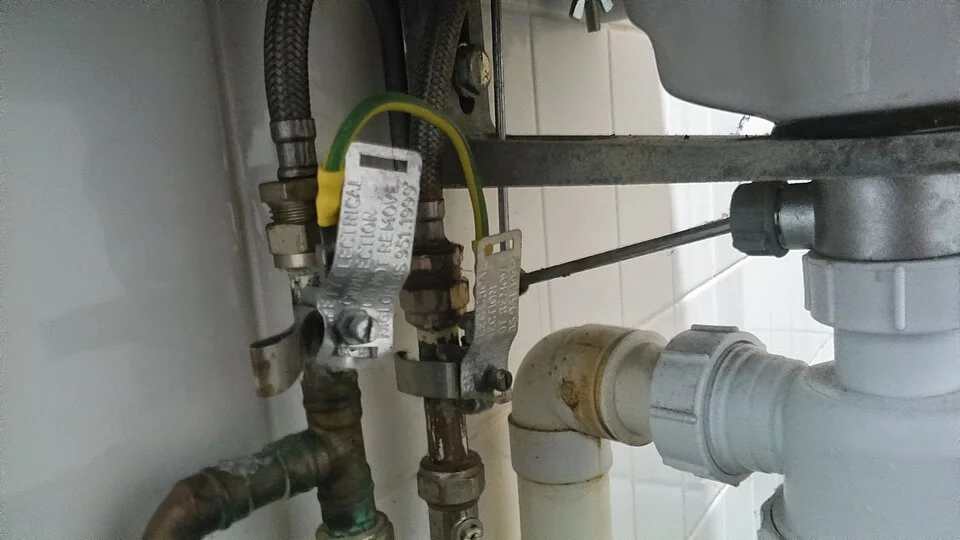
The separate metal pipes, hoses and white drain sections provide reference points for the accessible location sketch. Copy the actual arrangement without handling pipework, identify only the services you know and label uncertain connections as unknown. The photograph does not establish an active leak or make a connection safe to touch; observe where water first appears during ordinary use.
Photo & usage
247homerescue · CC0 · Source. Display copies resized and encoded as WebP; no instructional details were fabricated or removed.
After ordinary clean-water wetness has been removed safely, note which visible areas are dry and which remain wet. A dry baseline helps locate new water. Use a normal viewing distance and a flashlight if suitable, keeping it away from water. Do not wrap absorbent material around joints where it could conceal the first appearance or interfere with equipment.
Record any recent event: a bottle spilled, the sink overflowed, a dishwasher ran or a spray hose was used. A cabinet can contain water unrelated to a pipe failure. That possibility should be checked without dismissing a recurring leak because a stored cleaner happened to be nearby.
Observe only brief normal use when appropriate
If there is no active leak or other reason to stop use, a brief observation during necessary ordinary sink use may show the timing. Do not fill the basin to its brim, create an overflow or repeatedly run an appliance to provoke water. Stop as soon as new leakage appears and arrange repair.
Write whether water appeared before use, while the tap ran, during draining or after water reached the faucet deck. These associations narrow the next questions. Water visible without sink use may involve a supply or another source; water during draining raises a drain-path question; water below the faucet after splashing may involve deck entry. None is a complete diagnosis.
EPA: A Brief Guide to Mold, Moisture and Your Home emphasizes prompt leak repair and drying. Avoid keeping a cabinet wet while collecting days of evidence. One clear first-appearance observation can be enough for a useful service request, especially when it identifies a connection or event the plumber can examine safely.
Compare three possible first appearances
These are illustrative invented examples for separate hypothetical sinks, not three stages of one tested leak. They demonstrate how to report events without naming an unverified failed part.
| Event | First visible water | Question for assessment |
|---|---|---|
| Sink unused | Droplet below supply connection | Is there a supply-side leak? |
| Ordinary basin drainage | New wetness on drain joint | Is the drain path leaking? |
| Water splashed around faucet base | Wet underside below deck | Is water entering around deck fittings? |
A droplet hanging at a joint could have travelled from above, so the description should include what was visible higher up. The event record supports targeted examination, not a guaranteed replacement list. Do not calculate water loss from an occasional drop unless volume and time were actually measured with a suitable method; this guide does not require that measurement.
Consider cold-surface water as a separate possibility
A cold supply pipe can collect condensation in humid air. Broad beading along a cold length raises that possibility, while water concentrated near a connection may raise a leak question. Both patterns can occur together, and a household look cannot always distinguish them. Do not touch hot lines or remove insulation to compare temperatures.
National Weather Service: Dew Point vs Humidity explains why moisture can condense when a surface is cold enough relative to the air. Record the pipe pattern and room conditions if available, but do not let a general RH reading overrule actual water. The air at a central shelf may differ from air inside a closed cabinet.
Do not wrap a wet suspect joint with insulation to make the droplets disappear. That can conceal a leak and delay repair. Ask the plumber to assess any uncertainty, especially when water continues without an obvious source. Insulation, sealing and replacement choices should follow the actual pipe system and relevant product instructions.
Give the plumber the sequence and the access limits
Provide the sink location, when the cabinet was last dry, the first visible water location and what ordinary use preceded it. Include accessible photographs and the identification of any connected dishwasher or filter if known. Say which valve, if any, was closed and whether the leak stopped afterward. Do not claim that a closed valve proves the entire system is sound.
Ask for the source to be identified, repaired and checked under appropriate use, and for advice on drying any affected cabinet materials. A swollen base or persistent odour may need separate restoration attention after the plumbing work. Do not simply place a new liner over damaged material.
Avoid pre-emptive tightening, adhesive patches or drain chemicals as part of the evidence routine. Different fittings use different seals and torque requirements, and an improvised adjustment can introduce another problem. The most useful household contribution is a clear record and safe access, not an attempt to perform every possible repair before the professional arrives.
Finish with a dry cabinet under normal use
After repair, follow the plumber's instructions and revisit the original event during normal use. Check the previously wet visible path and the cabinet base. A dry fitting immediately after wiping is only a starting point; the useful observation is that new water does not return when the relevant fixture is used appropriately.
Allow affected materials to receive the drying or restoration they need. A room meter cannot certify that a swollen board or hidden cavity is dry. Keep stored items out of the way until they and the cabinet are suitable for return. Repack so future access to valves and visible connections remains possible.
Close the record with the repair performed, the follow-up observation and any unresolved material damage. If water returns, share that sequence rather than assuming the first repair failed in exactly the same way. The finished task is source control with a usable cabinet, not simply a puddle hidden beneath a fresh absorbent mat.
THE REFERENCE FILE
Sources & scope
Documentation reviewed 1 Nov 2026. Examples are illustrative; this article does not claim hands-on product testing. Follow the instructions for your actual material, model and location.