Opening the washer to find yesterday's wet load creates a familiar decision: dry it, rinse it or wash it again? There is no useful answer based only on a clock. Check the textiles, their condition and the appliance instructions, then choose a compatible route. The goal is clean dry laundry and a washer ready for normal use, with any persistent problem clearly identified.
Establish what was left and what happened
Record roughly when the wash finished and whether the machine remained closed. Note the load's contents, wash programme and detergent. Include a power interruption, incomplete drainage or an error message if one occurred. A completed load left wet is different from one that never finished its wash or spin.
Inspect the machine display and accessible drum without reaching into moving equipment. Follow the manual if water remains or the door is locked. Do not force a door or bypass a safety interlock to rescue the laundry. An appliance fault needs its own supported troubleshooting route.
Keep any unusual contamination outside this ordinary forgotten-load workflow. A load containing special work chemicals or infectious material may require specific guidance. For everyday clothes, begin with a careful condition check rather than adding a disinfectant or household chemical mixture to an uncertain process.
Check the garments as separate care groups
Read labels again before choosing recovery settings. A mixed load may include a blouse that cannot tumble dry, a wool item needing special handling or trim with a restrictive temperature limit. The fact that these items were already washed together does not justify repeating an unsuitable process.
GINETEX's symbol explanations help interpret washing and drying limits. Keep process restrictions as well as temperature in view. A lower temperature does not automatically make a strong-agitation programme suitable for every delicate garment. Separate items whose routes need correction before another cycle begins.
Inspect for colour transfer, lingering soil, unusual stiffness and changes in shape. Record damage rather than trying to fix it through an increasingly hot wash. A forgotten load can reveal a problem that began with the original sorting, not with the time spent in the drum.
Choose recovery from observation and instructions
Whirlpool's forgotten-load article discusses checking condition and rewashing when needed. Use that general advice with the garment and appliance instructions, rather than treating a particular elapsed-hour rule as universal. Room conditions, fabrics and the original wash can vary.
Check ordinary odour without putting your face into the drum or directly against suspect fabric. A musty or sour smell is useful evidence that drying alone may not be an adequate next step. A strong perfume smell is not proof of cleanliness, and absence of smell cannot certify microbial safety.
If a rewash is appropriate, use a compatible programme and product directions. Do not automatically add extra detergent, bleach or vinegar. The recovery process should address the observed condition while preserving the textiles. If you cannot identify a compatible route for a special item, hold it and seek manufacturer or professional advice.
Compare three illustrative forgotten-load cases
These records are invented and illustrative. They are not microbial tests or a universal safe-time chart. The elapsed duration is deliberately not used as the sole decision variable; the observed condition and care route matter.
| Finding | Additional information | Next step |
|---|---|---|
| Load damp; cycle completed | Ordinary fabrics; condition acceptable | Choose supported next care stage |
| Musty odour | Garments permit a compatible wash | Rewash as directed; inspect again |
| Standing water; error displayed | Cycle may be incomplete | Follow appliance troubleshooting first |
The first row does not establish that every damp load should go directly to the dryer. It means the household must use the actual care information and observation. The third row shows why a detergent-heavy rewash is not a substitute for resolving an incomplete cycle or drainage issue. Keep the decisions separate and factual.
Rewash without compounding a dose problem
Find the original detergent and check its concentration, load guidance and washer compatibility. Whirlpool's dosing advice notes that excessive detergent can leave residue. A recovery wash should not become a second dosing error simply because the first load was forgotten.
Follow the product and appliance directions for the chosen recovery process. If the load is being divided into smaller care groups, use the appropriate dose for each, not the original full-load quantity twice. Do not infer that fragrance strength or visible foam indicates a successful recovery.
Keep previously treated stains in view. A residual mark needs its own permitted pretreatment and pre-heat inspection, while a whole-load odour complaint needs the broader wash and machine check. Combining several stain products with an extra detergent dose makes the result harder to interpret and can conflict with fabric restrictions.
Inspect the washer as an independent source
After unloading, look at accessible seals, dispenser areas and the drum as the manual permits. Remove trapped small garments and ordinary debris safely. Do not dismantle inaccessible parts or reach around powered mechanisms. If the appliance itself has persistent odour, follow its cleaning programme and product instructions.
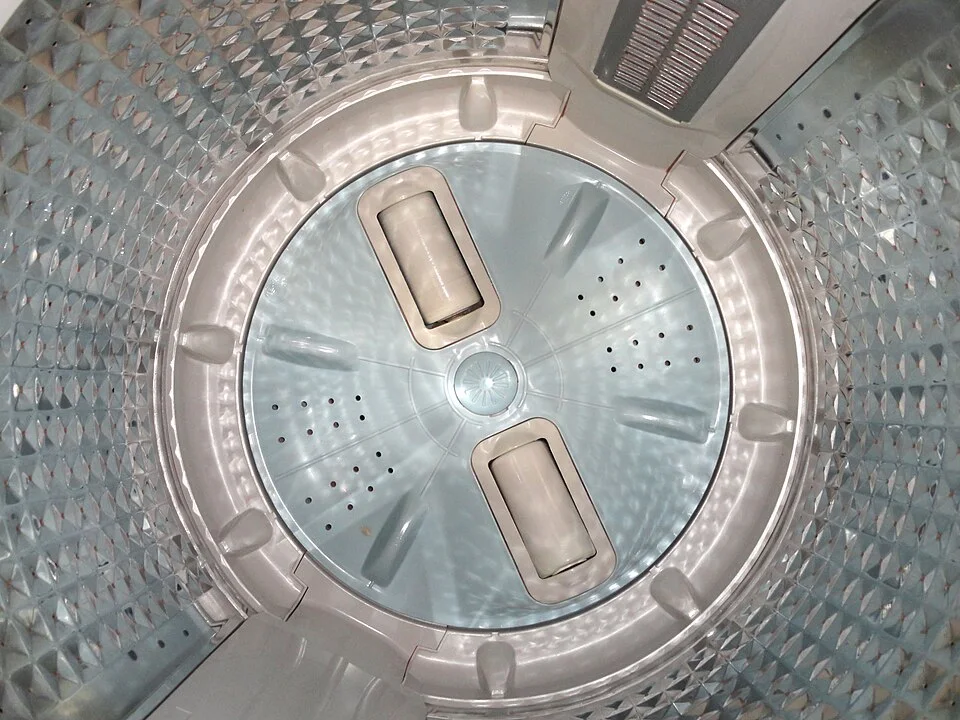
The empty top-loading basket exposes the washing base and inner walls for a permitted visual check after unloading. Treat the pictured Samsung Wobble interior as an access reference only. Inspect accessible areas and any filter or dispenser solely as your own model’s manual permits; do not remove components or infer odour, cleanliness or a recovery result from this photograph.
Photo & usage
Krishna Chaitanya Velaga · CC BY-SA 4.0 · Source. Display copies resized and encoded as WebP; no instructional details were fabricated or removed.
Whirlpool notes that washer odour can transfer to laundry. That creates a reason to check the machine, not proof that every forgotten load requires service. Record whether odour was present before the recovery wash and whether it remains afterwards. Keep machine-cleaning chemicals separate from garment washing unless the instructions explicitly prescribe otherwise.
If the manual recommends leaving a door or dispenser open for drying, balance that instruction with household child and pet safety and the manufacturer's guidance. Do not create an unattended access hazard. A suitable storage or ventilation arrangement should be deliberate rather than copied from another washer model.
Reserve the drying destination before restarting
Prepare the correct hanging, flat or tumble route for each garment group. A successful recovery wash still leaves unfinished wet laundry if the rack is full or nobody can unload. Choose a practical completion time, set a reminder if helpful and identify any drying exceptions to another household member.
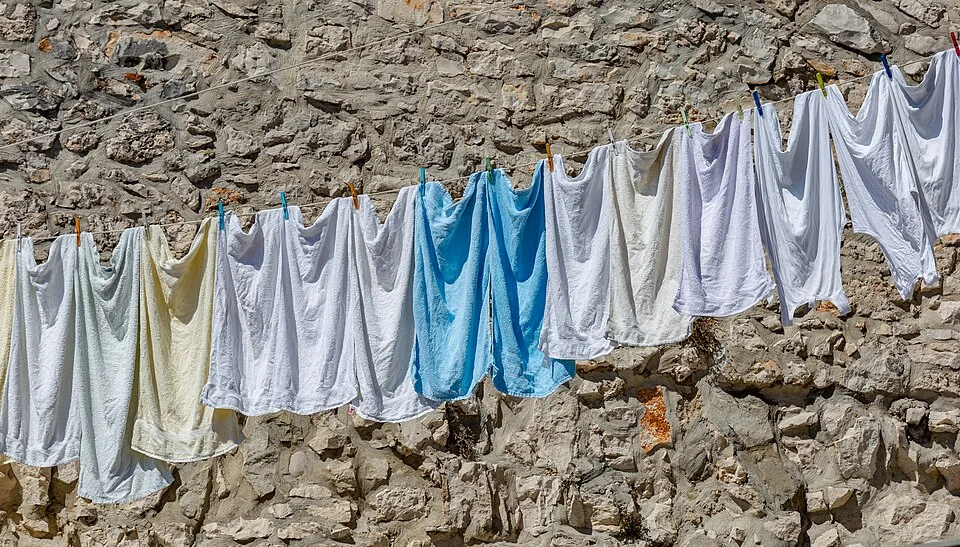
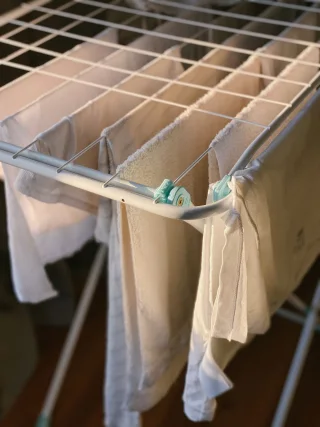
The separate hanging positions show the line length needed when garments must leave the washer promptly. Before restarting a forgotten load, prepare each item’s permitted hanging, flat or tumble route and arrange a practical unloading time. The outdoor shirts illustrate spacing; they do not establish that sunlight or hanging is suitable for every item in your load.
Photo & usage
Michal Klajban · CC BY-SA 4.0 · Source. Display copies resized and encoded as WebP; no instructional details were fabricated or removed.
Transfer promptly when the cycle completes and inspect before heat. Check remaining stains, colour changes and odour. Follow the garment's permitted drying route and keep special pieces out of automatic transfer. A combined washer-dryer requires particular attention to selecting a wash-only or compatible complete programme.
After drying, check thick seams, waistbands and folded edges. Do not fold a slightly damp garment into a crowded drawer. If a musty odour persists despite a supported recovery route, review machine condition and product history before repeating indefinitely. Seek appropriate advice when the cause remains unresolved.
Finish with one practical prevention change
Choose a small change tied to the actual failure: start only when an unloading window exists, set a phone reminder or leave a visible load note for a shared household. Do not create a complicated schedule if the issue was a one-off interruption. The prevention step should make completion easier, not merely add another reminder nobody uses.
Return fully dry acceptable laundry to storage and label any held garment with its unresolved issue. Clean measuring tools and put products away securely. Keep the machine in its manual-approved ready state and verify that no small item remains trapped at an accessible seal.
The task closes when the textiles and washer each have a clear status. A forgotten load becomes manageable when the household responds to observed condition, supported care and a realistic drying plan rather than a universal deadline or a stronger fragrance.
If someone else restarts the load, leave the garment exceptions beside the machine before handing over. Name the flat-dry item and the piece awaiting stain inspection rather than saying only that the laundry needs finishing. Remove the note once the load is genuinely complete so an old instruction does not accidentally govern a different basket next time.
THE REFERENCE FILE
Sources & scope
Documentation reviewed 1 Nov 2026. Examples are illustrative; this article does not claim hands-on product testing. Follow the instructions for your actual material, model and location.