Choose what happens immediately after the doorway
A furniture delivery can pass the entrance and still become chaotic inside. Existing furniture occupies the final position, packaging fills the passage and nobody knows whether assembly is included. Make a landing plan before the delivery window, with a place for the new item, a route for packaging and a decision about the old furniture.
Read the service description. Threshold delivery, room placement, assembly and packaging removal are different services. Confirm what was purchased and what preparation the household must provide. Do not assume a retailer's photographs describe the carrier's actual obligations.
Keep the exact order, dimensions and delivery contact available. The existing sofa-measuring guide covers purchase fit; this article handles the receiving sequence after that decision. A previously reviewed route still needs to be clear on the actual day.
Resolve the existing furniture first
Decide whether the old item is staying elsewhere, being collected or leaving through another confirmed route. Coordinate timing so it does not occupy the new item's installation space. If it must remain temporarily, assign a position that preserves access and ordinary household use.
Arrange suitable help for moving heavy or anchored furniture. Follow its instructions and do not shift a loaded tall unit casually. CPSC's Anchor It guidance provides context for tip-over prevention; any restraint removed during a planned move needs an appropriate reinstallation plan.
Avoid relying on an unconfirmed sale or donation for same-day clearance. If the collector cancels, the new delivery still needs somewhere to go. Choose a fallback in advance or change the delivery booking under its terms before the last rescheduling opportunity.
Recheck the route in its current state
Walk from the permitted unloading point to the final room. Remove movable clutter and identify doors, turns and surfaces that need attention. Room & Board and Pottery Barn both provide measuring guidance for delivery routes; give the carrier updated information if access has changed since purchase.
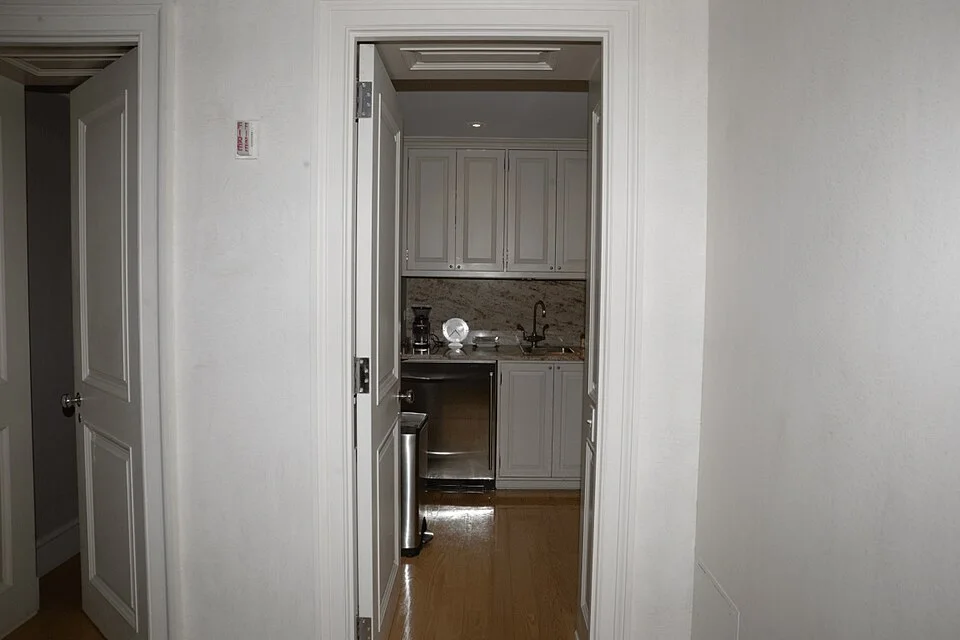
The open door and frame identify an actual opening where hinges, the door leaf and its handle may affect the delivery path. Rewalk the current route and measure its clear span in the intended operating state, including turns beyond the opening. No dimension is supplied here, and the photograph gives no permission to remove fittings or force furniture through.
Photo & usage
Federal Bureau of Investigation · Public domain · Source. Display copies resized and encoded as WebP; no instructional details were fabricated or removed.
Check building bookings, keys and contact availability. A lift reservation is useful only if the correct lift can be accessed during the delivery window. Keep security details within the people who need them, and confirm who can authorise a change if a route is blocked.
Do not remove doors, rails or fixed fittings without appropriate authorisation and qualified help. If the actual item or route differs from the reviewed plan, pause for the carrier's assessment. Forcing a delivery is not a completion strategy.
Budget separate receiving zones
This illustrative plan has a 16-square-metre room. Existing essential furniture and its operating space use 7 square metres. The new item's proposed footprint uses 3, and a temporary packaging zone uses 2. The remaining area is 16 − 7 − 3 − 2 = 4 square metres.
That arithmetic does not prove the delivery works. The four square metres might be fragmented behind furniture, and the packaging zone might block the entrance. Draw the actual shapes and preserve the route through the room. If assembly needs additional space, obtain its requirements separately.
If the old item temporarily occupies another 2.5 square metres, the arithmetic balance falls to 1.5. This is a signal to review timing and layout, not an access standard. Use exact dimensions, ordinary-use trials and carrier assessment for the real decision.
Agree surface protection and packaging handling
Ask the carrier what protection it provides and what the household should prepare. Use only methods suitable for the surfaces and their condition. Newly finished coatings or floors may have product-dependent restrictions on tape, coverings and contact.
Identify where packaging can be opened without hiding the item's identity or obstructing the route. Ask whether the crew removes it as part of the service. If packaging must be retained for a seller process, choose a dry, secure location and a review date.
Keep children and pets away from active handling and small components under an appropriate household arrangement. Do not ask them to hold doors or packaging in a moving route. The landing plan should reduce simultaneous activity around the crew.
Inspect the correct item at the right moment
Compare model, configuration, finish and package count with the order before installation proceeds beyond a practical correction point. For a sectional, confirm the actual orientation using the manufacturer's definition. Similar-looking components may belong to different configurations.
Record visible condition with context and detail photographs where appropriate. Describe what is seen without guessing cause. Follow the retailer's reporting and signing process, and raise an inaccurate or incomplete statement before signing it.
If assembly is included, ask what the crew will demonstrate at handover. A sleeper, recliner or adjustable component needs its intended operating space and the relevant instructions. Do not treat a wrapped item placed in the room as completed assembly if the service includes more.
Confirm placement through ordinary operation
Place the furniture in the agreed position with the crew's permitted assistance. Check doors, drawers, nearby controls and normal routes. Use manufacturer clearances for equipment or moving parts rather than relying on a remembered decorating rule.
If the position fails, identify the actual conflict before moving the piece repeatedly. A cable outlet, cabinet door or projecting sill may require a different orientation. Keep any alternative within the reviewed access and installation requirements.
For furniture needing anchoring or another installation step, arrange that work before loading or use as instructed. Do not let the delivery team's departure convert an incomplete installation into an assumed finished state. Record who owns the remaining action and any use restrictions.
Close delivery and restore circulation
Keep copies of the receipt, delivery note, product instructions and any condition exception. Record the actual item identity if an authorised substitution occurred. Preserve relevant packaging under the seller's process until unresolved questions are answered.
Remove packaging and temporary protection through suitable routes, then walk the room in its normal state. Check that the old furniture's temporary location has not become a new obstruction. Complete its planned handoff or relocation.
The delivery is complete when the right item is accounted for, its condition and service handover are documented, required installation is arranged or finished and household routes are restored. A successful arrival should leave a usable room rather than a new storage problem.
Sequence several delivered items
If a delivery contains several pieces, ask the carrier which placement order suits the route and service. A large cabinet placed first may block the turn needed for a table, while packages stacked at the entrance may prevent the crew reaching the final room. Share the landing plan before unloading starts.
Mark destinations by exact item identity rather than a vague description such as “the long one.” Keep an authorised receiver available to answer placement questions. If the household changes its mind, check that the alternative does not obstruct access for the remaining load.
For modular pieces, preserve component labels until the intended arrangement is confirmed. Similar parts can have different connectors or orientations. Do not discard protective packaging or tags simply to make the room look finished while an identity question remains unresolved.
After the final piece is placed, inspect the route as well as the furniture. Record any relevant condition issue through the carrier's process and restore doors and permitted temporary protection under the agreed service.
THE REFERENCE FILE
Sources & scope
Documentation reviewed 1 Nov 2026. Examples are illustrative; this article does not claim hands-on product testing. Follow the instructions for your actual material, model and location.