Define the finished room before assigning dates
A room refresh can stall even when every individual job looks small. Furniture arrives before the floor is ready, curtains need measurements from a rail not yet installed, or a second paint coat conflicts with the only available delivery window. Begin with the intended finished functions and list the work required to achieve them.
Separate inspection, preparation, installation, decorating and furnishing. Write the output each task must produce for the next person. “Wall painted” is incomplete if the next task requires the coating to be ready for contact, cleaning or masking. Those stages can have different product instructions.
Check whether the work disturbs old paint or other suspect materials. EPA's remodeling publications advise resolving underlying problems and considering existing hazards before work begins. This planning article does not provide a method for hazardous material removal or replace a qualified assessment where one is needed.
Draw dependencies before a calendar
Put each task on a separate line and add what it depends on. A curtain order may depend on the confirmed rail and heading. A cabinet installation may depend on a finished wall and suitable anchoring arrangement. A final furniture position may depend on access to sockets and equipment clearances.
Identify work that can happen elsewhere while the room is unavailable. Choosing textiles, confirming package dimensions and obtaining quotations can often proceed without occupying the work area. Do not schedule two activities together merely because different people perform them; they may compete for the same entrance or clean surface.
Ask each supplier what “ready” means for its next step. Save the exact product or installation instructions with the task. A general decorating article can suggest an order, but it cannot supply the drying, substrate or clearance requirements of the actual materials selected.
Inspect before covering or furnishing
Look at the accessible surfaces for visible damage, staining, loose material or recurring moisture signs. Record the location and ask the relevant professional about unresolved causes before concealing them. EPA's best-practices guidance emphasises correcting the cause of a problem rather than only its appearance.
Keep observations separate from diagnoses. A stain does not by itself identify a leak, and a dry-looking patch does not prove the source has been resolved. If investigation or repair is needed, put it ahead of decorative work and update the schedule after the outcome is known.
For rental property, obtain necessary permissions before changing finishes or fixings. Record who is responsible for reinstatement or later removal. A reversible furnishing choice may simplify the programme, but it still needs to fit the household's use and the equipment instructions.
Calculate a dependency window
This illustrative schedule assumes the selected coating permits a second coat after a four-hour interval under the actual conditions and its instructions. The first coat finishes at 10:00, so the earliest planned second-coat start is 14:00. If application takes two hours, it finishes at 16:00.
The household then chooses a separate 48-hour no-contact allowance for this invented programme, subject to the actual manufacturer's requirements. That would place the next contact task at 16:00 two days later. It is a planning assumption, not a universal paint cure time.
If the first coat finishes at 13:00 instead, the same sequence finishes the second coat at 19:00 and shifts the next gate to 19:00 two days later. A delivery booked for 09:00 that day no longer follows the chosen sequence. Move the delivery or revise the programme with the supplier; do not quietly shorten a product-dependent interval.
Distinguish touch, recoat and service readiness
Read the technical sheet for the exact product and version being purchased. The reviewed Benjamin Moore N627 sheet distinguishes touch-dry, recoat and washing guidance under stated conditions. Its figures belong to that product, not to every paint carrying the same colour or sheen name.

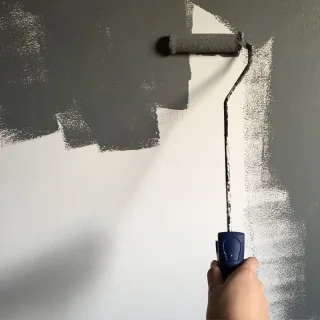
The roller shows coating application in progress, which is different from confirming when the surface can receive furniture, coverings or another coat. For the exact product and version, record the maker’s touch, recoat and service guidance together with the relevant conditions. This photograph identifies no paint formulation, drying time or completed readiness check.
Photo & usage
U.S. Navy photo by Petty Officer 2nd Class Kelly M Agee · Public domain · Source. Display copies resized and encoded as WebP; no instructional details were fabricated or removed.
Record the temperature and other conditions relevant to the instructions without inventing a correction formula. If conditions fall outside the stated range or the surface behaves unexpectedly, ask the manufacturer or responsible decorator before proceeding. A calendar alarm cannot prove a coating is ready.
Discuss when furniture, curtains, tapes and protective coverings may contact new finishes. Do not assume a dry surface can safely support adhesive protection or a tightly pressed cabinet. Keep the next operation pending until the product guidance and the person responsible for application support it.
Release delivery only when access is ready
Confirm the room and route can receive the actual packages. Include turning space, assembly area and a location for packaging. A room can be ready for occupancy while still lacking the clear floor area required to assemble a large cabinet.
Ask the retailer about rescheduling notice and storage terms before placing the order. Put the last change date on the programme. If readiness is uncertain near that date, make the delivery decision consciously rather than allowing a default booking to become an emergency.
Keep other trades out of the route during unloading unless the arrangement has been coordinated. Protect finishes using methods approved for those surfaces and the stage of cure. The programme should name who installs and removes protection, since abandoned sheeting or tape can create a new completion problem.
Update the sequence when one task slips
When a repair, delivery or drying stage takes longer, find the dependent tasks and move those first. Work that does not depend on the delayed stage can continue in another suitable area. Avoid restarting the entire plan or filling the gap with extra scope that creates more dependencies.
Record the new completion evidence, not only the new date. If a wall repair remains damp or an installer is waiting for a correct fitting, the next task needs that fact. A date marked “finished” without evidence makes later decisions unreliable.
Use one current schedule shared with the relevant people. Keep earlier commitments in the correspondence file, but clearly mark superseded dates. Conflicting calendars are especially costly when a household, decorator and delivery company each believe their own version is final.
Release the room through ordinary use
Check doors, drawers, curtains and equipment access after furnishing. Walk the daily routes and inspect the finishes under normal lighting. Record incomplete work as a short list with a responsible person rather than hiding it behind styling objects.
File the final paint specification, installation instructions and useful dimensions. Keep leftover materials only under their storage guidance and local disposal arrangements. A project is easier to maintain when the household can identify what was installed.
The refresh is complete when the sequence's final functions work and the outstanding list is controlled. Decorative photographs can wait until the practical handover is done; the important evidence is a room that can be used without undoing newly completed work.
Check working days and shared resources
Confirm whether quoted intervals use calendar days, working days or booked attendance days. A supplier's five-working-day lead time can cross a weekend, while a product recoat interval may be stated in hours under specified conditions. Keep those conventions separate on the programme.
Check shared tools, access keys and helper availability as resources. Two independent tasks may still compete for the only suitable ladder or the person authorised to receive a delivery. Record that conflict before putting both activities in the same slot. If a resource changes, move the affected work and tell the relevant people; do not assume a technically independent task can proceed without the practical means to perform it.
THE REFERENCE FILE
Sources & scope
Documentation reviewed 1 Nov 2026. Examples are illustrative; this article does not claim hands-on product testing. Follow the instructions for your actual material, model and location.