Begin at the occupied breakfast seat
A table can appear pleasantly sunlit from the doorway while someone seated there looks directly into a bright opening. Morning comfort is a relationship between the window, the table and the person's eyes. Sit in each regularly used seat with the usual plates, mugs and reading material before adjusting the covering.
Identify what makes the meal awkward. Direct sun on a face, a bright reflection on a glazed plate and a shadow over small print are different problems. Write a separate note for each seat. If one person keeps moving a chair during breakfast, record the movement instead of treating it as a preference with no connection to light.
This exercise assumes an existing adjustable blind or shutter with normal accessible controls. It does not require a new fixture, glass treatment or exterior addition. YourHome's lighting discussion differentiates direct sunlight from diffuse daylight, providing the useful starting point: intercept the troublesome beam without assuming that all natural light must be removed.
Follow the morning change across the table
Look at the room at the beginning and end of its normal breakfast period. Low morning sun can move across the tabletop noticeably during one meal. Mark the beam's limits on a sketch using the table edge and a fixed placemat position as references. Avoid taping delicate table finishes or leaving loose marks where food is served.
At each check, write whether sunlight strikes eyes, paper or reflective crockery. A beam that misses the table at 07:30 might reach it at 08:00. The final blind setting needs to work across the occupied period, or the household needs one simple adjustment halfway through. Do not judge it from a single flattering instant.
East exposure is only a clue. Nearby buildings may interrupt the first light, and seasonal changes alter its angle. The Australian shading guidance includes orientation-specific approaches, but its compass examples should be read in their geographic context. Your actual table observations matter more than copying a universal east-window rule from a drawing.
Change angle before changing the whole room
With the blind lowered to its normal position, tilt the slats slowly until direct sun no longer reaches the troublesome seat. Look for whether light now reaches the ceiling or another bright surface. Check that the adjustment has not merely moved a sharp reflection from a plate to the glossy tabletop.
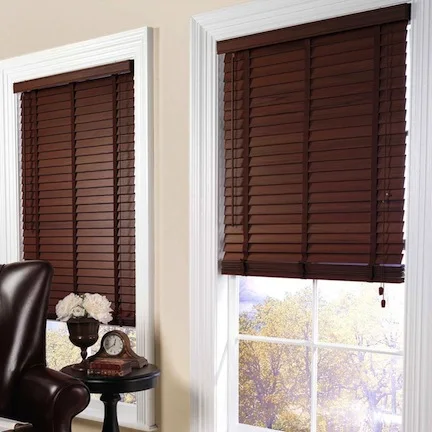
The slatted coverings and nearby chair show the relationship to inspect before darkening the whole room. Use the actual blind’s intended tilt control to intercept the troublesome direct beam, then check the second seat and tabletop. The photograph does not establish east orientation, a particular slat material or the angle that will control glare in another room.
Photo & usage
David Mallet · CC0 · Source. Display copies resized and encoded as WebP; no instructional details were fabricated or removed.
Try the smallest further tilt that keeps the problem controlled as you shift naturally in the chair. A setting that works only while the person holds their head perfectly still is fragile. Repeat from the second seat. If the needs conflict, test rotating the table slightly or exchanging seats before deciding the blind must be fully closed.
CCOHS distinguishes glare from insufficient light. Use that distinction while reading the menu, newspaper or cereal packaging you actually use. If glare disappears but ordinary print becomes difficult to see, note both outcomes. The useful setting balances them; a room that is uniformly dark has not automatically become a better breakfast space.
Compare repeatable positions with invented observations
The following example is illustrative. It represents a hypothetical 30-minute breakfast, divided into six five-minute observation blocks. A troublesome block means direct sun or a clearly distracting reflection reaches the seated view. These counts are an informal household comparison, not a validated visual comfort score.
| Setting | Troublesome blocks out of six | Ordinary print at table |
|---|---|---|
| Slats horizontal | 5 | Readable, with reflections |
| First shaded setting | 1 | Readable |
| Fully closed | 0 | Existing lamp needed |
The first shaded setting removes four troublesome blocks compared with the horizontal setting. Four blocks multiplied by five minutes gives 20 minutes of the sampled period. That is a reduction in recorded troublesome blocks, not a percentage improvement in vision or a guarantee for every morning.
The fully closed position removes the remaining block but costs useful daylight in this example. The household might prefer one small later tilt instead. Record that decision and test it during another similarly bright breakfast. Do not treat observations made under clouds as equivalent to a clear-sky trial.
Check reflections with the actual table setting
A glossy plate, polished cutlery or glass-topped table can preserve a reflection after the direct beam no longer reaches the face. Move one reflective object at a time while remaining seated. If the bright patch moves with it, the object contributes to the problem. If it stays in the same screen or table area, inspect the broader light path.
Try a matte placemat already suitable for the surface, a different plate position or a modest table rotation. Keep food hygiene and normal use in mind. You should not need to balance crockery at an unusual angle or place unstable objects near the edge to make the light tolerable. A solution that works only for a staged empty table is incomplete.
After each change, restore the ordinary breakfast items and repeat the task. The source guidance supports examining reflected glare, but it does not certify particular household materials as glare-free. A placemat described as matte may still show a bright sheen at a low angle. Let the occupied comparison determine whether it earns its place.
Make the setting easy to reproduce
Blind angles are difficult to describe as precise degrees without a reliable indicator. Use a visible reference within the product's normal operation: slat faces just hide the bright sky from the main seat, or the lower rail stays at the same existing feature. Never add a modification that interferes with movement or the manufacturer's safety arrangements.
Write a short instruction containing the seat, time period and weather condition. For example, use the shaded breakfast setting on clear mornings, then reopen after the table is cleared. Include any second adjustment only if it genuinely matters. A routine with four tiny interventions is unlikely to survive a busy weekday.
Keep control cords and loops inaccessible to children, and ensure chairs do not create new access to them. Check the full movement path before adopting a partly lowered position. The table should remain usable without dragging items away from the window every morning. Physical convenience is part of completion, because an awkward setting will soon be abandoned.
Recheck after a change in season or habits
The final setting should be checked from every occupied chair at the start and end of breakfast. Print remains readable, direct sun stays out of the relevant view, and no plate or table reflection requires people to lean away. Confirm that reopening restores the preferred daytime room rather than leaving a forgotten dark corner.
Repeat the observation if breakfast shifts later, a tablecloth changes the surface or the season moves the beam. Keep the old note with its date instead of overwriting it. Comparing two seasonal settings can be more useful than searching for one compromise that works poorly throughout the year.
If the table remains uncomfortable with the beam controlled, examine whether the main problem is heat, a different bright window or the seat arrangement. That is a reason for a new focused trial, not evidence that daylight itself is unsuitable. Finish when the household can reproduce a setting that supports an ordinary meal with ordinary objects in place.
THE REFERENCE FILE
Sources & scope
Documentation reviewed 1 Nov 2026. Examples are illustrative; this article does not claim hands-on product testing. Follow the instructions for your actual material, model and location.