An oily food mark can become harder to see while a shirt is wet and reappear once the fabric dries. That makes “it looked clean at unloading” an unreliable finish line. Work from the spill history, the garment instructions and the dry appearance. A controlled treatment gives you evidence for the next decision without turning one food spot into several overlapping experiments.
Distinguish the meal from the laundry history
Identify the food if possible: salad dressing, cooking oil and creamy sauce can leave different combinations of colour and grease. Ask whether the garment has already received detergent, stain spray or a dryer cycle. Write down any treatment you cannot identify. Uncertainty matters because a translucent patch may contain both food and cleaning residue.
Inspect the location in daylight or another consistent light. A mark on a shirt front after dinner points toward food; similar patches distributed across several garments suggest a laundry-process question worth investigating separately. ACI's mystery-stain guidance uses pattern and timing as diagnostic clues. Treat them as clues rather than a laboratory identification.
Read the full care label before proceeding. Stop this workflow for leather, suede, fragile trim or professional-care garments. A washable fibre name does not cancel a restriction on the constructed garment. Keep the item aside while you resolve a missing instruction with its manufacturer.
Lift excess material without grinding it in
For a fresh spill, carefully lift any solid food with a clean, blunt edge. Work without scraping hard across the threads. Put a plain absorbent cloth behind the affected layer and gently blot surplus oil. Rotate to a clean area as material transfers. Do not chase the outer edge with vigorous rubbing.
Avoid coating the stain with a large pile of household powder. That can lodge in stitching and complicate the next wash. A heavy sauce deposit should be reduced by lifting and blotting before you consider a product, but the fabric should not be abraded in pursuit of a perfectly dry-looking surface.
Check both sides of the garment and any pocket beneath the spill. Remove absorbent supports before washing. If oil has passed into a lining whose care route differs from the outer fabric, pause and seek product-specific advice. The visible face may be only the accessible part of the problem.
Select one permitted laundry treatment
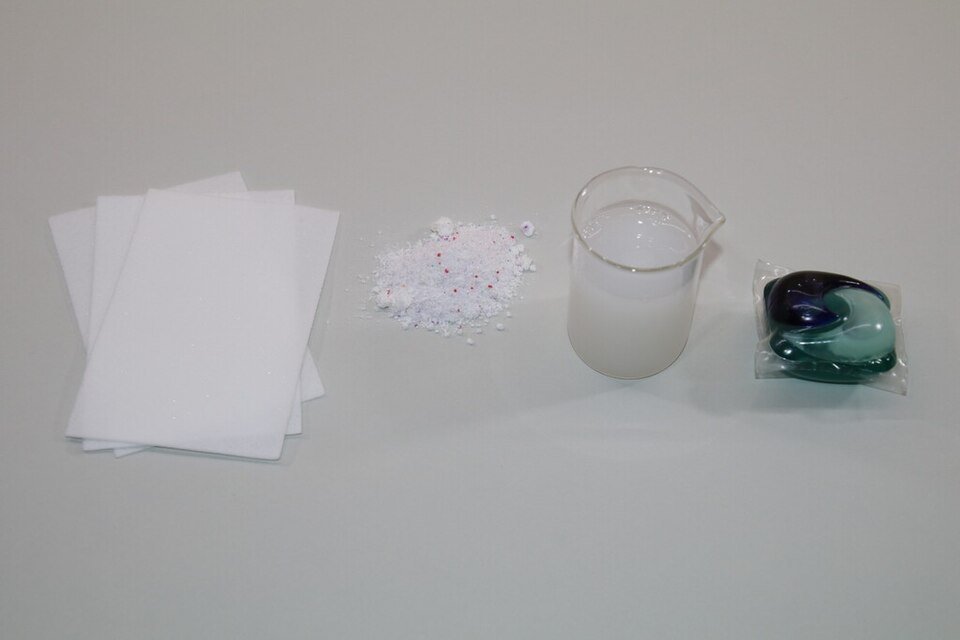
Choose a stain remover or liquid laundry detergent expressly suitable for the garment and for the intended pretreatment. ACI's stain toolkit includes pretreatment for grease and oil marks. Read the actual bottle for restrictions, application and dwell time; the toolkit does not supply universal permission for your fabric.
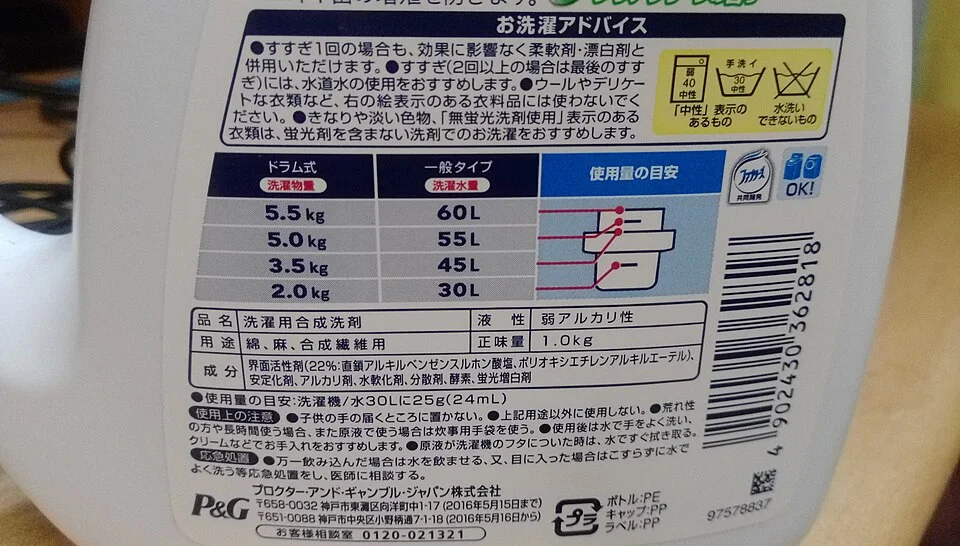
The bottle’s back panel groups dosing information, fabric exclusions and usage directions in one place. Read the complete label on your own selected laundry treatment and compare it with the garment instructions before pretreating an oily mark. The photographed Japanese formulation and table belong to that product; they supply no universal dose, dwell time or permission to use another detergent as a pretreatment.
Photo & usage
Dquai · CC BY-SA 4.0 · Source. Display copies resized and encoded as WebP; no instructional details were fabricated or removed.
Test a concealed area and watch for colour transfer, sheen changes or surface damage. Apply only as directed to the mark, using a clean support if needed. Do not improvise a solvent treatment from internet lists, especially near flames or appliances. Professional care is the better boundary where instructions require solvents or the fabric response is uncertain.
Dishwashing liquid is not automatically a washer detergent. If a garment or treatment source permits a small hand pretreatment, its removal requirements still matter before machine washing. Avoid pouring a household dish product into the washer. Using a purpose-labelled laundry pretreatment keeps this workflow easier to interpret and repeat.
Wash once with the decisions recorded
Choose the permitted cycle and temperature from the garment and appliance instructions. Separate the piece from incompatible colours, delicate constructions and heavily soiled items. A single stained shirt does not require a harsher wash for every other garment in the drum. Measure the correct laundry detergent for the actual load.
Record the treatment product and wash settings before starting. You need only a short note, such as “dress shirt, oil pretreatment per label, normal permitted wash, hold for inspection.” This prevents another household member from adding a second stain product or transferring the piece directly to the dryer.
Do not infer a successful wash from the absence of foam or from a strong fragrance. Neither tells you whether the oil mark remains. Unload promptly enough to separate the shirt and examine the original footprint. If visible residue remains, give the garment an approved drying destination while you decide what it means.
Use the dry appearance to choose the next move
Inspect a permitted air-dried garment from the front and reverse. Compare the marked area with nearby fabric of the same weave and colour. A translucent shadow can suggest remaining oil, but it can also reflect another residue or a changed finish. Refer back to the original history instead of naming the cause from appearance alone.
If the patch has improved and the fabric remains unchanged, a label-permitted repeat may be reasonable. If no useful change occurred, reconsider the stain identity and prior treatment before repeating. If there is colour loss, roughness or a spreading halo, stop. Those observations shift the problem from stain removal toward damage assessment.
ACI advises checking stains before dryer heat. Keep an unresolved garment out of both the dryer and ironing queue. A professional cleaner may still have options, but needs an accurate account of treatment and heat exposure. Do not promise that every grease mark can be restored.
Read an illustrative three-way comparison
The following entries are invented examples of observation, not household testing. They compare the same type of visible complaint under different histories. Their purpose is to show why a second wash is a decision rather than an automatic response.
| History | Observation | Decision |
|---|---|---|
| Fresh dressing splash; one compatible treatment | Smaller translucent edge; unchanged fabric | Consider a permitted repeat |
| Unknown mark; several previous products | Broad stiff halo | Stop adding products; assess residue history |
| Fresh oil spot; vigorous brushing | Pale rough centre | Stop; possible surface damage |
The first entry gives a reason to consult the same product's repeat directions. The second gives a reason to simplify the history and ask for advice. The third makes stronger chemistry irrelevant to the changed surface. These distinctions are more useful than declaring all three garments “still dirty.” Keep the description concrete when handing an item to someone else.
Check the support cloth for a secondary mark
A support placed behind an oily spot can transfer material to another part of the garment if it is reused carelessly. Move to a clean section as directed and keep the opposite layer away from the collected deposit.
After treatment, inspect both the original area and the fabric that rested against the support. If a new mark appeared, record its location and stop treating it as an unexplained laundry defect. Clean reusable supports by their appropriate route before returning them to storage. A plain support with a known history makes the next stain session easier to interpret than an absorbent cloth carrying residue from several earlier jobs.
Close the loop without over-treating
Release the garment when the dry comparison shows an acceptable result and no cleaning residue or new damage. Check seams where the support cloth or pretreatment may have left moisture. Fold or hang according to the care instructions and put the item away fully dry.
For a persistent mark, choose between professional assessment and accepting the cosmetic limitation. Record that choice so the same piece is not treated repeatedly by different people. Repeated cycles without a defined observation point can consume effort while making the treatment history less useful.
Clean reusable supports in a suitable separate route and return products to storage. If the source was a leaking food container or an oily apron pocket, fix that immediate cause before the next use. The practical outcome is a garment with a known status and a repeatable decision, rather than a mystery spot migrating through every laundry load.
THE REFERENCE FILE
Sources & scope
Documentation reviewed 1 Nov 2026. Examples are illustrative; this article does not claim hands-on product testing. Follow the instructions for your actual material, model and location.