Name the delay that keeps recurring
A room does not necessarily become comfortable when its last sun patch disappears. Upholstery, walls and other surfaces may remain warm, outside air may still be hot, or dinner preparation may coincide with the end of sun. Begin by documenting the delay rather than assigning it immediately to one material or window.
Choose the place people actually use in the evening. Write down the activity and the point at which they move elsewhere or change a setting. The end of visible sun is one event on the page; the return of comfortable use is another. If the room remains usable throughout, the exercise can stop without creating a problem from a display reading alone.
Keep the scope observational. You are not estimating the thermal capacity of the building or diagnosing insulation. YourHome's passive cooling discussion offers a framework for heat gain and removal, while HSE's comfort material reminds you that air temperature is incomplete. The timeline helps decide which small next trial is worth doing.
Mark the end of sun in more than one place
From indoors, note when direct sun leaves the occupied seat, the floor and the relevant glazing. These events can occur at different times. A sofa may leave the beam while another exposed surface continues receiving it. Sketch the sequence using permanent features and record the sky condition so a cloud is not mistaken for the day's final shading.
Use normal controls and avoid going onto roofs, exterior ledges or inaccessible balconies to inspect surfaces. For this exercise, observations from the occupied room are enough. If you cannot see whether a particular external surface is exposed, mark it unknown rather than completing the diagram from assumption.
Do not touch surfaces that might be excessively hot, and do not press an ordinary air thermometer against them to obtain a surface measurement. A simple note that one cushion feels warmer than an unexposed cushion can support the next comparison. If using any surface instrument, its limitations belong beside the readings rather than disappearing from the final account.
Record the evening sequence at fixed times
Keep one air thermometer in a shaded stable position, clear of electronics and supply outlets. Record every half hour through the period of interest. Alongside each reading, note window and blind positions, cooling operation, cooking, lighting and the number of occupants. Brief event notes are more useful than a long narrative written from memory at bedtime.
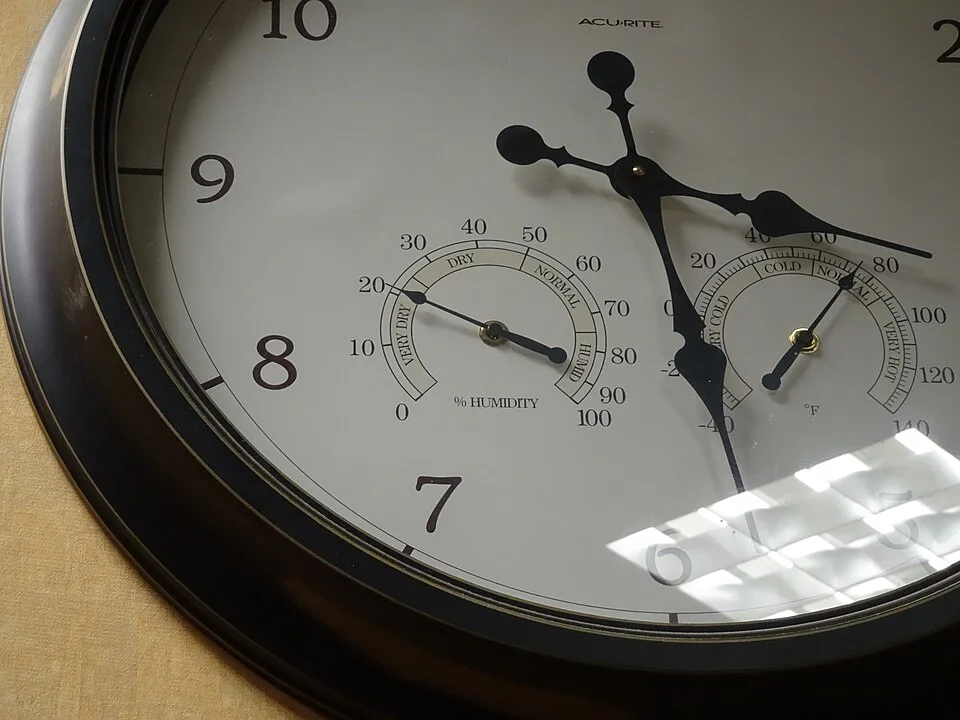
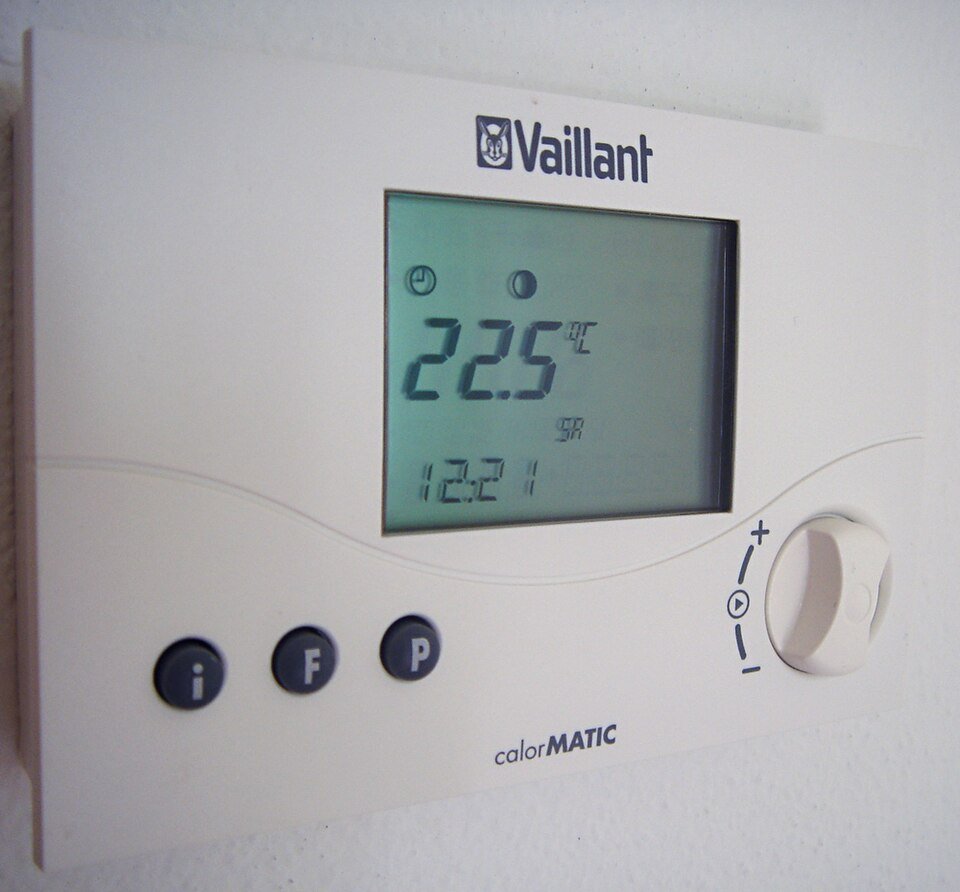
The clock face and separate instrument dials illustrate the different entries needed in an evening record. At fixed times, copy the actual room temperature and note occupants, cooling, cooking and covering states. Use a shaded suitable meter position and identify the units; this shop clock photograph cannot show a household trend, instrument accuracy or the cause of lingering warmth.
Photo & usage
B137 · CC BY-SA 4.0 · Source. Display copies resized and encoded as WebP; no instructional details were fabricated or removed.
Ask the same seated person for a simple description at each check. For example, seat still unpleasantly warm, warm but usable, or comfortable for reading. Keep clothing and activity ordinary and note changes. A person who has just carried groceries upstairs is not in the same state as someone who has been sitting quietly.
A second room may provide context, but only if its sensor position and use are documented too. Do not subtract a hall reading from a sunroom reading and call the difference stored solar heat. The rooms can differ in exposure, airflow, equipment and instrument behaviour. Use the comparison to generate a question, not manufacture a precise causal quantity.
Calculate an illustrative delay
This invented timeline shows the difference between an observable delay and an inferred mechanism. Suppose direct sun leaves the sofa at 17:10 and the last visible floor patch at 17:40. The person first describes the sofa as comfortable for ordinary reading at 19:00. The room thermometer changes from 29.0°C at 17:00 to 28.5°C at 19:00.
From sofa shade to comfortable use, the delay is 110 minutes: 50 minutes to 18:00 plus 60 to 19:00. From the last floor patch to comfortable use, it is 80 minutes. The recorded air-temperature change is 0.5°C over two hours, not a measured surface cooling rate.
If the room's normal cooking period ran from 17:30 to 18:20, the timeline contains an obvious overlapping influence. You cannot assign all 110 minutes to the sofa's earlier exposure. An earlier-shade trial on a comparable day, or an observation on an evening without that cooking activity, would help distinguish the possibilities.
These illustrative times are descriptive examples. They are not expected delays for any furniture, glazing type or climate, and they do not establish that a room is safe or unsafe at a particular temperature.
Choose the next trial from the sequence
If the seat becomes uncomfortable during direct sun and stays that way after it, test earlier operation of the existing shade. Keep the later evening routine as similar as practical. The question is whether preventing earlier exposure changes the later occupied experience, not whether closing a curtain instantly cools an already warm room.
If warmth starts only when cooking or equipment use begins, record that pattern before changing window coverings. A separate trial involving the timing of ordinary activities may be more informative. Do not interrupt necessary ventilation or run equipment outside its instructions to create a cleaner experimental contrast.
If outside remains warmer than indoors, opening windows immediately after sun leaves may not offer useful cooling. Treat indoor-outdoor conditions as a separate decision. The source guidance supports considering heat removal as well as gain, but it does not provide a universal household waiting period. Choose the next observation based on what remains uncertain in your own timeline.
Avoid turning a feeling into false precision
An upholstery note is not a measurement of stored heat in joules. A lower evening air reading is not a direct estimate of energy saved. Keep numerical claims tied to what the instrument and record actually provide. You can say the chair was comfortable 40 minutes earlier on a trial evening if the notes support it, while acknowledging different weather.
Be careful with infrared images and handheld readings if they enter the record. Surface appearance, measurement angle and instrument settings can affect results. Colourful thermal images can look more definitive than they are. There is no need to add them merely to make an ordinary household investigation seem technical.
Keep negative results. If earlier shading removes the beam but the after-sun complaint persists, that is evidence that the local exposure was not the whole explanation. Retain the improved visual condition if useful, then investigate another recorded influence. Repeating the same unsuccessful timing change without a new question adds effort without clarifying the problem.
Finish with a usable evening plan
The final note should distinguish what is known from what is suspected. Known might mean the sofa receives direct sun until about 17:10 and becomes comfortable later under the recorded conditions. Suspected might mean cooking contributes or warm surrounding surfaces matter. Link the next action to that uncertainty rather than presenting the suspicion as a confirmed defect.
Check the adopted change through an ordinary full evening, including reading, conversation and access to windows. Make sure the chosen shade position does not leave someone without useful light or obstruct a cooling outlet. If a chair move is part of a later trial, document it separately so the original timeline remains interpretable.
Close the record when a repeatable operating change makes the occupied period acceptable, or when the observations justify seeking targeted help. Persistent unexplained overheating can require a broader assessment. Your timeline then provides concrete times, conditions and complaints, which are far more useful than saying the room simply stays hot after sunset.
THE REFERENCE FILE
Sources & scope
Documentation reviewed 1 Nov 2026. Examples are illustrative; this article does not claim hands-on product testing. Follow the instructions for your actual material, model and location.