Start with the unit printed beside the number
A water meter display and a bill may show different-looking numbers for the same supply. One may record cubic feet while the account charges in hundreds of cubic feet; another may display cubic metres with decimal places. Before subtracting readings, identify the physical unit and any display multiplier.

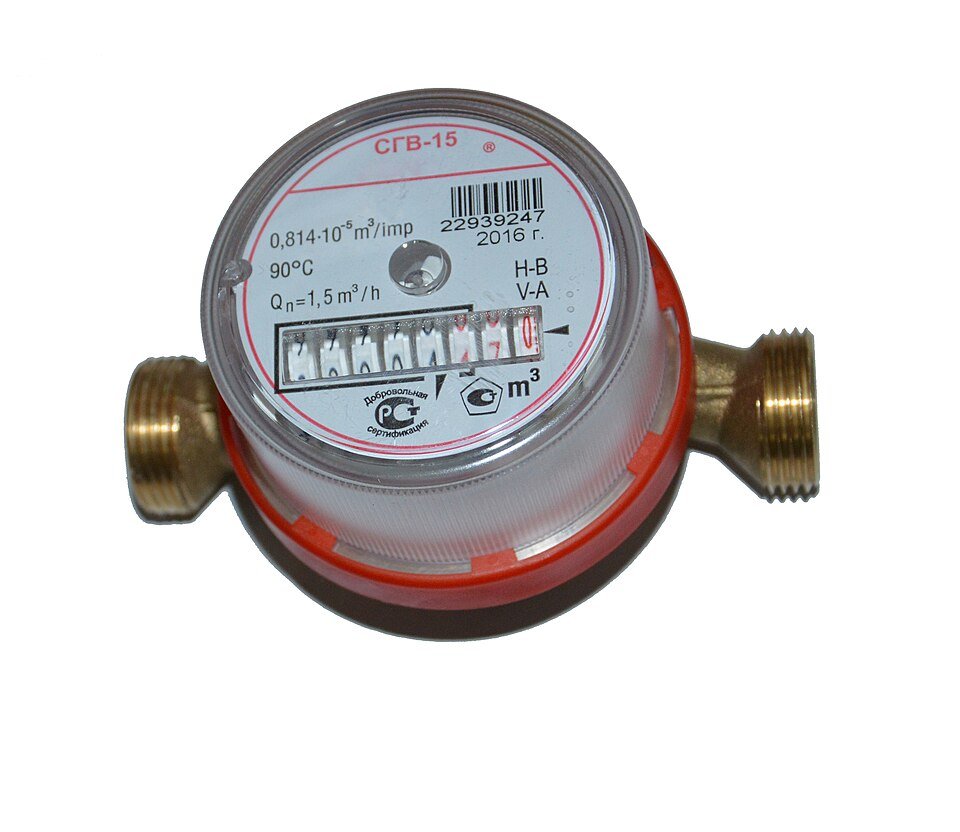
The open face lets you locate the main register and printed scale before copying a reading. Retain the physical unit and any documented multiplier, then use the supplier’s digit convention. Do not decide which numbers belong on a bill solely from their colour, and leave covers, seals and fittings undisturbed.
Photo & usage
Gpkp · CC BY-SA 4.0 · Source. Display copies resized and encoded as WebP; no instructional details were fabricated or removed.
Use the supplying utility's instructions for the actual register. DC Water and LADWP publish examples, but their illustrated digits and colour conventions should not be copied onto every meter. A black or red background alone is not enough to establish which digits your account uses.
Record the meter identifier, unit wording and the complete accessible display. If access requires lifting a heavy cover, entering a confined space or disturbing utility equipment, use an online reading or ask the utility for help. DC Water specifically discourages residents from reading outside meters where cover handling presents a hazard.
Confirm that the register serves your account
Compare the meter number with the bill or ask the utility to confirm the connection. In a shared building, several registers may be close together. Do not assign a meter to your household because it is nearest the entrance or has a handwritten label.
Note whether the account is individually metered, submetered or billed under another arrangement. A building's master register may include communal use and other households. It cannot establish your own consumption without the applicable allocation method.
Keep an identity photograph only where it can be taken safely and with permission. Avoid sharing account numbers or access details unnecessarily. The household working sheet needs enough information to trace the reading, while a public example should omit private identifiers.
Preserve the original reading before simplifying it
Write the full displayed value and its time, then make a separate column for the bill-compatible figure. If the utility ignores fractional billed units, keep that convention beside the translated value. Do not erase decimals from the only record.
For a dial register, follow the actual utility's sequence and direction instructions. Alternating dials can be misread if treated like a row of ordinary digits. If a pointer sits close to a boundary, obtain the utility's guidance rather than resolving the uncertainty by choosing the number that matches your expectation.
A display replacement, reset or rollover can break simple subtraction. Record any known meter change and ask for the closing and opening readings. A negative difference is a reason to investigate identity and sequence, not evidence that the household produced water.
Translate one hypothetical register difference
This illustrative example uses a register confirmed to display cubic feet. The first reading is 125,400 cubic feet and the second 126,100. The difference is 700 cubic feet. If the tariff unit is 100 cubic feet, consumption is 700 ÷ 100 = 7 billed units.
Using the billing approximation of 748 US gallons per hundred cubic feet gives 7 × 748 = 5,236 US gallons. Miami-Dade's sample bill demonstrates that type of conversion. The factor is a practical billing convention; retain the account's own stated conversion where one is supplied.
If you accidentally treat the 700 cubic feet as 700 billed units, the translated volume becomes 523,600 gallons, a hundredfold error. The unit label beside each intermediate value makes that mistake visible before it reaches a household cost estimate.
Keep metric and gallon conventions explicit
A cubic metre equals 1,000 litres. For a confirmed cubic-metre register, subtract readings in cubic metres first, then multiply if a litre figure is useful. Do not apply a hundred-cubic-foot conversion to a metric display because the bill uses the word “unit.”
Where gallons are used, identify the gallon convention. US and imperial gallons differ. Keep the utility's published unit throughout the calculation and convert only for a specific comparison with a clearly stated factor.
Do not introduce false precision. A bill rounded to whole units cannot support an exact one-litre daily change, even if a calculator displays many decimals. Preserve the original resolution and mark derived averages as approximate when the input is rounded.
Reconcile the bill using matching dates
Compare the billed start and end readings with the utility's read dates. A photograph taken several days after the bill's end date will normally show a different cumulative total. Record the later date rather than treating the difference as an error.
Check for a multiplier or conversion line in the bill legend. Miami-Dade's published sample separates meter consumption units from a later gallon-based presentation, illustrating why a familiar-looking number may belong to a different calculation stage.
If the relationship remains unclear, send the utility the unit wording, meter identity and dated readings through its approved channel. Ask one precise question: which display digits and multiplier produce the billed consumption? A clear unit query is easier to resolve than a general allegation that the bill is wrong.
Choose an observation interval the register can support
Find the smallest reliable increment you can read without ambiguity. A coarse whole-unit display may be useful over a month but unsuitable for comparing two short tap uses. Use an appropriate direct volume-and-time method for a fixture where safe, rather than claiming precision the meter cannot provide.
Remote data may have its own interval, delay or rounding. Ask what the portal represents before comparing it with a physical reading taken at a different time. A daily chart and a live cumulative register are different records.
Keep a note of estimated or inaccessible readings. Do not fill missing values by inventing decimals. A gap clearly marked is more useful than a smooth-looking spreadsheet that conceals assumptions.
Close the translation sheet with a repeat check
Repeat the conversion with a second pair of dated readings and verify that the result has the expected order of magnitude. Check arithmetic independently with the inverse conversion: billed units multiplied by their size should recover the original register difference.
Save the supplying utility's register instructions with the sheet and record the review date. If the meter is replaced, create a new identity entry rather than assuming the old display convention continues.
The unit work is complete when another household member can follow the reading, subtraction and conversion without guessing what “units” means. That reliable translation can then support bill comparisons, baseline tracking and appropriately limited cost calculations.
Handle a fractional boundary without losing evidence
Consider a confirmed metric register that shows 50.96 cubic metres at the start and 51.04 at the end. The household difference is 0.08 cubic metre, or 80 litres. If someone copied only whole digits, the apparent difference would be one cubic metre, or 1,000 litres. That simplified transcription would overstate this illustrative short interval by 920 litres.
This does not mean a utility that bills whole units is wrong. The utility may carry fractions forward or use another defined convention across its billing sequence. Keep the full household observations and ask how the supplier translates them for billing. The household worksheet and the billing register can serve different resolutions.
Write the decimal marker clearly and distinguish it from a thousands separator. When moving a reading between a phone, spreadsheet and handwritten sheet, check the imported value rather than assuming formatting survived. A comma can be interpreted differently by software settings.
Before using a short interval for a fixture comparison, ask whether the display resolution is adequate. An 80-litre difference may be visible on one register and unresolvable on another. Preserve the observation as a range or choose a more appropriate method instead of manufacturing digits below the readable scale.
THE REFERENCE FILE
Sources & scope
Documentation reviewed 1 Nov 2026. Examples are illustrative; this article does not claim hands-on product testing. Follow the instructions for your actual material, model and location.