Define a usable first night
The first night after a move does not require a finished home. It requires a safe route through the rooms, a usable place to sleep, basic washing supplies and a workable food plan. Write those outcomes before opening cartons. Otherwise the most interesting box can consume the hour needed to find bedding.
Confirm which rooms and facilities are available before directing the delivery. A bedroom awaiting repairs may be unsuitable for immediate setup. A kitchen with an unresolved appliance issue may need a different meal plan. Record the limitation and choose an alternative that actually exists, rather than unpacking as though every room were ready.
Separate delivery reconciliation from unpacking. Check expected pieces and note visible exceptions through the mover's process first. FMCSA's moving checklist supports supervising receipt; once that record is secure, one household member can start restoring essential functions without losing track of what arrived.
Keep one continuous route open
Choose a place for unopened cartons that leaves the entrance, bathroom and sleeping area accessible. Ask every helper to use that location. A single clear lane can disappear when three people independently decide that a different doorway is a convenient temporary shelf.
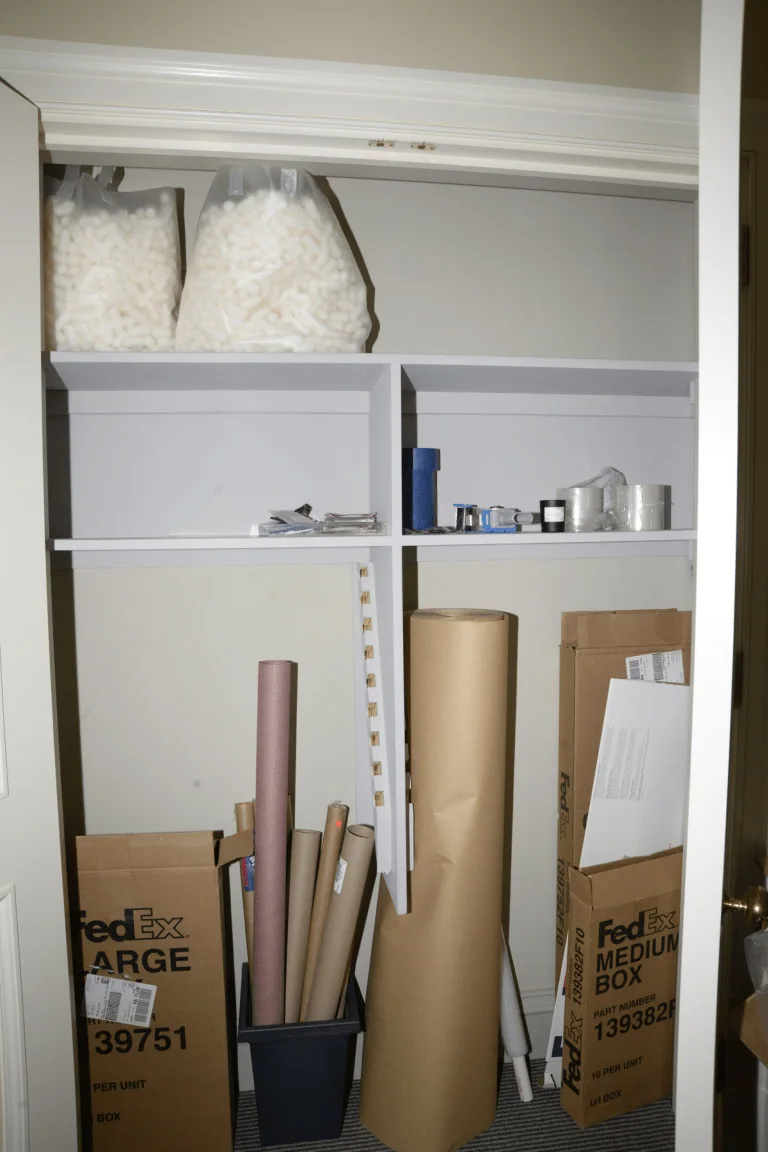
The cupboard groups packing materials in one defined place, which helps explain why supplies need a destination during unpacking. Choose the actual carton-opening area away from the continuous entrance, bathroom and sleeping route, then open one carton at a time. This photograph does not show a working passage or establish safe route widths, carton loads or an ideal stacking arrangement.
Photo & usage
Federal Bureau of Investigation · Public domain · Source. Display copies resized and encoded as WebP; no instructional details were fabricated or removed.
Open one carton at a time in a small working area, remove its contents and collapse or relocate the packaging. Avoid spreading paper across the passage. Keep scissors and small fittings in a controlled container, and keep packaging away from children and pets. Clear the floor before carrying another object through.
Do not press tall storage furniture into service merely to reduce the carton count. CPSC's Anchor It campaign highlights furniture tip-over hazards. Follow the actual furniture's assembly and anchoring instructions before loading it, and arrange appropriate permission and installation where required. A pile of unopened books is preferable to a loaded, incomplete bookcase.
Build the sleeping station completely
Locate the correct bed components, fixings and instructions. If the intended bed cannot be completed properly, use an appropriate temporary arrangement already planned for the household. Do not improvise structural parts or assume a partly assembled frame can be used for one night.
Check bedding dimensions and pillow requirements before opening decorative bedroom cartons. Put the travel clothes, next morning's essentials and chargers in recognisable places. A bed made with sheets but surrounded by inaccessible bags is only partly operational.
Keep the night route to the bathroom clear in the lighting that will actually be used. Check that doors can open and that cables do not cross the route. Ask the people sleeping there to walk it before bedtime, including anyone using their usual mobility aid. Record a specific obstruction and move the object that causes it instead of telling someone to remember where it is.
Restore washing and meals with a small kit
Put soap, a hand towel, toilet supplies and personal washing items in the working bathroom. Give each household member an identifiable place for personal items. Check the facilities normally without dismantling fittings or attempting unfamiliar repairs. Report visible leaks or failures through the appropriate channel.
For meals, begin with the utensils and food needed for the next actual meal. Verify appliance readiness using its instructions before relying on it. If a refrigerator has just been moved, obtain the model-specific guidance rather than applying a remembered universal waiting time. Keep food safety decisions separate from the desire to finish unpacking.
Use a modest washing-up setup and a defined place for clean items. Opening every kitchen carton creates unnecessary surfaces to clean and more things to relocate. Expand the kitchen when the first meal cycle works: preparation, eating, washing and putting away without searching through unopened boxes.
Allocate the evening using a realistic time budget
This illustrative evening plan assumes two adults and three available hours. One adult spends 45 minutes establishing the sleeping area and 30 minutes clearing clothing and the night route. The other spends 30 minutes on bathroom supplies and 45 minutes on a simple kitchen setup.
Each person therefore has 75 minutes of assigned setup work. A shared 30-minute meal and 30-minute packaging clearance bring each person's planned commitment to 135 minutes. Against the 180-minute window, that leaves 45 minutes for interruptions and final checks. These are invented task durations, not a promise about any household's pace.
If bed assembly alone takes 120 minutes, the first person's planned total rises to 210 minutes, exceeding the evening by 30 minutes. Change the sleeping plan, obtain appropriate assembly help or postpone a lower-priority task. Do not claim that the other person's spare time solves the problem unless they can actually take over a defined activity.
Use the second day to assign permanent homes
After the first night, note what had to be searched for and which temporary positions caused friction. Use those observations to choose the next unpacking group. Work clothes may matter more than books; a working laundry arrangement may matter more than displaying ornaments.
Unpack one category into measured, suitable storage. If the contents exceed the space, pause for a decision rather than creating an unnamed overflow pile. Keep items awaiting a storage decision together with a written question. That makes the remaining work visible.
Electronics need their correct cables and a suitable location before connection. Follow equipment instructions and avoid loading a desk with unidentified power supplies. Set aside unwanted electronics for an appropriate donation or recycling route. EPA's electronics guidance calls for personal information to be removed before transfer; finding an old device during unpacking is a reason to plan that task, not to put it in ordinary recycling.
Give helpers closed tasks
A helpful instruction has a defined category, destination and stopping point. “Put these clean towels on this shelf” is easier to complete than “sort the bathroom.” Tell helpers which cupboards are already assigned and which areas must remain empty for installation or inspection.
Ask them to keep uncertain objects in a named tray rather than guessing. Small furniture fixings, spare keys and unfamiliar appliance parts are especially vulnerable to being tidied into the wrong drawer. Photograph or label them where their origin is known.
Do not allow speed to erase the moving evidence. Keep cartons and packaging relevant to an unresolved delivery issue according to the carrier's instructions. Mark those materials so a helper does not dispose of them during an otherwise useful clearance. Assign one person to maintain the exception list while others restore ordinary household use.
Finish with a function check
At the end of the second day, prepare a drink, find the next day's clothes, use the bathroom and walk the night route. Check that each task can be completed without moving a carton or borrowing an essential item from an undisclosed bag. Those small trials show whether the setup works.
Count the unresolved functions rather than the unopened boxes. List the missing object or decision, its location if known and the next action. An unfinished guest room may be acceptable; a bathroom with no accessible towels needs attention sooner.
Keep the remaining schedule modest and specific. Allocate the next category to the storage it will occupy, and include packaging removal. The first two days are complete when ordinary essentials work, circulation remains open and unresolved items have clear owners. The rest of the home can then develop without repeatedly dismantling the basics.
THE REFERENCE FILE
Sources & scope
Documentation reviewed 1 Nov 2026. Examples are illustrative; this article does not claim hands-on product testing. Follow the instructions for your actual material, model and location.