Removing sofa covers is easy to start and surprisingly difficult to reverse when several similar panels are wet or drying. Plan the return route first. Identify the exact fabric, map each piece and read the maker's washing, drying and refitting instructions. A removable cover is not automatically washable, and a zipper does not give permission to strip the entire upholstered assembly.
Confirm which covers are intended for care
Find the sofa identifier and the precise cover fabric and colour option. Check the product page, manual and sewn labels together. IKEA directs owners to individual product information for washability and temperature. A different cover option in the same sofa range may require another method.
Identify fixed upholstery, removable cushion covers, frame covers and decorative pillows separately. Do not remove an inner liner, barrier or filling unless the instructions authorise it. A professional-care label means this home-wash workflow stops for that component, even if its zipper opens easily.
Photograph existing seam strain, faded panels and worn corners. A wash can reveal earlier wear once dust and folds are removed. Keeping that starting record helps you distinguish a new fit problem from an old stretched area. If construction is already damaged, resolve repair or professional care before wetting it.
Make a piece map that survives the wash
Photograph the sofa from the front and label positions in a separate note: left seat, right seat, left back and so on. Record what left and right mean from the viewer's perspective. Similar panels can have different piping, fasteners or corner shapes, so inspect both sides before assuming interchangeability.
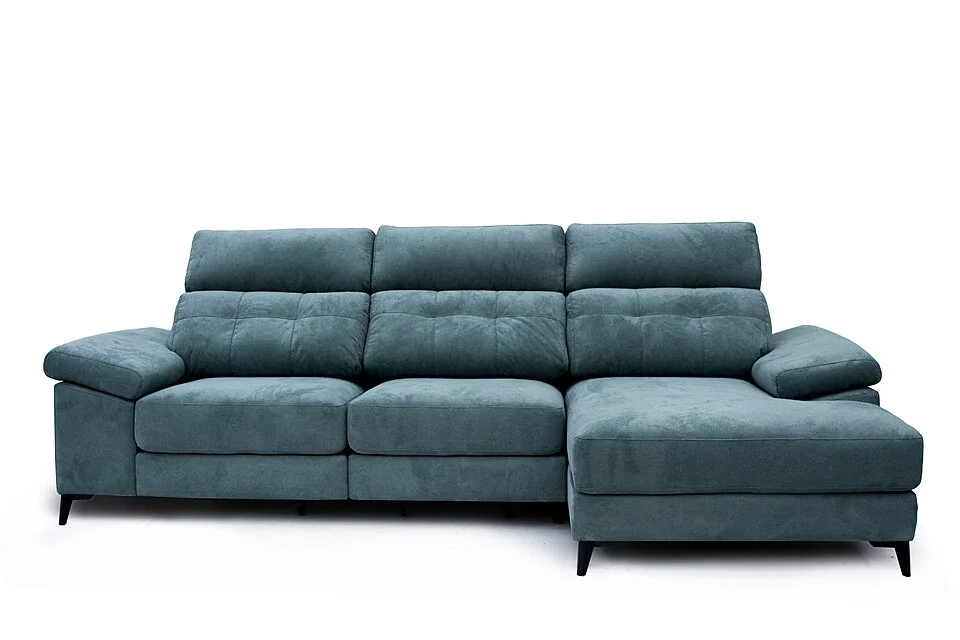
The sofa’s differing seat shapes, back sections and chaise position show why apparently similar covers should not be treated as interchangeable. Photograph your own sofa from the front and record left and right consistently, then count only the parts its maker permits you to remove. This product photograph establishes neither cover removability nor washability, and its panel divisions are not a parts list for another model.
Photo & usage
Confortonline · CC BY-SA 4.0 · Source. Display copies resized and encoded as WebP; no instructional details were fabricated or removed.
Use a drawing or numbered photographs rather than writing directly on fabric. Do not attach an adhesive label that can dissolve or leave residue in the wash. If the maker provides part codes, copy them into the map. Keep any permitted detachable hardware together in a labelled container outside the laundry.
Count the pieces before removal and after each stage. This is an organisation check, not a reason to remove components the maker says should remain fixed. A short map should make the return route obvious to another household member without requiring them to remember how the sofa looked before it was stripped.
Separate care instructions by component
Read every relevant label, including bleach, drying and ironing restrictions. GINETEX explains symbol meanings, but the actual labels establish the route. A frame cover and cushion cover can have different handling needs even when their visible fabric matches. Do not use one label as permission for the whole set.
Check whether the maker recommends washing matching pieces together to manage appearance, and whether your washer can accommodate that group within the specified programme. If the recommended set exceeds your machine's appropriate capacity, seek a suitable facility or professional service rather than packing the drum tightly.
Record the exact refitting stage. Some products may require complete drying; others may specify a particular earlier stage. Follow the maker's wording and do not borrow a damp-refitting tip from another sofa. The timing decision belongs before washing because it determines where every piece will wait and who must be available.
Work through an illustrative piece-count check
All counts here are invented and illustrative. Suppose a permitted removable set contains two seat covers, two back covers and one frame cover. That is 2 + 2 + 1 = 5 pieces. During drying, four pieces are visible and the second back cover remains in a laundry bag. The count identifies a missing stage, not a vanished part.
| Group | Expected count | Recorded status |
|---|---|---|
| Seat covers | 2 | Both on permitted drying supports |
| Back covers | 2 | One drying; one still in laundry bag |
| Frame cover | 1 | On separate permitted route |
The arithmetic is simple but operationally useful: 4 located in drying positions plus 1 located in the bag equals the expected 5. The map prevents someone from starting reassembly with an incomplete set. It does not establish that all five pieces share a wash method or that this hypothetical sofa resembles yours.
Remove loose debris and wash as directed
Collect accessible hair and crumbs with a fabric-compatible method before washing. Check zippers, piping and seams for trapped grit. Follow the maker's instructions about fastening or opening zippers and turning covers. Do not generalise one brand's fastening advice to every cover construction.
Use a detergent compatible with the textile and washer and measure according to its directions. ACI's laundry guidance groups by care requirements as well as colour and soil. Avoid adding unrelated towels or garments simply to fill space; they may introduce lint, incompatible treatment or an awkward load shape.
Apply any stain treatment only if both the cover and product instructions permit it. Test where directed and keep a record of the treated panel. An existing mark that survives the wash needs inspection before heat, not automatic extra detergent or bleach. Keep the piece map close to the unloading area.
Dry with the refitting instructions in view
Prepare the permitted supports before unloading. Spread or position covers so dense seams, hems and zipper tape receive the directed exposure. Keep pieces identifiable by their mapped features. Do not drape a large wet cover across a delicate sofa frame merely because the original shape seems convenient.
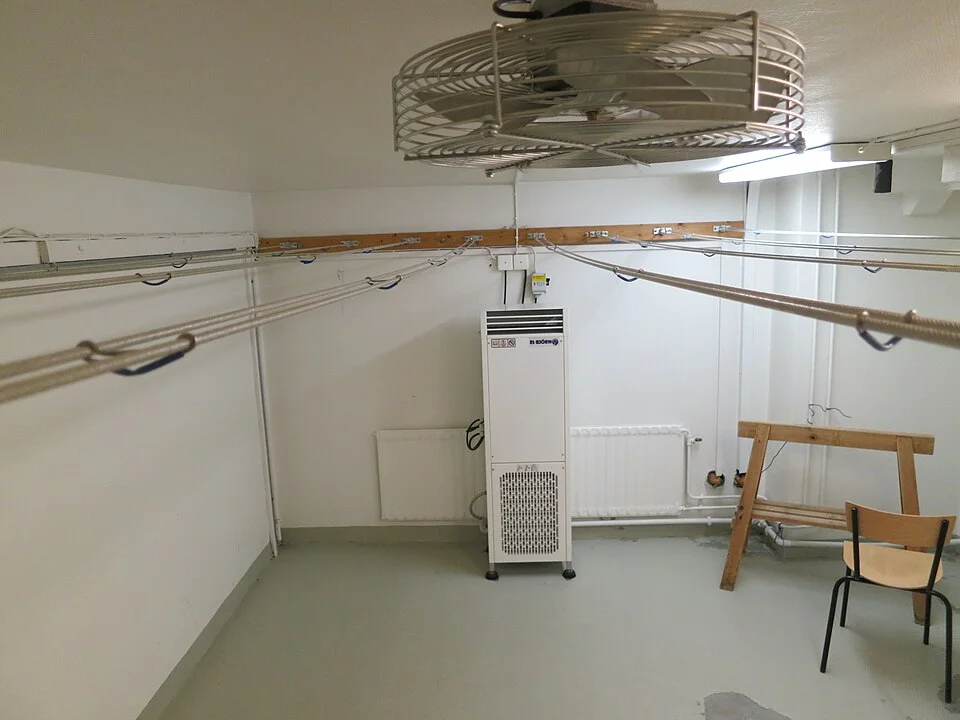
The empty lines show a drying destination that can be planned before covers are unloaded. Check that your permitted supports can carry each piece without burying hems or zipper tape, and keep the piece map nearby. This room’s fan and drying equipment do not establish suitable heat, airflow or refitting timing for any sofa model; follow the cover maker’s exact drying instructions.
Photo & usage
R. Henrik Nilsson · CC BY 4.0 · Source. Display copies resized and encoded as WebP; no instructional details were fabricated or removed.
Follow tumble, line, flat or other specified drying instructions precisely. Do not use unapproved heat to accelerate a slow corner. Check the refitting stage against the maker's wording and be available when that stage occurs. If the instruction is unclear, ask before creating a time-sensitive wet assembly.
Inspect for colour change, unusual stiffness and distorted seams. A small surface wrinkle is different from a cover that no longer follows its intended outline. Do not stretch the fabric aggressively to pre-empt a fit problem. Keep the item supported while deciding whether the observed condition is expected or needs advice.
Refit by the map without forcing tension
Clean the accessible frame and cushion surfaces only by their own permitted methods before replacing covers. Match panels to the map and follow the manufacturer's fitting order. Align seams and corners before closing fasteners. A zipper that resists may indicate a rotated panel or misplaced insert rather than insufficient strength.
Stop if closing requires exceptional force or puts seams under obvious tension. Recheck orientation, part identity and the prescribed fitting stage. Do not sit on a cushion to force a zipper closed or cut an internal piece to make a cover fit. Those actions can damage the assembly and remove useful evidence for support.
If a panel remains unsuitable, photograph it in a supported position and contact the maker with the product identifier and care history. Include the actual wash and drying settings. Do not promise that another wash or stretching will reverse a dimensional change. The immediate aim is to preserve the material while resolving the mismatch.
Check the whole sofa before returning it to use
Verify that every expected piece is present, fasteners close normally and seams sit in their intended positions. Check any remaining drying requirement, especially at dense edges and between layers. Keep the sofa out of use until the product's return-to-use conditions are met.
Inspect cushion support and accessible hardware without altering the structure. Look at the set in ordinary light for appearance differences and compare with the starting photographs. Record a remaining stain or fit issue as a specific held question rather than repeatedly treating all covers.
Store the piece map with the confirmed instructions for the next care session. Remove temporary objects and clean the laundry landing area. The project is complete when the set is correctly identified, cared for and refitted within its own instructions, with no missing panel or forced seam concealed beneath a tidy-looking sofa.
THE REFERENCE FILE
Sources & scope
Documentation reviewed 1 Nov 2026. Examples are illustrative; this article does not claim hands-on product testing. Follow the instructions for your actual material, model and location.