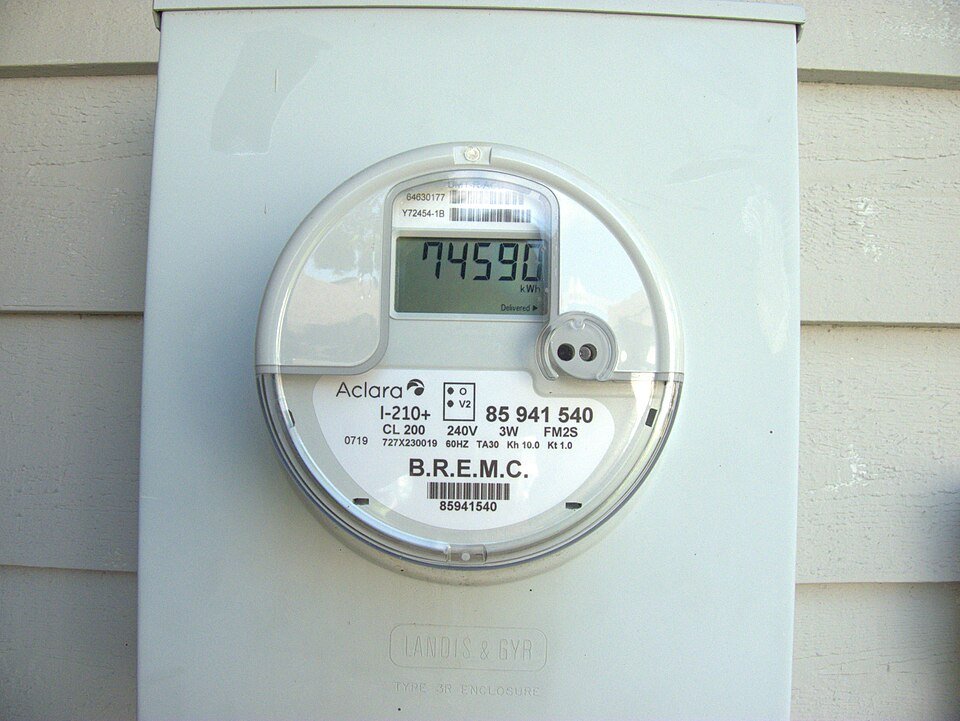
A photograph of a meter number can be useful evidence, but it is incomplete without the register, unit and time. Some meters cycle through several displays. A total taken from one register cannot be compared casually with a different tariff register or an instantaneous power screen.
Create a reading log from safely accessible information. Do not open meter covers, break seals or enter a restricted area. If the meter cannot be read safely, use the utility's account information or ask for assistance. This record is an observation task, not electrical work.
Identify the meter and the register first
Match the meter identifier with the account information where the utility provides it. Record the relevant display label or register code and unit. If the meter has multiple tariff registers, keep separate rows or columns for each rather than assuming the largest number is the total you need.

The LCD presents a register code beside the number and kWh unit, while the face includes separate identification markings. Retain all three kinds of information with the observation time. Confirm the meaning of the code with the supplying utility rather than applying this example’s register convention to a different meter.
Photo & usage
RobbieIanMorrison · CC BY 4.0 · Source. Display copies resized and encoded as WebP; no instructional details were fabricated or removed.
Follow the utility's instructions for the exact meter. PSE&G — Meter Reading provides examples of digital and dial reading methods for its customers. Those methods do not establish the meaning of another utility's display codes. Obtain the correct guide when the register cannot be identified confidently.
Do not press unfamiliar controls that could change equipment operation. A meter may have a normal display-scroll control, but follow the documented procedure. Record what remains uncertain instead of guessing. If an account portal and physical display differ, check timestamps and register definitions before interpreting the difference as a billing error.
- Match the safely accessible meter identifier with the account information where available.
- Record the register code, visible unit, full reading and observation timestamp together.
- Compare only matching cumulative registers and preserve gaps instead of inventing intermediate readings.
Choose a repeatable observation time
Record a full date and local time for every reading. For a daily comparison, aim for similar times without pretending a late reading occurred on schedule. A twenty-three-hour interval and a twenty-five-hour interval are not equal days, even if both readings were taken on consecutive dates.
Note time-zone or clock changes when relevant. If using downloaded utility intervals, preserve the file's time convention. Daylight-saving changes can affect interval counts in some systems; check the utility documentation rather than deleting an extra row or filling a missing one by assumption.
Use a simple log with meter identity, register, unit, reading, timestamp and reading source. Mark whether the figure was personally observed, supplied by the utility or estimated. Keep original photos or downloads privately if they contain identifying information. The record should remain traceable without exposing account details in a shared household note.
Distinguish accumulated energy from live power
EIA — Measuring Electricity explains the difference between watts and kilowatt-hours. For a cumulative utility-meter log, the useful difference is normally between comparable energy readings. A screen showing kW describes power at that moment and cannot be subtracted from a kWh register to obtain consumption.
The P3 International — P4400 Operation Manual illustrates the same unit distinction on one plug-in instrument, whose controls alternate between cumulative energy and elapsed time. It is not an instruction manual for a utility meter. Use it only as an example of why a changing display requires explicit unit identification.
Copy decimal places as instructed for the meter and submission process. Do not discard them in your private analytical record if they are relevant and reliable, but follow the utility's required format when submitting a reading. A portal may accept different precision from the display, and those two purposes should remain distinct.
Calculate an illustrative interval and daily equivalent
The following readings are illustrative. A cumulative register shows 12,480.6 kWh at the first observation and 12,504.6 kWh at the second. The difference is 24.0 kWh. If the elapsed time is exactly 48 hours, the daily equivalent is 24 ÷ 48 × 24 = 12 kWh per day.
If the same energy difference occurred over 44 hours, the daily equivalent would be 24 ÷ 44 × 24 = about 13.09 kWh per day. Calling both intervals two days would conceal that difference. Keep the original elapsed hours so the normalization can be checked later.
These calculations do not identify appliance contributions. They also assume the same cumulative register, no reset and a consistent accounting boundary. A meter exchange, rollover or change from import total to another register invalidates the simple subtraction until the utility's documented treatment is understood. Do not repair a negative difference by adding guessed digits.
Mark events that interrupt comparability
Record a meter replacement, account change or known data correction alongside the observations. Keep old and new meter identifiers separate. The closing reading of one device and opening reading of another are not ordinary endpoints on a single cumulative scale.
Note unusual occupancy, power outages and major equipment changes without assigning their energy effects automatically. An outage can shorten the time equipment operated, but elapsed calendar time still includes the interruption. Decide whether the question concerns use per calendar day or per powered hour and label that choice clearly.
Where solar generation, export or a battery is involved, identify which register is being logged. Grid imports alone may not equal total household electricity use. Do not combine different flows into a net figure unless the accounting method is understood and supported by the relevant utility documentation.
Compare the log with a bill only at matching boundaries
Find the bill's reading dates, register and meter identity. A private reading taken several hours later can legitimately be higher. Do not present the difference as overbilling without accounting for the interval and the supplier's actual or estimated status.
If a discrepancy remains, prepare a concise question with the original bill, relevant log entries and the exact register information. Ask the utility to explain its reading basis or correct the record as appropriate. Do not promise yourself a refund based on an approximate private comparison.
Keep payment obligations and dispute procedures separate from the arithmetic exercise, following your supplier's official process. The log improves the evidence available for a question; it does not establish legal rights or authorize withholding payment. Focus on the specific mismatch that the documents can actually show.
Preserve a missed observation without inventing a reading
If a planned reading is missed, leave the gap and use the next safely available comparable endpoint. The longer interval still provides an energy difference when the register is consistent. Do not insert an invented intermediate number merely to make a daily graph continuous.
An illustrative 36 kWh accumulated over three complete days supports a 12 kWh daily average across those days. It does not show that each day used exactly 12 kWh. If one day contained guests or an outage, retain that note rather than distributing the total evenly and calling the distribution measured.
Where a spreadsheet requires a continuous series, keep observed values and any interpolated values in separate fields with clear status. Exclude invented daily allocations from claims about a particular event. The decision boundary is simple: interval totals can remain useful after a missed reading, while day-specific attribution usually needs better evidence. This preserves the log’s value without rewarding fabricated precision or unnecessary extra meter visits.
Finish with an audit of the log itself
Check for transposed digits, mixed units, repeated timestamps and missing register codes. Recalculate one interval independently. A sudden negative or implausibly large difference is a reason to inspect the source entries before diagnosing the home or accusing the meter of failure.
Preserve corrections rather than overwriting the original silently. Mark the corrected value, reason and date in the private record. This lets a later reader understand why a graph or average changed. Keep uncertainty visible when a blurred photograph cannot support a precise number.
Completion means every reported interval can be traced to comparable readings and a known elapsed time. Continue only at a frequency that serves a practical question. A few careful observations are more useful than a large log whose register identities and timestamps are missing.
THE REFERENCE FILE
Sources & scope
Documentation reviewed 1 Nov 2026. Examples are illustrative; this article does not claim hands-on product testing. Follow the instructions for your actual material, model and location.