Begin with the surface question
Primer is often added to a shopping list as insurance, or omitted because a finish paint says it includes primer. Both shortcuts can miss the actual decision. The useful question is what the surface needs before the selected finish coating can be applied successfully.
Record the substrate, existing finish and visible condition where known. Mark uncertainty instead of guessing. A painted wall may include bare repair patches, glossy areas and staining, each requiring a different discussion with the manufacturer or decorator. One room name does not describe one uniform substrate.
Do not disturb old or suspect coatings to identify them casually. EPA's lead programme describes hazards associated with relevant US pre-1978 paint disturbance. Obtain appropriate assessment and local guidance where needed. This article organises the purchase decision; it does not provide a preparation method for hazardous materials.
Map unlike areas before choosing products
Draw the wall and identify bare areas, repairs, sound existing finish and unresolved defects. Give each area a simple label so advice can be linked to the right location. Photograph accessible details without scraping or sanding merely to produce a sample.

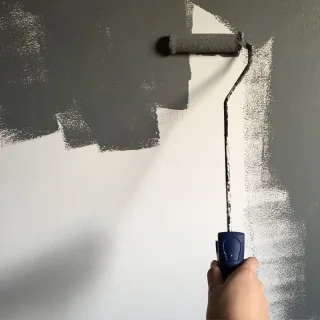
The roller coats the masonry face beside a separate metal fitting. In your own surface map, give different materials, repairs and unresolved marks separate entries before asking for a coating recommendation. This application photograph does not identify the product, show the preparation beneath it or establish whether a primer was required.
Photo & usage
Michael Cory · CC BY 2.0 · Source. Display copies resized and encoded as WebP; no instructional details were fabricated or removed.
Separate staining from its possible cause. A water mark may remain after a problem is repaired, but a new or recurring mark needs investigation before decorative treatment. Primer can be part of a coating system; it should not be used to conceal evidence of an unresolved underlying issue.
Ask the supplier what additional information is needed. The reviewed Benjamin Moore N627 sheet includes guidance for different substrates and difficult surfaces, illustrating why the exact product system matters. Do not transfer a recommendation for that product to another manufacturer's finish without confirmation.
Distinguish the roles being requested
Discuss whether the need is adhesion, stain control, sealing a porous area or another stated function. A product recommended for one role may not address another. Write the supplier's recommendation with its intended surface and limitations rather than retaining only a product name.
Ask whether treatment is local or across the whole surface and how transitions should be handled under the selected system. A small repair patch can affect appearance differently from the surrounding finish, but the appropriate response depends on the materials and instructions.
Do not invent a universal test such as touching the wall or applying a strip of tape as proof that primer is unnecessary. If the manufacturer specifies a compatibility or adhesion check, follow that procedure with appropriate permission and safety arrangements. Otherwise keep the uncertainty with the person qualified to assess it.
Keep treatment areas separate in the estimate
This illustrative area record has a 24-square-metre wall group containing 3 square metres of bare repair patches and 2 square metres of a separately assessed stain area. If those areas do not overlap, the combined local-treatment area is 5 square metres, leaving 19 square metres of other wall.
If 1 square metre of the stain area lies inside the repair patches, the distinct combined area is 3 + 2 − 1 = 4 square metres. Adding the categories without subtracting overlap would overstate it by 1 square metre.
These invented areas do not establish which primer is required or how many coats should be applied. Use the agreed treatment map and the actual product's coverage instructions for purchasing. The arithmetic simply prevents double-counting when different surface conditions occupy the same place.
Confirm compatibility across the coating system
Record the exact primer and finish product, their intended surfaces and the required preparation. Ask about application conditions, recoat intervals and any maximum interval before overcoating. Save the current technical documents for the supplied products.
A retailer's general statement that products are “both water based” is not a complete compatibility answer. Request guidance for the specific combination and substrate. If the finish changes, check whether the primer recommendation remains appropriate rather than assuming the earlier approval still applies.
Benjamin Moore's FAQ provides product-selection context, but the actual technical sheet and manufacturer advice govern the selected system. Keep marketing language separate from the instructions needed to carry out the work. A coating sold as paint and primer may still have situations requiring a separate specialist product.
Buy the specified product and enough usable stock
Once the surface decision is made, calculate quantity using the agreed areas, coat requirements and product coverage. Keep the primer estimate separate from the finish estimate. Container sizes and retailer tinting arrangements may differ, so verify the actual order.
Check the label, product number and intended use before leaving the supplier. Ask about any discrepancy between the recommendation and the product supplied. Do not accept a similar-sounding substitute without confirming that it addresses the same role and remains compatible with the finish.
Store and transport the containers under their instructions. Keep warning labels legible and retain the receipt and specification. If an order is collected by another household member, give them the written identity check rather than asking for “the usual primer.”
Make the surface ready before application
Confirm that required repairs and preparation have been completed by the responsible person. A purchase does not make the surface ready. If new moisture, loose material or an unexpected reaction appears, stop the affected decorative stage and seek the relevant advice.
Follow the selected system's application and timing instructions. Do not shorten intervals to keep a furniture delivery date. Environmental conditions and substrate state can affect readiness, and a clock alone cannot answer every question.
Keep the treatment map during application so local areas are not missed or treated with the wrong product. Record any authorised change. If a whole-surface treatment replaces a spot-treatment plan, update quantities and the product file rather than leaving the original shopping record as the only account.
Close the file with what was actually used
Record the final products, treated areas and dates. Keep the relevant technical documents with the finish-paint identity so future repairs can understand the coating system. Label retained stock with its actual purpose without covering safety information.
Inspect the finished surface through the agreed handover process and record specific concerns. A visible difference does not automatically prove the primer was wrong; preparation, application and other factors may need review. Describe the observation before assigning a cause.
The primer decision is complete when the substrate questions have answers, the supplied system matches those answers and the record describes actual use. Buying an extra can without that chain of evidence is not the same as resolving the surface problem.
Preserve the question that produced the recommendation
Save the surface description sent to the manufacturer or retailer alongside its answer. A recommendation can be misused later if the original question is lost. Advice for a small bare patch should not silently become approval for an unidentified glossy door.
If new evidence appears during preparation, send the revised description and ask whether the system changes. Record the response and update the treatment map. Keep unopened stock separate while the question is unresolved so it is not used simply because it has already been purchased.
For work carried out by a decorator, agree who chooses and buys the system. Two independently selected primers can create a confusing handoff. The responsible person should have the final product identity and the relevant instructions before application starts.
THE REFERENCE FILE
Sources & scope
Documentation reviewed 1 Nov 2026. Examples are illustrative; this article does not claim hands-on product testing. Follow the instructions for your actual material, model and location.