A clear mirror is only one checkpoint
A mirror can clear while a lower wall, bath rim or folded towel remains wet. If the household switches off extraction as soon as a reflection returns, that visible event may be doing too much work. Choose a broader finish line: the normal shower moisture event has ended, accessible wet surfaces have been dried or are drying appropriately, and the room's air trend is recovering toward its own background.
Begin during an ordinary shower day. Do not run extra hot water to create a stronger test. Use the installed fan and controls as intended, and preserve any continuously operating ventilation setting. Record the normal starting routine so a later improvement has something meaningful to compare with.
PNNL Building America: Bathroom Exhaust Fans treats bathroom extraction as a system that should discharge outdoors. A fan's sound or a clearing mirror cannot establish that discharge path. If you do not know where the system exhausts, request identification rather than opening a ceiling or entering a roof space.
Watch the air, one surface and one textile
Choose one representative meter position outside the direct steam plume, following the instrument's instructions and keeping electrical equipment away from splashes. Record temperature with RH before the shower. Select an accessible wall or rim that routinely stays wet, plus the towel arrangement used afterward. These three observations reveal different parts of the drying task.
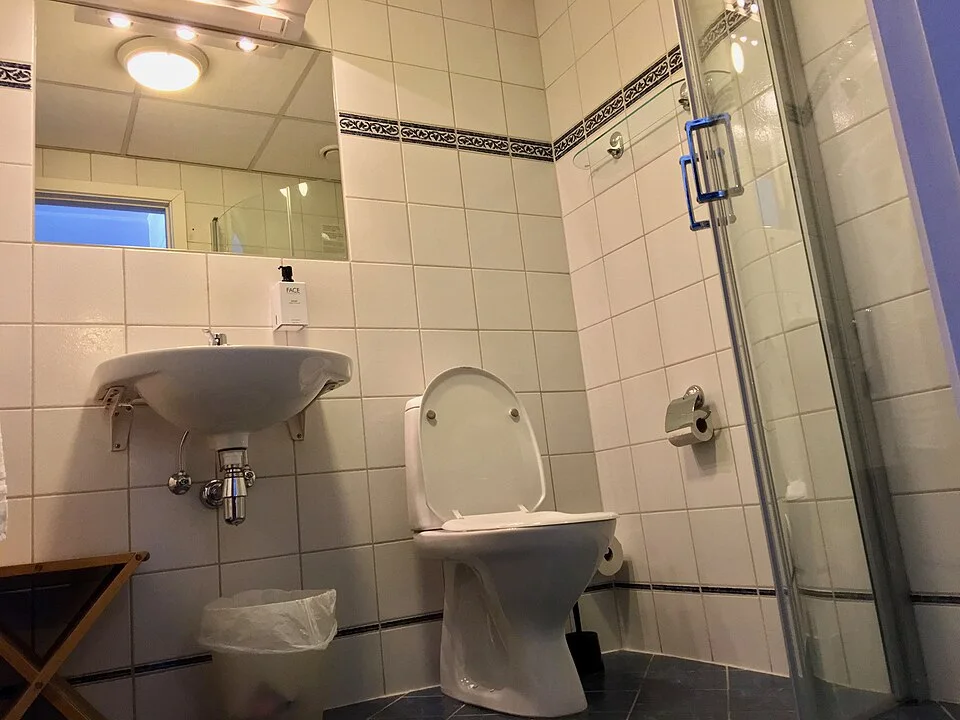
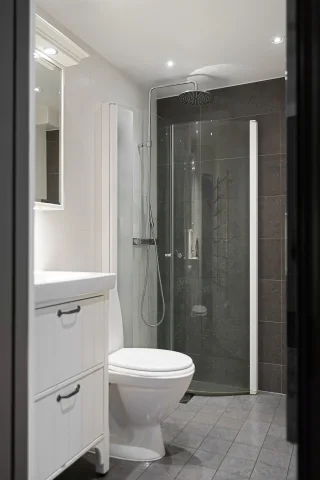
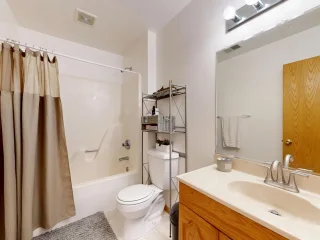
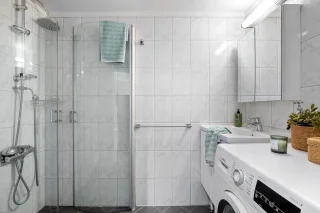
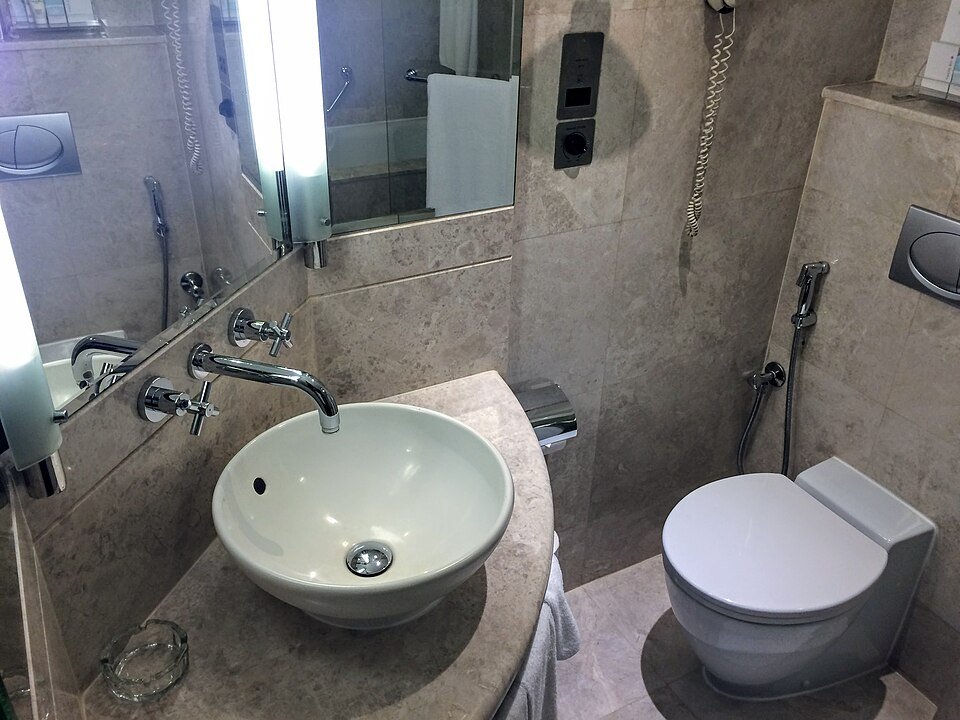
The basin rim, tiled wall and shower enclosure provide distinct accessible surfaces to identify before ordinary bathing. Choose one consistent surface observation and keep the meter outside direct steam or splashes, following its instructions. The towel arrangement is not established by this view; record your actual textile separately rather than treating a clear mirror as proof that all three observations have recovered.
Photo & usage
Wolfmann · CC BY-SA 4.0 · Source. Display copies resized and encoded as WebP; no instructional details were fabricated or removed.
For the wall, use consistent descriptions such as beaded, streaked, damp-looking or clear. If you wipe it, record when. For the towel, note whether it hangs spread or folded and whether its underside remains damp at the next ordinary use. Do not handle suspected mould or move fixtures to improve access.
Set observations around events rather than an arbitrary stopwatch target: shower ends, mirror clears, the intended fan run-on ends, and the room is next used. Add the actual times. This makes the record useful even when someone needs the bathroom before the planned observation or the shower duration changes.
Read run-on guidance in its proper context
Published guidance does not supply one guaranteed drying time for every bathroom. Health Canada: Guide to addressing moisture and mould indoors advises using the bathroom exhaust during bathing and for at least 30 minutes afterward. The PNNL bathroom-fan guide recommends a one-hour run-on for intermittent operation. Those recommendations have different contexts; neither proves that a particular room is dry at a particular minute.
Use the instructions for your installed system and seek advice if its intended operation is unclear. A fan may also contribute to whole-home ventilation and should not be treated as an optional noise source that can always be switched off. Do not alter wiring, defeat sensors or replace a control simply to match an article's example.
Your observation period should establish whether the normal routine leaves recurring wetness. If it does, ask about airflow, discharge, control operation and moisture sources. Increasing runtime can be useful, but it cannot repair a disconnected duct, water leak or material already damaged by repeated dampness.
Read a sequence with two finish times
All entries below are illustrative and invented. They are not a field test of a fan or a recommended humidity curve. The shower ends at 07:20, and the room meter remains in one position throughout.
| Time | Air reading | Accessible observations |
|---|---|---|
| 07:00 | 21°C, 48% RH | Before shower; wall dry |
| 07:20 | 23°C, 76% RH | Shower ends; wall beaded |
| 07:35 | 22°C, 65% RH | Mirror clear; wall still wet |
| 08:05 | 21°C, 52% RH | Wall wiped earlier; towel spread |
The mirror clears 15 minutes after the shower ends. The last observation occurs 45 minutes after it ends, 30 minutes after the mirror clears. RH is 4 percentage points above the starting display at the same indicated temperature. These calculations describe timing and readings only. Because the wall was wiped, its later appearance cannot demonstrate unaided drying or the fan's removal rate.
Do not ask the fan to manage every puddle
Where finishes permit, remove accessible standing water with an appropriate squeegee or cloth and place the wet cloth in a suitable drying arrangement. Keep the floor clear and dry enough for safe movement. Spread towels so folds do not trap moisture, while respecting heater clearances and the towel manufacturer's care guidance.
Record this as a deliberate change if the old routine left liquid standing. Compare another ordinary shower with similar duration and water temperature, without forcing exact sameness. Liquid removal can change the surface task even if the room's RH trace looks similar. A towel hung better may dry more evenly without proving anything about the fan's capacity.
Do not use a portable heater or ordinary electrical fan in a splash zone as an improvised drying solution. If the bathroom's normal system cannot manage routine use, ask for assessment of the installed arrangement. Additional equipment must be suitable for its location and used according to its own instructions.
Identify wetness outside the shower event
A patch that remains wet before anyone bathes, grows after rain or appears below a plumbing connection needs a separate investigation. Shower steam may make an existing defect more visible without being its sole cause. Record the location and timing accurately; do not keep extending the fan timer while ignoring an active leak.
EPA: A Brief Guide to Mold, Moisture and Your Home emphasizes prompt water control and drying. The practical boundary here is visible deterioration, repeated dampness or a persistent musty smell despite ordinary drying measures. These findings justify maintenance or qualified assessment without waiting for a perfect series of RH readings. A household instrument does not measure moisture inside the ceiling.
Avoid poking, scraping or repainting a suspect patch during the logging exercise. Disturbance can spread material and remove useful evidence of the pattern. Photograph from a normal accessible position if helpful. If the water is contaminated or near electrical fittings, stop the household observation and arrange appropriate urgent assistance.
Finish at the next ordinary bathroom visit
Revisit the selected surfaces before the next shower. The room should not carry a new moisture event into material that never recovered from the previous one. Note whether the towel is still folded and damp, whether the wall is newly beaded, and whether the meter is back near its usual background under comparable temperature conditions.
A workable finish is a repeatable routine that clears standing water, uses intended extraction and leaves the accessible surfaces without recurring wetness or damage. Keep one representative record showing what changed. If the result remains poor, provide the event times and observations to the property manager or ventilation professional.
Close the job with the correct claim: the revised routine improved the observed drying pattern, or the room needs further assessment. Do not call it a passed ventilation test. The mirror remains a useful checkpoint, but the completed task is a bathroom routine judged by more than a clear reflection.
THE REFERENCE FILE
Sources & scope
Documentation reviewed 1 Nov 2026. Examples are illustrative; this article does not claim hands-on product testing. Follow the instructions for your actual material, model and location.